


Data Tranformation
SAP data transformation enables controlled mapping, conversion, and harmonisation of SAP data to support S/4HANA migrations, system changes, and audit ready data governance across ECC and S/4HANA landscapes.
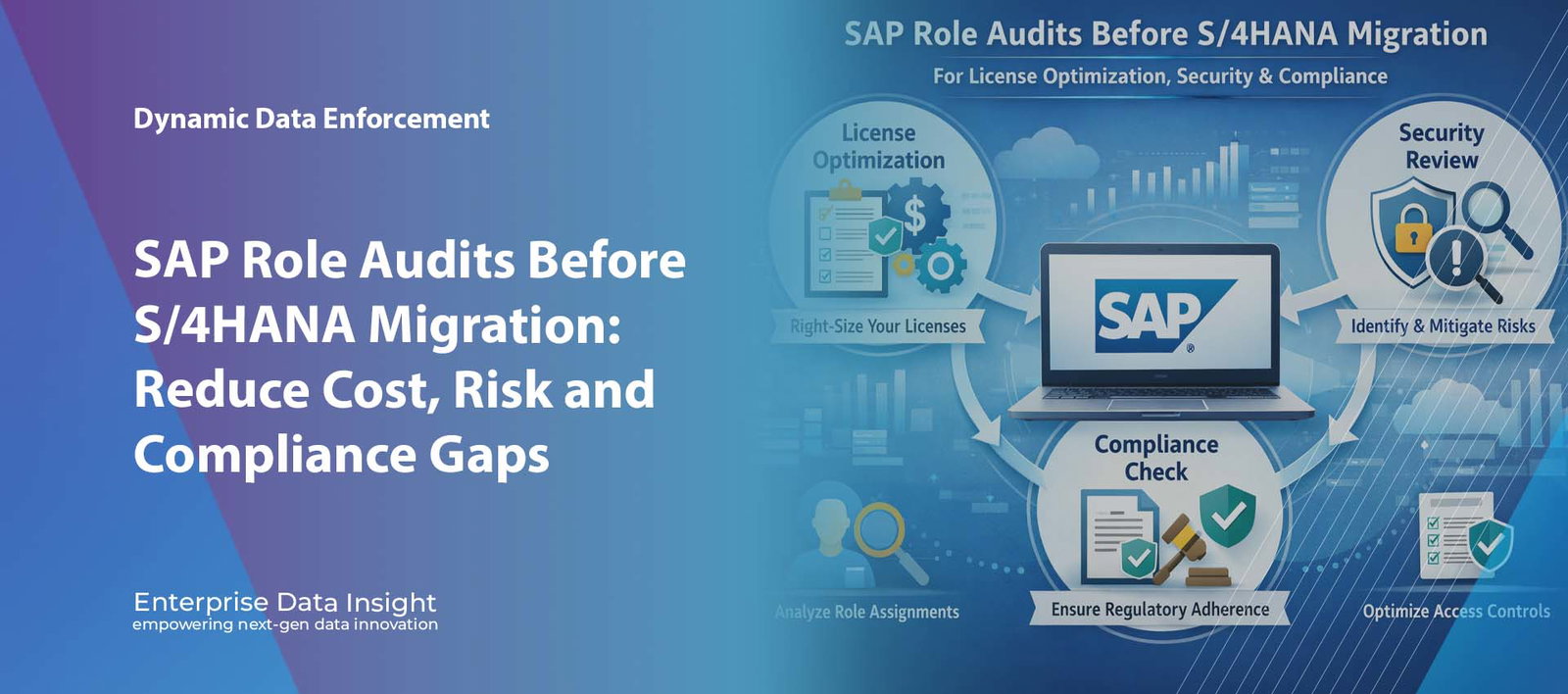
SAP GRC | SAP Security | S/4HANA Migration | Role Management Powerful SAP Role Audits Before S/4HANA Migration to Cut Cost, Strengthen Security and Improve Compliance SAP role audits before S/4HANA migration can uncover hidden licence waste, excessive access, weak Segregation of Duties control, and outdated authorisations before they are carried into the new platform. For organisations moving from ECC to S/4HANA, this workstream is not just a technical review. It is a business decision that improves cost control, protects sensitive data, and helps create a cleaner access model for the future environment. Lower spend Identify dormant users, duplicate accounts, and poor licence classification before migration. Stronger control Reduce broad access to payroll, finance, procurement, vendor, and customer records. Cleaner future state Improve role design and resolve SoD issues before S/4HANA goes live. How Enterprise Data Insight helps Enterprise Data Insight helps organisations analyse users, roles, authorisations, licence usage, and SoD exposure so the move to S/4HANA starts with better visibility and stronger governance. Role analysis Licence visibility Access simulation SoD governance Explore EDI GRC Solutions Talk to Our Team A role audit before migration helps reduce licence waste, tighten access, and improve governance before S/4HANA go live. Table of Contents Why role reviews matter before S/4HANA How an audit reduces licence waste How it strengthens security How it improves SoD compliance A practical SAP example How Enterprise Data Insight helps FAQ Conclusion Organisations preparing for S/4HANA often focus on data transformation, infrastructure, testing, and custom code. Yet many programmes leave one of the biggest risks untouched: the existing role model. Old roles, inactive accounts, duplicate identities, and broad access rights can all move into the target system unless they are reviewed early. Why SAP Role Audits Before S/4HANA Migration Matter A structured review of roles and authorisations gives businesses a clearer picture of who has access, why that access exists, and whether it still reflects real job responsibility. This matters because most SAP environments have evolved over many years, often through urgent changes, copied roles, manual workarounds, and limited clean up. Over time, organisations often accumulate: inactive and dormant users duplicate identities across SAP systems excessive authorisations roles that no longer match real responsibilities hidden SoD conflicts avoidable licence cost Reviewing access before S/4HANA helps prevent historical control issues from becoming future operational problems. How SAP Role Audits Before S/4HANA Migration Optimise Licence Spend One of the strongest business reasons for this activity is licence optimisation. Many organisations pay for more than they need because they cannot clearly see how users behave, which licence types are assigned, or whether access levels truly match real usage. A review can reveal where cost is being driven by poor classification, unused accounts, or duplicated access across different SAP environments. Combine users across systems In many landscapes, one person appears in several SAP applications with overlapping access and inconsistent licence treatment. Rationalising those identities can improve utilisation and reduce waste. Remove inactive access Some users log in rarely but still consume expensive licence categories. Identifying and removing dormant access frees capacity for real business demand. Better user classification also helps businesses avoid assigning higher cost licence categories where they are not justified by actual activity. Where savings usually come from Identify Find dormant users and redundant access still consuming cost. Classify Match users to the right licence category based on real behaviour. Consolidate Reduce duplicated identities across connected SAP systems. Reallocate Free up licence capacity without avoidable extra spend. How SAP Role Audits Before S/4HANA Migration Strengthen Security S/4HANA introduces broader ways to interact with enterprise data through Fiori, analytics, mobile usage, and connected business processes. That makes accurate access design more important than ever. A strong review helps organisations understand: who can access sensitive business data which roles expose payroll, finance, vendor, or customer records which users can change or extract critical information where broad access no longer matches business need how different personas should see different data This is especially relevant in HR, finance, procurement, master data, and business partner management where the impact of poor access design can be significant. Dynamic access questions where is the user coming from what data are they trying to access what device are they using what data are they trying to extract Data areas most exposed employee payroll data financial postings and journals vendor and supplier records customer and business partner data How SAP Role Audits Before S/4HANA Migration Improve SoD Compliance Segregation of Duties remains one of the most common control issues in SAP landscapes. A pre migration audit helps identify high risk combinations before they are moved into the future system. Common examples include: creating vendors and approving payments maintaining master data and posting transactions creating purchase orders and approving goods receipts posting journals and approving adjustments The best time to reduce SoD risk is before migration, not after go live when those conflicts are already embedded in the new environment. A Practical SAP Example Imagine an ECC system where a broad HR role has evolved over many years. General administrators, payroll specialists, and support staff all inherit similar permissions. During the review, the business discovers that some users can view salary data and deductions even though they only need employee master record access. If that role moves unchanged into S/4HANA, the same issue continues. A proper audit allows the organisation to separate responsibilities, redesign access by persona, and reduce exposure before migration. The real goal is not simply to review access. It is to build a cleaner, safer, and more efficient role model for the future SAP environment. How Enterprise Data Insight Helps Enterprise Data Insight helps organisations turn role audits into a structured and measurable migration workstream. Instead of relying on manual spreadsheets and fragmented review methods, teams gain better visibility across roles, users, authorisations, licence exposure, and SoD risk. Enterprise Data Insight supports: role and user analysis across SAP environments licence visibility and more accurate user classification access simulation for what if analysis SoD risk identification and governance
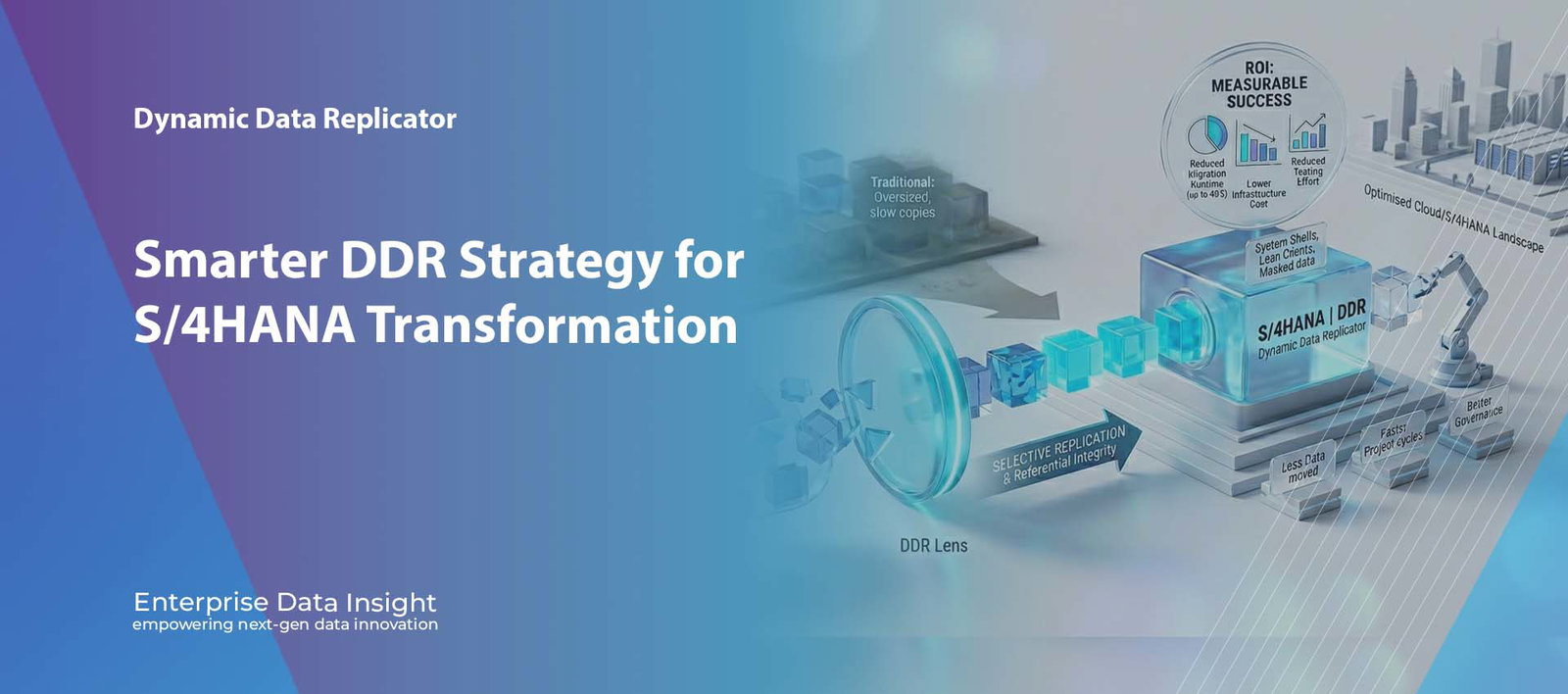
S/4HANA Strategy | SAP Test Data Management | Technical Perspective Powerful DDR for S/4HANA Strategy DDR for S/4HANA Strategy should begin before the upgrade itself, not after the project is already carrying too much data, too many oversized environments, and too much testing overhead. Many organisations still approach S/4HANA programmes with the same heavy refresh habits they used in ECC. That usually means full system copies, repeated duplication of data, slow test cycles, and growing non production cost. Dynamic Data Replicator changes this by enabling system shells, lean clients, and masked data for testing so the S/4HANA journey starts with more control, lower risk, and better ROI. Less data moved Reduce unnecessary SAP data volume before upgrade, test, and migration activities begin. Faster project cycles Use lean clients and focused datasets to speed up testing, rehearsal, and validation. Better governance Apply masked data for testing and tighter control of what enters non production environments. What this solves technically DDR helps organisations prepare for S/4HANA by reducing full copy dependency, creating shells and lean clients, controlling data volume, and protecting sensitive business content before the upgrade effort expands. System shells Lean clients Masked data Migration ROI Explore Dynamic Data Replicator Use the ROI Calculator DDR for S/4HANA Strategy helps organisations reduce migration risk, create system shells, build lean clients, use masked data for testing, and improve ROI before SAP S/4HANA upgrade. A modern DDR for S/4HANA Strategy is not about copying less data for the sake of it. It is about carrying the right SAP data into the right stage of the programme. That distinction matters because one of the most common sources of cost and inefficiency in S/4HANA projects is poor control over non production data. When every downstream system becomes a near clone of production, project teams inherit unnecessary volume, Basis teams inherit unnecessary workload, and the business inherits unnecessary risk. Why you need Dynamic Data Replicator before your S/4 upgrade By the time many organisations start worrying about data efficiency, the S/4HANA project is already paying for oversized environments, repeated refreshes, and slower testing cycles. A stronger DDR for S/4HANA Strategy starts earlier. It helps teams define what data is really required before the upgrade work intensifies. This is beneficial because it allows organisations to: reduce the non essential data carried into project environments create more focused systems for testing and rehearsal improve security through masked data for testing control infrastructure growth across non production improve project efficiency before conversion complexity expands The earlier DDR is introduced into the S/4HANA programme, the greater the benefit. Data control established before the upgrade starts is always more effective than trying to retrofit control after the project has already expanded. System shells and why they matter System shells are one of the most important technical advantages in a well structured DDR for S/4HANA Strategy. A shell provides the foundation of the SAP environment without bringing across the full transactional weight of production. It creates a controlled technical baseline that can be used to prepare project systems, align configuration, and support early validation work in a cleaner way. This is useful because shell based preparation: reduces unnecessary target complexity helps project teams build cleaner migration landscapes improves control of what data is added later and why supports more disciplined preparation before S/4HANA conversion In practical terms, a shell lets the organisation start with structure and control rather than with volume and baggage. Lean clients before S/4HANA are a strategic advantage Lean clients are another major reason why DDR for S/4HANA Strategy is so beneficial. Instead of maintaining oversized project and test systems that mirror production unnecessarily, organisations can provision smaller clients containing only the scope needed for the specific project, workstream, or validation cycle. Lean clients help by: reducing database and infrastructure footprint making environments easier and faster to provision improving test focus by limiting noise from irrelevant data supporting multiple project streams without every stream carrying full productive history Traditional project landscape large full copies into QA and project systems high storage and compute demand more duplicated data than required slower refresh and validation cycles DDR led project landscape lean clients aligned to project need smaller systems with clearer scope better testing efficiency lower operational and infrastructure overhead Masked data for testing improves security and project control Any serious DDR for S/4HANA Strategy must include masked data for testing. S/4HANA projects involve repeated technical, functional, integration, and business validation cycles. If those cycles depend on raw production data in non production, unnecessary risk is introduced across the programme. DDR supports safer testing by enabling masked datasets that still preserve business usefulness. This is particularly beneficial for: broader user participation in testing training and rehearsal systems project work involving third parties or partners better non production governance and compliance Technical benefits of DDR for S/4HANA Strategy The technical strength of DDR comes from its SAP native approach. Rather than handling data as a generic external exercise, DDR works in a way that respects SAP business relationships and helps preserve technical consistency across connected scope. A stronger DDR for S/4HANA Strategy helps teams: selectively replicate SAP data rather than moving full productive scope preserve referential integrity across related SAP objects create smaller targets for testing and project preparation apply scrambling rules to sensitive content reduce non production burden before the conversion effort expands How beneficial is DDR before S/4HANA The benefits are both operational and financial. Operationally, DDR makes project systems lighter, more focused, and easier to manage. Financially, DDR reduces the waste associated with oversized non production environments, repeated heavy refreshes, and unnecessary duplication of data across the programme. Typical benefits include: smaller non production SAP systems lower storage and infrastructure demand faster test readiness and refresh cycles better quality validation using relevant, controlled datasets stronger security posture through masked test data less rework caused by bloated or poorly scoped systems Where ROI is created The ROI of DDR before S/4HANA comes from combined savings and efficiency gains. It is not

carve out and migrate to S/4HANA Confident Carve Out and Migrate to S/4HANA with a Unified, Intelligent Approach Carve out and migrate to S/4HANA in one streamlined move, without delays, data inconsistencies, or duplicated effort. When programmes split carve out and migration into two disconnected projects, teams end up extracting data twice, reconciling twice, and absorbing avoidable risk. Enterprise Data Insight delivers a unified pathway that isolates the right scope, transforms it for S 4HANA, and loads it cleanly into the target system with governance built in. Explore Dynamic Data Transformation View Dynamic Data Replicator Talk to a specialist Useful external resources: SAP S 4HANA overview, SAP Help Portal, GDPR overview. Internal reading: SAP test data management, production data access control. Carve out and migrate to S/4HANA without running two projects Carve out and migrate to S/4HANA should not mean building two separate workstreams, repeating extraction activities, and repeating reconciliation. The traditional approach creates delays because data is handled multiple times and issues are discovered late, when correction is expensive. A unified approach replaces double handling with one controlled flow. How to carve out and migrate to S/4HANA in one intelligent move Enterprise Data Insight delivers a single process that pinpoints the target scope, expands it into the full related footprint, transforms it for S 4HANA, and loads it directly into a clean target. This reduces complexity and improves certainty for programme leaders and stakeholders. What changes with a unified pathway One scope definition Select company code or organisational boundary once and keep it consistent throughout. Relationship aware extraction Linked master and transactional dependencies move together, not as isolated fragments. S 4HANA ready transformation Data is aligned to target structures and simplification requirements before it lands. Governance and evidence Policy and traceability are built in, supporting regulated markets and audit needs. Why organisations choose Enterprise Data Insight for carve out and migrate to S/4HANA programmes Carve out and migrate to S/4HANA is often driven by M and A, divestiture, operational restructuring, or strategic platform modernisation. In these programmes, speed only matters if integrity holds. Enterprise Data Insight focuses on controlled movement, transformation accuracy, and reduced risk. Data accuracy that survives the move Only relevant and logically linked data is moved. This avoids migrating redundant history while protecting the operational dataset required for continuity. Compliance baked in, from the first extraction You can apply retention and masking policies during transformation, supporting privacy and governance requirements from the outset rather than as a late stage add on. Enhance carve out and migrate to S/4HANA with optional security and testing controls After you carve out and migrate to S/4HANA, most programmes still need secure non production refresh and controlled production access. Enterprise Data Insight supports both, without adding operational noise. Dynamic Data Enforcement for real time access control and masking in production. Dynamic Data Replicator for secure test system refresh and scrambling in non production. Segregation of Duties support for compliant access validation after migration. Who benefits most when you carve out and migrate to S/4HANA in one move A unified model is designed for organisations that cannot afford programme drift, late defects, or weak governance evidence. It aligns technical delivery with business urgency and board level confidence. CIOs and IT leaders who need predictable delivery and controlled scope. M and A and divestiture leaders who require clean separation with continuity. SAP programme managers who need fewer phases and fewer handoffs. Security and compliance leaders who need defensible evidence and policy enforcement. Conclusion: carve out and migrate to S/4HANA with clarity, pace, and control Carve out and migrate to S/4HANA should be a single controlled pathway, not two disconnected projects. Enterprise Data Insight reduces double work, protects data integrity, and accelerates timelines with governance and compliance built in. Explore Dynamic Data Transformation Use the ROI Calculator Talk to a specialist Tip: Share your company code scope, target date, and whether this is divestiture, merger, or restructuring. We will recommend the cleanest unified pathway and governance approach. In this article Stop running two projects One intelligent move Why EDI Enhance the programme Who benefits Conclusion Recommended next step If you plan to carve out and migrate to S/4HANA, replace duplicated phases with one controlled pathway that protects integrity and produces evidence. Learn about Dynamic Data Transformation See DDR for secure testing Talk to a specialist #tdms #datamanagement #datareplicator #datasecurity #datascrambling #datamasking #clientrefresh #clientcopy #dynamicdatareplicator #ddr #saps4hana #sapclientrefresh #sapselectivecopy #sapsystemcopy #sapdatamanagement #sapdatamasking #dataprivacy #gdpr #SAPGovernance #SAPCompliance#AuditReady #DataGovernance #SAPControls #RegulatoryCompliance #DynamicDataEnforcement #DDE#SAPSecurity #SAPAccessControl #SAPABAC#SAPZeroTrust #SAPAuthorization #SAPRiskManagement #InsiderThreat Ready to carve out and migrate to S/4HANA with one unified process Reduce double work, protect data integrity, and accelerate delivery with a controlled pathway that extracts, transforms, and loads in one streamlined move. Explore Dynamic Data Transformation Talk to a specialist Talk to a specialist Tell us what you need and we will route your enquiry to the right team. Close