


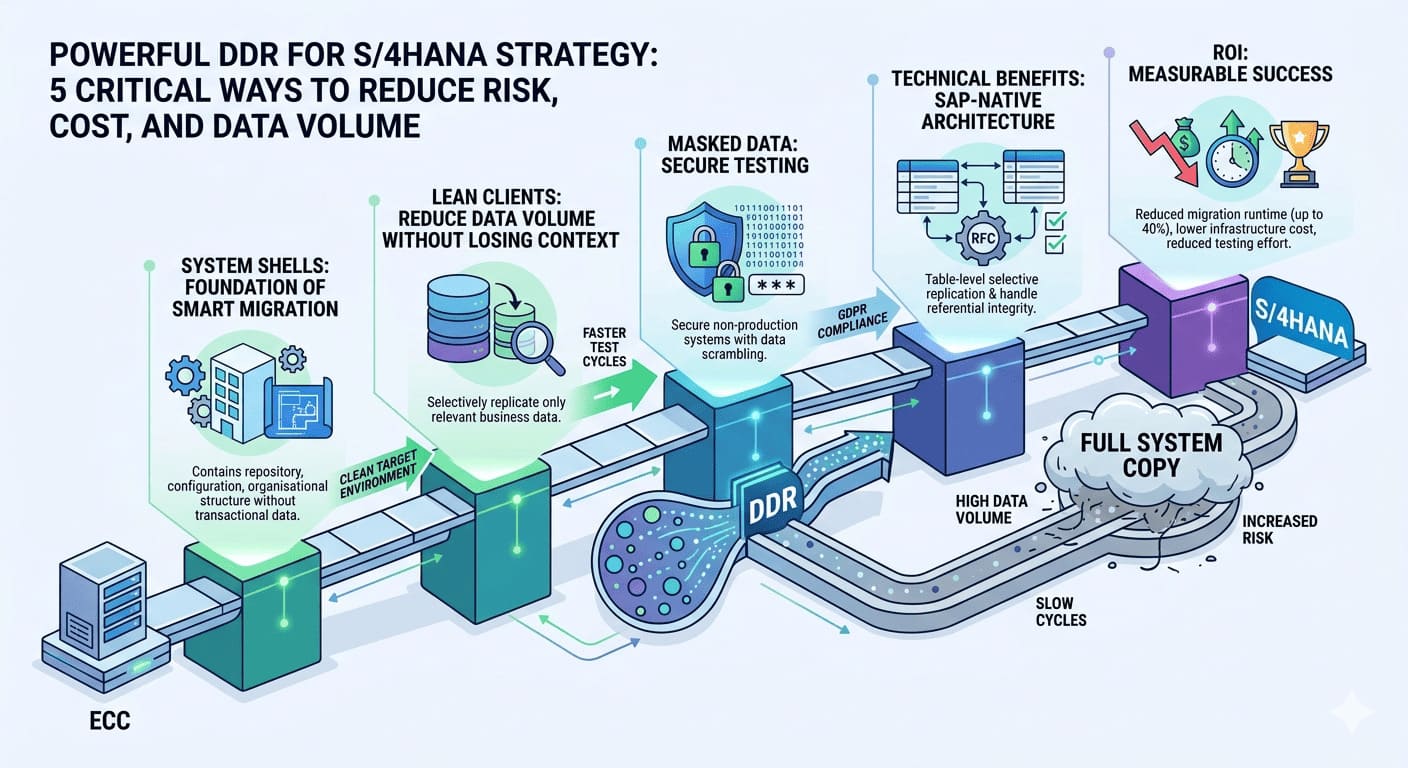
Powerful DDR for S/4HANA Strategy
Powerful DDR for S/4HANA Strategy
DDR for S/4HANA Strategy should begin before the upgrade itself, not after the project is already carrying too much data, too many oversized environments, and too much testing overhead. Many organisations still approach S/4HANA programmes with the same heavy refresh habits they used in ECC. That usually means full system copies, repeated duplication of data, slow test cycles, and growing non production cost. Dynamic Data Replicator changes this by enabling system shells, lean clients, and masked data for testing so the S/4HANA journey starts with more control, lower risk, and better ROI.
What this solves technically
DDR helps organisations prepare for S/4HANA by reducing full copy dependency, creating shells and lean clients, controlling data volume, and protecting sensitive business content before the upgrade effort expands.
A modern DDR for S/4HANA Strategy is not about copying less data for the sake of it. It is about carrying the right SAP data into the right stage of the programme. That distinction matters because one of the most common sources of cost and inefficiency in S/4HANA projects is poor control over non production data. When every downstream system becomes a near clone of production, project teams inherit unnecessary volume, Basis teams inherit unnecessary workload, and the business inherits unnecessary risk.
Why you need Dynamic Data Replicator before your S/4 upgrade
By the time many organisations start worrying about data efficiency, the S/4HANA project is already paying for oversized environments, repeated refreshes, and slower testing cycles. A stronger DDR for S/4HANA Strategy starts earlier. It helps teams define what data is really required before the upgrade work intensifies.
This is beneficial because it allows organisations to:
- reduce the non essential data carried into project environments
- create more focused systems for testing and rehearsal
- improve security through masked data for testing
- control infrastructure growth across non production
- improve project efficiency before conversion complexity expands
The earlier DDR is introduced into the S/4HANA programme, the greater the benefit. Data control established before the upgrade starts is always more effective than trying to retrofit control after the project has already expanded.
System shells and why they matter
System shells are one of the most important technical advantages in a well structured DDR for S/4HANA Strategy. A shell provides the foundation of the SAP environment without bringing across the full transactional weight of production. It creates a controlled technical baseline that can be used to prepare project systems, align configuration, and support early validation work in a cleaner way.
This is useful because shell based preparation:
- reduces unnecessary target complexity
- helps project teams build cleaner migration landscapes
- improves control of what data is added later and why
- supports more disciplined preparation before S/4HANA conversion
In practical terms, a shell lets the organisation start with structure and control rather than with volume and baggage.
Lean clients before S/4HANA are a strategic advantage
Lean clients are another major reason why DDR for S/4HANA Strategy is so beneficial. Instead of maintaining oversized project and test systems that mirror production unnecessarily, organisations can provision smaller clients containing only the scope needed for the specific project, workstream, or validation cycle.
Lean clients help by:
- reducing database and infrastructure footprint
- making environments easier and faster to provision
- improving test focus by limiting noise from irrelevant data
- supporting multiple project streams without every stream carrying full productive history
Traditional project landscape
- large full copies into QA and project systems
- high storage and compute demand
- more duplicated data than required
- slower refresh and validation cycles
DDR led project landscape
- lean clients aligned to project need
- smaller systems with clearer scope
- better testing efficiency
- lower operational and infrastructure overhead
Masked data for testing improves security and project control
Any serious DDR for S/4HANA Strategy must include masked data for testing. S/4HANA projects involve repeated technical, functional, integration, and business validation cycles. If those cycles depend on raw production data in non production, unnecessary risk is introduced across the programme.
DDR supports safer testing by enabling masked datasets that still preserve business usefulness. This is particularly beneficial for:
- broader user participation in testing
- training and rehearsal systems
- project work involving third parties or partners
- better non production governance and compliance
Technical benefits of DDR for S/4HANA Strategy
The technical strength of DDR comes from its SAP native approach. Rather than handling data as a generic external exercise, DDR works in a way that respects SAP business relationships and helps preserve technical consistency across connected scope.
A stronger DDR for S/4HANA Strategy helps teams:
- selectively replicate SAP data rather than moving full productive scope
- preserve referential integrity across related SAP objects
- create smaller targets for testing and project preparation
- apply scrambling rules to sensitive content
- reduce non production burden before the conversion effort expands
How beneficial is DDR before S/4HANA
The benefits are both operational and financial. Operationally, DDR makes project systems lighter, more focused, and easier to manage. Financially, DDR reduces the waste associated with oversized non production environments, repeated heavy refreshes, and unnecessary duplication of data across the programme.
Typical benefits include:
- smaller non production SAP systems
- lower storage and infrastructure demand
- faster test readiness and refresh cycles
- better quality validation using relevant, controlled datasets
- stronger security posture through masked test data
- less rework caused by bloated or poorly scoped systems
Where ROI is created
The ROI of DDR before S/4HANA comes from combined savings and efficiency gains. It is not only about storage. It is about lower landscape cost, faster preparation, better testing control, and improved use of skilled SAP project teams.
ROI of DDR for S/4HANA Strategy
A credible ROI conversation should include both direct and indirect gains. Direct gains may appear in lower infrastructure use, reduced non production size, and fewer large refresh activities. Indirect gains are often more valuable. These include faster test readiness, reduced project drag, stronger governance, and better delivery quality across the full S/4HANA programme.
Broader reference points on modern SAP delivery and secure handling of business data can be explored through SAP S/4HANA, SAP DevOps, and GDPR guidance.
Why DDR is a stronger strategy for S/4HANA preparation
A stronger DDR for S/4HANA Strategy goes beyond basic refresh activity. It directly connects SAP Test Data Management to migration preparation, system shell creation, lean client planning, masked testing, and measurable ROI before the main upgrade effort starts.
That is the practical advantage. DDR improves the architecture, control, and economics of the S/4HANA journey before project complexity reaches its peak.
The best S/4HANA upgrade is not the one that carries the most data forward. It is the one that reaches the target with the right scope, the right landscape, and the right control from the start.
Conclusion
DDR for S/4HANA Strategy should be established before the main upgrade effort accelerates. Waiting until later stages means the organisation is already paying for oversized systems, slower testing, and duplicated data across the programme.
By using system shells, lean clients, and masked data for testing, Dynamic Data Replicator helps organisations reduce risk, lower cost, improve control, and strengthen ROI before S/4HANA migration becomes more complex.
Explore Dynamic Data Replicator, review the ROI Calculator, and connect this post internally to related content on SAP Test Data Management, client refresh, lean clients, data scrambling, and S/4HANA readiness.