


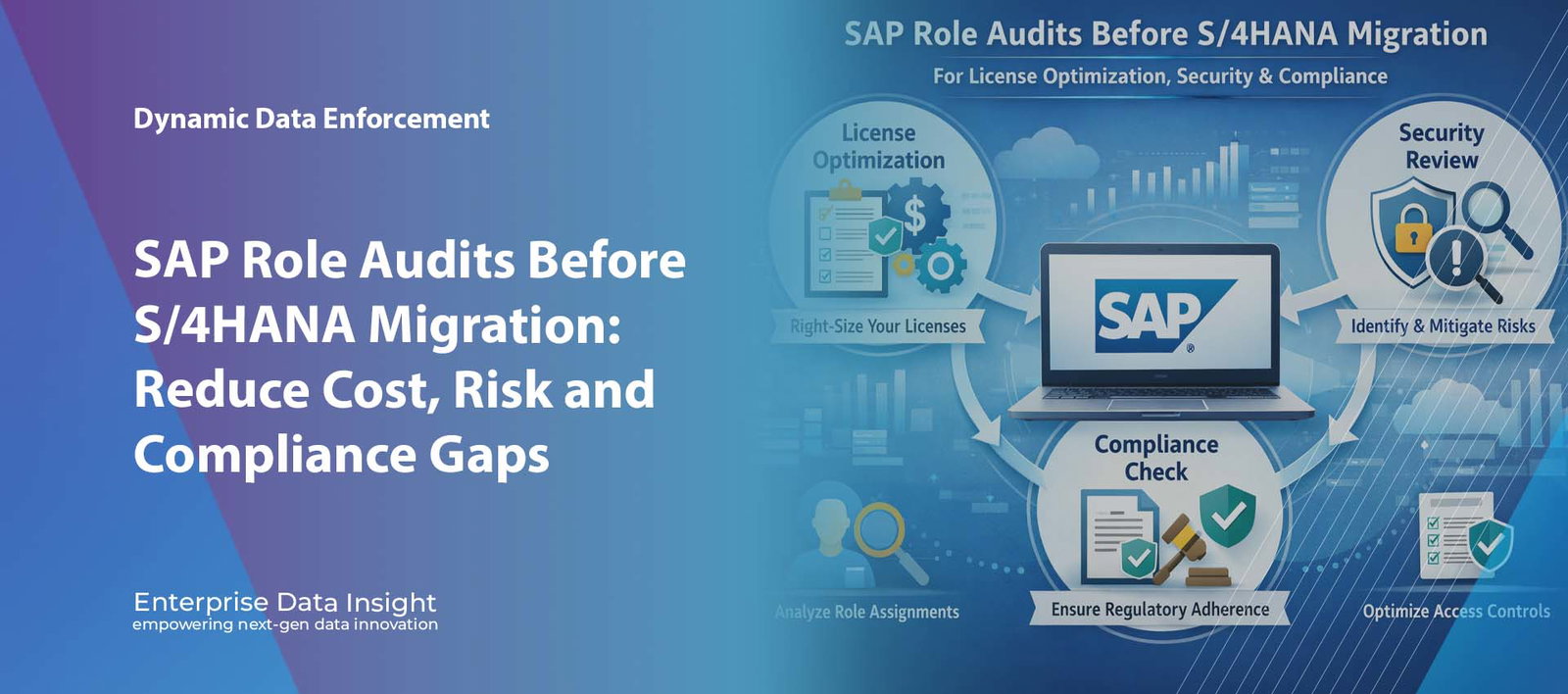
SAP GRC | SAP Security | S/4HANA Migration | Role Management Powerful SAP Role Audits Before S/4HANA Migration to Cut Cost, Strengthen Security and Improve Compliance SAP role audits before S/4HANA migration can uncover hidden licence waste, excessive access, weak Segregation of Duties control, and outdated authorisations before they are carried into the new platform. For organisations moving from ECC to S/4HANA, this workstream is not just a technical review. It is a business decision that improves cost control, protects sensitive data, and helps create a cleaner access model for the future environment. Lower spend Identify dormant users, duplicate accounts, and poor licence classification before migration. Stronger control Reduce broad access to payroll, finance, procurement, vendor, and customer records. Cleaner future state Improve role design and resolve SoD issues before S/4HANA goes live. How Enterprise Data Insight helps Enterprise Data Insight helps organisations analyse users, roles, authorisations, licence usage, and SoD exposure so the move to S/4HANA starts with better visibility and stronger governance. Role analysis Licence visibility Access simulation SoD governance Explore EDI GRC Solutions Talk to Our Team A role audit before migration helps reduce licence waste, tighten access, and improve governance before S/4HANA go live. Table of Contents Why role reviews matter before S/4HANA How an audit reduces licence waste How it strengthens security How it improves SoD compliance A practical SAP example How Enterprise Data Insight helps FAQ Conclusion Organisations preparing for S/4HANA often focus on data transformation, infrastructure, testing, and custom code. Yet many programmes leave one of the biggest risks untouched: the existing role model. Old roles, inactive accounts, duplicate identities, and broad access rights can all move into the target system unless they are reviewed early. Why SAP Role Audits Before S/4HANA Migration Matter A structured review of roles and authorisations gives businesses a clearer picture of who has access, why that access exists, and whether it still reflects real job responsibility. This matters because most SAP environments have evolved over many years, often through urgent changes, copied roles, manual workarounds, and limited clean up. Over time, organisations often accumulate: inactive and dormant users duplicate identities across SAP systems excessive authorisations roles that no longer match real responsibilities hidden SoD conflicts avoidable licence cost Reviewing access before S/4HANA helps prevent historical control issues from becoming future operational problems. How SAP Role Audits Before S/4HANA Migration Optimise Licence Spend One of the strongest business reasons for this activity is licence optimisation. Many organisations pay for more than they need because they cannot clearly see how users behave, which licence types are assigned, or whether access levels truly match real usage. A review can reveal where cost is being driven by poor classification, unused accounts, or duplicated access across different SAP environments. Combine users across systems In many landscapes, one person appears in several SAP applications with overlapping access and inconsistent licence treatment. Rationalising those identities can improve utilisation and reduce waste. Remove inactive access Some users log in rarely but still consume expensive licence categories. Identifying and removing dormant access frees capacity for real business demand. Better user classification also helps businesses avoid assigning higher cost licence categories where they are not justified by actual activity. Where savings usually come from Identify Find dormant users and redundant access still consuming cost. Classify Match users to the right licence category based on real behaviour. Consolidate Reduce duplicated identities across connected SAP systems. Reallocate Free up licence capacity without avoidable extra spend. How SAP Role Audits Before S/4HANA Migration Strengthen Security S/4HANA introduces broader ways to interact with enterprise data through Fiori, analytics, mobile usage, and connected business processes. That makes accurate access design more important than ever. A strong review helps organisations understand: who can access sensitive business data which roles expose payroll, finance, vendor, or customer records which users can change or extract critical information where broad access no longer matches business need how different personas should see different data This is especially relevant in HR, finance, procurement, master data, and business partner management where the impact of poor access design can be significant. Dynamic access questions where is the user coming from what data are they trying to access what device are they using what data are they trying to extract Data areas most exposed employee payroll data financial postings and journals vendor and supplier records customer and business partner data How SAP Role Audits Before S/4HANA Migration Improve SoD Compliance Segregation of Duties remains one of the most common control issues in SAP landscapes. A pre migration audit helps identify high risk combinations before they are moved into the future system. Common examples include: creating vendors and approving payments maintaining master data and posting transactions creating purchase orders and approving goods receipts posting journals and approving adjustments The best time to reduce SoD risk is before migration, not after go live when those conflicts are already embedded in the new environment. A Practical SAP Example Imagine an ECC system where a broad HR role has evolved over many years. General administrators, payroll specialists, and support staff all inherit similar permissions. During the review, the business discovers that some users can view salary data and deductions even though they only need employee master record access. If that role moves unchanged into S/4HANA, the same issue continues. A proper audit allows the organisation to separate responsibilities, redesign access by persona, and reduce exposure before migration. The real goal is not simply to review access. It is to build a cleaner, safer, and more efficient role model for the future SAP environment. How Enterprise Data Insight Helps Enterprise Data Insight helps organisations turn role audits into a structured and measurable migration workstream. Instead of relying on manual spreadsheets and fragmented review methods, teams gain better visibility across roles, users, authorisations, licence exposure, and SoD risk. Enterprise Data Insight supports: role and user analysis across SAP environments licence visibility and more accurate user classification access simulation for what if analysis SoD risk identification and governance

The basic premise of search engine reputation management is to use the following three strategies to accomplish the goal of creating a completely positive first page of search engine results for a specific term…
SAP data anonymisation SAP Data Anonymisation Made Safer: 7 Powerful Reasons DDR Protects SAP Test Data by Design SAP data anonymisation has moved from a compliance task to a delivery requirement. Agile delivery, continuous releases, and large scale S 4HANA programmes demand test environments that are realistic, controlled, and safe. The risk is not only what data you copy, but how you copy it. When sensitive information lands in a non production system even briefly, you create exposure and audit complexity. Dynamic Data Replicator, DDR, applies protection during replication so teams can move quickly without compromising governance. Explore DDR for Test Data View DDR Platform Overview Talk to a specialist External resources: GDPR overview, UK ICO GDPR guidance, SAP S 4HANA overview, and our DDT platform video on YouTube. Follow Enterprise Data Insight on LinkedIn. SAP data anonymisation is now a serious delivery control Modern SAP delivery has less tolerance for slow refresh cycles, uncontrolled access, and inconsistent datasets. Teams need production like behaviour without production risk. That is why effective anonymising SAP test data has become a core part of programme governance, particularly across HR, finance, and customer processes. The real issue is execution. Many approaches copy full datasets first and apply masking later. That creates an avoidable exposure period and makes assurance harder. DDR changes this by applying anonymisation during replication, reducing risk and improving control. Data subsetting that stays referentially intact Data subsetting means extracting only what is needed for testing, training, or project delivery, while keeping relationships intact across SAP modules. This is not just about reducing volume. It is about improving speed, lowering cost, and keeping non production landscapes fit for purpose. DDR supports selective replication by organisational unit, business object, and time period, so you can build lean environments without breaking end to end scenarios. If you are designing a programme wide approach, start with our SAP Test Data Management capability overview. Protection during replication removes the exposure window DDR adopts a protect first model. Sensitive fields are transformed in transit, so personal information never arrives in the target system in clear form. This approach supports privacy by design principles and strengthens assurance across regulated regions, including the Middle East. What changes when anonymisation happens during replication? Zero clear text landing Sensitive values do not exist unprotected in the target environment. Stable test scenarios Referential integrity is preserved for meaningful test execution. Repeatable refresh outcomes Rules apply consistently across cycles and parallel landscapes. Audit evidence inside SAP Scope, rules, and execution records are available for assurance. Agile and DevOps demand safer test data, faster Agile delivery requires rapid iteration and dependable environments. When refresh lead times stretch, teams compress testing, reduce coverage, and accept avoidable risk. By combining selective replication with on the fly masking, DDR supports faster cycles without compromising control. If you are mapping programme governance, it helps to align controls with recognised guidance such as NIST Cybersecurity Framework and your internal privacy requirements. Use case: SAP HCM and employee data protection Employee data often carries the highest sensitivity, particularly across HR master data, payroll, time, and organisational structures. A safe approach requires that non production datasets remain usable for testing while personal identifiers are protected. DDR supports controlled extraction and transformation patterns so teams can validate scenarios such as payroll runs, time evaluation, and reporting without exposing personal information. If you also need runtime controls in production, review Dynamic Data Enforcement. Why security leaders prefer an SAP native approach Security teams need evidence, consistency, and reduced operational overhead. When data handling is fragmented across tools and scripts, governance becomes difficult and outcomes vary. DDR runs natively inside SAP and orchestrates replication, transformation, and logging in one controlled execution path. This reduces handoffs, simplifies assurance, and helps organisations demonstrate compliance intent with practical controls. For a full platform view, see the DDR platform overview. Conclusion: SAP data anonymisation should improve delivery, not slow it SAP data anonymisation should never be a last minute step. It should be built into how data moves, how systems are refreshed, and how evidence is produced. DDR helps organisations secure non production environments while supporting speed, repeatability, and governance across complex SAP programmes. Explore DDR for Test Data Use the ROI Calculator Talk to a specialist Tip: Share your environment count, refresh frequency, and sensitive data scope. We will recommend a selective replication and transformation approach aligned to your programme. In this article Why anonymisation matters now Subsetting with integrity Protection during replication Agile and DevOps impact SAP HCM use case Why security leaders prefer SAP native Conclusion Recommended next step If you operate across regulated regions or run multiple test landscapes, align your approach to repeatable refresh, controlled scope, and evidence led governance. Learn about DDR DDR platform overview Talk to a specialist #tdms #datamanagement #datareplicator #datasecurity #datascrambling #datamasking #clientrefresh #clientcopy #dynamicdatareplicator #ddr #saps4hana #sapclientrefresh #sapselectivecopy #sapsystemcopy #sapdatamanagement #sapdatamasking #dataprivacy #gdpr #SAPGovernance #SAPCompliance#AuditReady #DataGovernance #SAPControls #RegulatoryCompliance #DynamicDataEnforcement #DDE#SAPSecurity #SAPAccessControl #SAPABAC#SAPZeroTrust #SAPAuthorization #SAPRiskManagement #InsiderThreat Ready to secure SAP test data without slowing delivery? Use Dynamic Data Replicator to combine selective replication and in flight protection, with governance evidence recorded in SAP for audit and assurance. Explore DDR Talk to a specialist Talk to a specialist Tell us what you need and we will route your enquiry to the right team. Close