


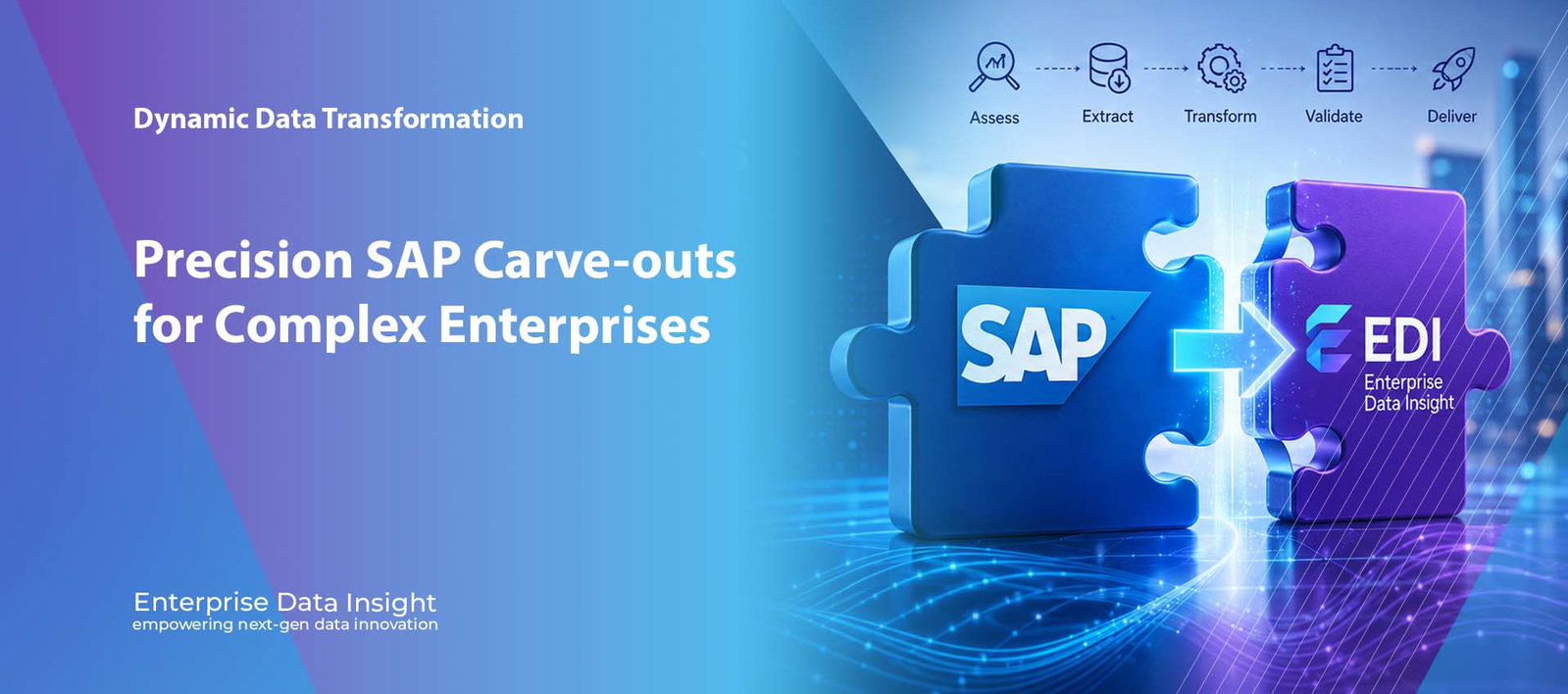
SAP Carve-out: Powerful Selective Transformation for Business Separation
SAP Carve-out: Powerful Selective Transformation for Business Separation
SAP Carve-out projects are among the most complex transformation programmes an organisation can undertake. A SAP Carve-out requires selective transformation, controlled data separation, validation, reconciliation, governance, and cutover planning so the business can separate legal entities, plants, company codes, or business units without disrupting operations.
What this solves
EDI helps organisations execute a SAP Carve-out without depending on risky full system copies, manual extraction, or uncontrolled data separation.
SAP Carve-out execution requires more than technical data extraction. It requires a controlled transformation strategy that protects business continuity, preserves data integrity, reduces operational risk, and ensures the carved-out organisation can operate confidently from day one.
A SAP Carve-out may be triggered by divestitures, mergers, acquisitions, restructuring, joint ventures, legal entity separation, regional operating model changes, or SAP S/4HANA transformation. In every case, the challenge is the same: how do you separate the right business data, processes, and history without destabilising the source organisation or delaying the target business?
Why SAP Carve-out Projects Are Difficult
SAP systems are deeply interconnected. A company code may be linked to plants, customers, vendors, materials, purchasing history, sales orders, financial postings, open items, pricing conditions, inventory, production data, attachments, interfaces, authorisations, and downstream reporting.
This means a SAP Carve-out cannot simply be treated as a data export. It is a selective transformation exercise that must understand business relationships across SAP modules and protect both the retained organisation and the separated entity.
- master data relationships must remain consistent
- transactional history must be scoped and validated
- open items must be reconciled
- custom tables and enhancements must be assessed
- interfaces and reporting dependencies must be reviewed
- security, privacy, and data ownership must be controlled
- cutover activities must be sequenced to minimise business interruption
A successful SAP Carve-out is not about moving the most data. It is about moving the right data, with the right context, at the right time, with the right controls.
The Business Disruption Risk
Poorly executed SAP Carve-out programmes can create significant disruption. If the scope is incomplete, the target organisation may be unable to transact effectively. If too much data is moved, the programme may increase cost, risk, complexity, and privacy exposure. If validation is weak, business users may lose confidence in the new environment.
Common SAP Carve-out risks include:
- missing master data required for operational continuity
- incomplete financial balances or open transactions
- broken document flow across sales, logistics, procurement, or finance
- incorrect organisational scope selection
- unplanned downtime during cutover
- insufficient audit evidence for what was transferred
- data privacy exposure caused by transferring non relevant records
EDI Approach to SAP Selective Transformation
Enterprise Data Insight supports SAP Carve-out execution using a selective transformation approach. Instead of relying on full system copies or manual extraction, EDI focuses on defining the precise business scope and executing controlled data separation with validation and governance built in.
The SAP Carve-out approach is designed to support complex scenarios such as company code carve-outs, plant separation, regional divestitures, business unit transfers, partial history migration, and SAP ECC to SAP S/4HANA selective transformation.
Selective scope definition
- company code
- plant
- sales organisation
- purchasing organisation
- business object
- date or fiscal year
- custom selection criteria
Execution control
- pre migration assessment
- dependency mapping
- simulation and test cycles
- validation and reconciliation
- audit logs and exception handling
- cutover planning
- post migration verification
Selective Data Separation Without Full System Duplication
Traditional SAP Carve-out approaches often depend on copying large volumes of data and then removing what is not needed. This can be expensive, slow, and difficult to control. EDI’s selective transformation approach works differently by identifying and transferring the relevant scope from the beginning.
This enables organisations to reduce unnecessary data movement, limit privacy exposure, improve target system efficiency, and simplify validation. It also helps reduce the risk of introducing irrelevant or sensitive records into the separated entity.
Validation and Reconciliation Are Non Negotiable
In a SAP Carve-out, data accuracy is not optional. The target organisation must be able to operate with confidence, and the retained organisation must not be destabilised by the separation. This makes validation and reconciliation essential throughout the programme.
EDI supports SAP Carve-out validation across:
- record counts and completeness
- financial balances and open items
- master data relationships
- document flow and transactional continuity
- cross module dependencies
- custom table and extension data
- exception reporting and remediation
Where EDI creates measurable SAP Carve-out value
A SAP Carve-out requires a balance of speed, control, data integrity, security, and business readiness. EDI helps organisations reduce disruption by making carve-out execution selective, repeatable, and auditable.
Common SAP Carve-out Scenarios
SAP Carve-out projects can vary significantly depending on the business event and target operating model. Some organisations need a clean separation of a legal entity. Others need a business unit transferred to a new owner. Some need to combine carve-out execution with SAP S/4HANA transformation.
- company code carve-out following divestiture
- plant or warehouse separation
- business unit sale or transfer
- regional operating model separation
- joint venture setup or exit
- post merger system rationalisation
- selective SAP ECC to SAP S/4HANA transformation
- cloud migration with scoped historical data
Security, Privacy, and Compliance During Carve-out
A SAP Carve-out often involves sensitive commercial, employee, customer, supplier, and financial data. Organisations must control what data is transferred, who can access it, and whether the receiving entity is entitled to use it.
EDI helps support SAP Carve-out data governance requirements by enabling selective scope control, auditability, and integration with security and masking strategies where required.
Organisations should also align carve-out execution with broader information security and privacy expectations. External frameworks and resources such as ISO 27001, GDPR, and SAP S/4HANA reinforce the importance of controlled data processing, governance, and auditability in enterprise transformation programmes.
Cutover Readiness and Business Continuity
Business disruption is often caused by weak cutover planning rather than the data migration itself. A strong SAP Carve-out programme must define when data is frozen, when extraction occurs, how deltas are handled, how validation is performed, and when business teams sign off.
EDI supports cutover readiness through repeatable execution cycles, simulation, validation evidence, exception reporting, and stakeholder review. This helps business teams move from uncertainty to controlled readiness.
SAP Carve-out projects succeed when selective transformation, data integrity, business readiness, and auditability are treated as one connected programme, not separate technical workstreams.
Why Enterprise Data Insight
Enterprise Data Insight brings SAP data management, replication, transformation, validation, masking, and governance experience together to support complex SAP Carve-out programmes. The focus is not simply on extracting data. It is on enabling a separated organisation to operate while protecting the stability of the retained SAP landscape.
EDI helps organisations:
- define SAP Carve-out scope with business and technical precision
- separate relevant SAP data without unnecessary full copies
- support SAP ECC, SAP S/4HANA, and hybrid transformation scenarios
- validate and reconcile data before cutover
- reduce operational disruption and transformation risk
- provide audit evidence for programme governance
Conclusion
SAP Carve-out projects require a selective, governed, and validated approach. Organisations cannot rely on broad extraction, manual separation, or limited reconciliation when critical business operations depend on the outcome.
With EDI’s selective transformation approach, organisations can execute SAP Carve-out projects with greater confidence, separating the right data and business scope while preserving continuity, integrity, security, and auditability.
For broader context, explore Dynamic Data Transformation for SAP S/4HANA, DDR Object Replicator, and Dynamic Data Insight.