


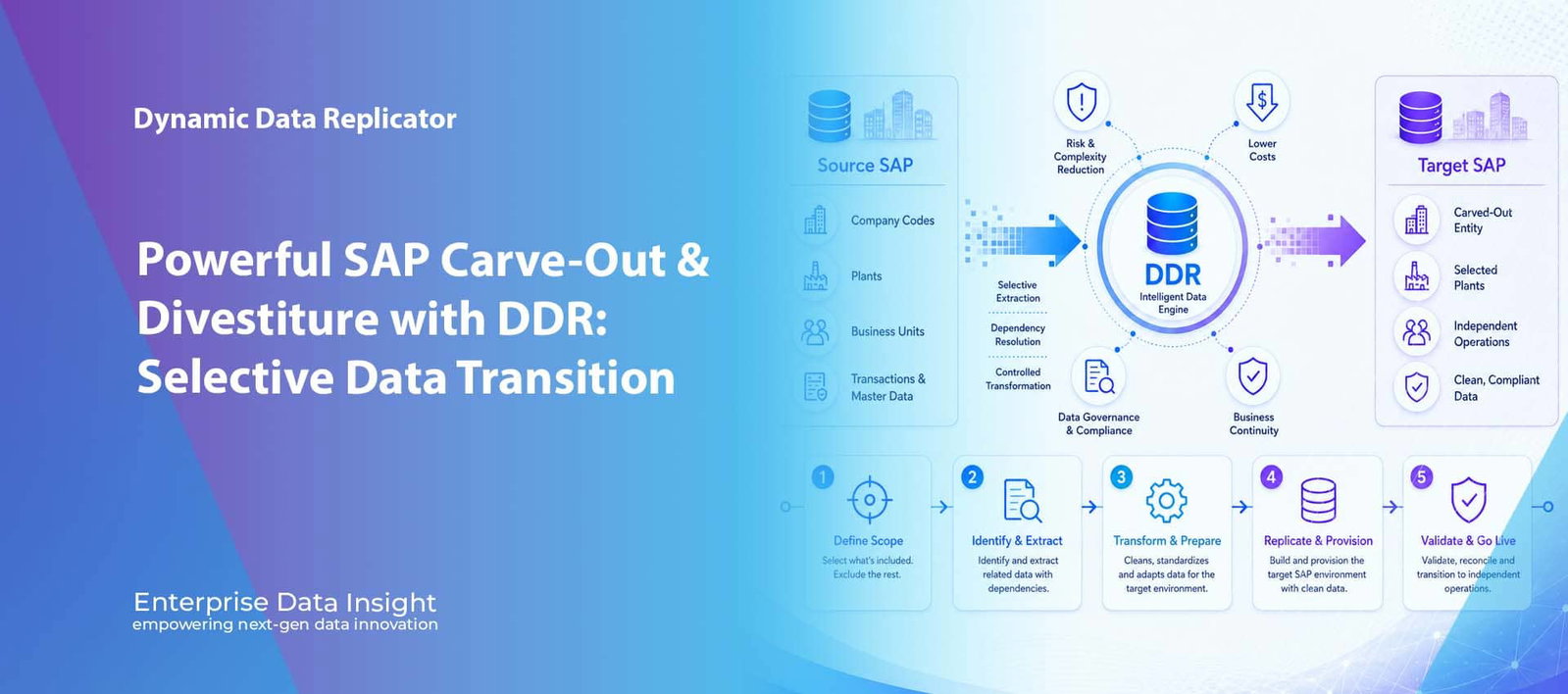
Powerful SAP Carve-Out & Divestiture with DDR: Selective Data Transition
Powerful SAP Carve-Out & Divestiture with DDR: Selective Data Transition
A powerful SAP carve-out strategy starts with the data-separation model, not the system copy. SAP carve-outs and divestitures are fundamentally data-separation programmes. The commercial transaction may involve the sale of a business unit, the separation of a legal entity, a joint-venture exit or the creation of a standalone operation, but the technical challenge is always broader than moving a few company codes. The target organisation needs a coherent, compliant and operationally usable SAP dataset containing the right master data, transactions, history and dependencies — without inheriting everything that belongs to the seller.
Start with the legal and operational scope: company codes, plants, organisational units, customers, materials, objects and required history.
Follow the related master, transactional and document-flow relationships needed to keep the selected business data usable.
Validate, cleanse and transform selected information so it fits the future operating model rather than simply reproducing the seller’s structure.
Reconcile records, relationships, balances and business processes so the target is demonstrably complete before transition.
What Does DDR Do in an SAP Carve-Out?
Dynamic Data Replicator (DDR) supports an SAP carve-out or divestiture by identifying the approved business scope, resolving the SAP data relationships needed by that scope, preparing the selected dataset and replicating it into a controlled target environment. The goal of the SAP carve-out is not simply to create a smaller copy of production. The goal is to create a business-ready target containing the data the separated organisation is entitled to receive and needs to operate.

Why SAP Carve-Outs Become Complex So Quickly
At first sight, an SAP carve-out can look like a straightforward organisational-selection exercise. A programme might identify a company code, several plants and a date range, then assume that those values define everything that must move. In a mature SAP landscape, however, the business data attached to that scope is distributed across many modules, objects and technical relationships, which is why an SAP carve-out must be engineered around the business process rather than a single organisational filter.
A selected company code can be linked to customers, vendors, materials, cost centres, profit centres, assets, contracts, purchase orders, sales orders, deliveries, invoices, accounting documents and years of related history. Those objects can then reference shared master data, cross-company transactions, custom tables, interfaces, attachments and downstream documents. A technically correct filter on one organisational field can therefore produce a target that is incomplete from a business-process perspective.
The central SAP carve-out challenge is consequently not just which tables contain the data. It is determining which business records belong to the separated organisation, which dependencies are required for those records to remain usable and which information must remain with the seller. DDR is designed around this relationship-driven view so that an SAP carve-out becomes a controlled selective data transition rather than a broad database-copy exercise.
Start With the Business Perimeter, Not the Database
A successful SAP carve-out begins by translating the transaction perimeter into a data perimeter. The programme needs to establish which legal entities, business units, organisational structures and historical periods are in scope before any technical extraction rules are finalised. Typical SAP carve-out criteria include company codes, plants, sales organisations, purchasing organisations, customers, vendors, materials, business objects and defined time periods.
Those values are important, but they are only the starting point. The business perimeter describes what the buyer or standalone organisation is expected to receive; it does not automatically identify every dependent record needed to operate that data. DDR uses the defined scope as the entry point for discovering the wider data footprint associated with the selected business.
The transaction perimeter identifies the legal entity being separated.
Plant-level operations may bring related materials, inventory, purchasing and production dependencies.
Commercial transactions may require customer, pricing, delivery, billing and accounting context.
Retention requirements can vary by object, legal obligation and future operational need.
The practical rule is simple: business scope should drive technical scope, but technical scope must expand far enough to preserve the approved business relationships. This prevents both under-selection, which produces broken processes, and over-selection, which moves information the target does not need or is not entitled to receive.
Dependency Resolution Is the Core of Selective SAP Data Separation
SAP transactions rarely exist as isolated records. A sales order, for example, can depend on customer and material master data, organisational assignments, pricing conditions and the subsequent document chain. The same transaction may later connect to delivery, goods movement, billing and financial posting. Moving only the primary document can therefore create a target that contains the record but cannot reproduce the process.
DDR approaches selective extraction as a dependency-resolution problem. The selected object becomes the anchor and the data model follows the related records that are required to preserve business meaning in the target. The exact dependency graph varies by process and landscape, but the engineering objective remains the same: preserve the relationships required for the selected business scope to function.
This distinction is critical. An SAP carve-out should not be considered successful because records were transferred successfully at database level. The SAP carve-out is successful when the selected business processes remain coherent and the target organisation can use the transferred data for the operational, legal and historical purposes defined by the programme.
A Carve-Out Must Follow Business Processes Across SAP Modules
Enterprise SAP processes cross technical module boundaries. Order-to-cash can touch SD, logistics and FI; procure-to-pay can span MM, inventory management and finance; production can depend on materials, bills of material, work centres, routings and controlling data. A carve-out design that treats each module as an independent migration stream can therefore miss relationships that are obvious from a business-process perspective.
DDR’s selective approach is intended to support cross-module dependency handling so the programme can follow the actual business relationship rather than stop at an organisational or module boundary. This becomes particularly important where the separated business must continue operating immediately after cutover and cannot tolerate gaps in the document chain.
From an architecture perspective, the target should be thought of as a coherent business-data graph. Individual tables and objects still matter technically, but they are selected because they form part of an approved process and dependency model, not because they happen to share the same module label.
Custom Objects and Z-Tables Must Be Part of the Carve-Out Design
Most long-running SAP landscapes contain customer-specific developments that have become essential to daily operations. These can include Z tables, bespoke master data, custom transaction stores, enhancements, industry extensions, workflow records and interfaces that have no standard SAP equivalent. Ignoring them because they sit outside the standard data model can leave the target business technically migrated but operationally incomplete.
The SAP carve-out design therefore needs an inventory of custom data that is linked to the selected business scope. The programme must determine how each custom object is related to standard SAP data, whether its history is required, whether transformation is necessary and how it will be validated in the target. DDR’s cross-module and custom-object support is intended to bring these objects into the same controlled SAP carve-out transition rather than treating them as an afterthought.
This is especially important for organisations that have used SAP for many years. Over time, custom tables often become part of the real business system of record even when the underlying process started with a standard SAP transaction.
The Target Operating Model May Not Match the Seller’s SAP Structure
An SAP carve-out target does not always inherit the seller’s organisational model unchanged. The future company may require new company-code assignments, numbering conventions, ownership structures, master-data standards or reporting hierarchies. In those situations, the SAP carve-out target cannot simply receive a technical copy of the selected source records; the dataset must be prepared to fit the future operating model.
The transformation stage provides the controlled point at which selected data can be validated, cleansed, mapped or transformed before final provisioning. The exact rules depend on the programme and should be explicitly governed because every transformation changes how the historic source information is represented in the target.
The goal is not transformation for its own sake. The programme should change only what the future operating model requires, preserve lineage back to the source and ensure the target result can still be reconciled against the approved carve-out scope.
Historical Retention Should Be Designed by Business Object
One of the largest contributors to SAP carve-out volume is history. A source system may contain ten, fifteen or twenty years of transactions, but the separated organisation may not require the same retention period for every object. Finance, tax, assets, open orders and operational history can each have different legal, contractual and business requirements, so the SAP carve-out retention model should be designed by business object rather than by one blanket date rule.
A selective transition should therefore avoid applying one arbitrary time filter to the entire system. Instead, the programme should define retention rules by business object and purpose, then use those rules as part of the extraction design. This allows the target to retain the history it genuinely needs while avoiding unnecessary data volume.
| Object / Area | Illustrative Requirement | Carve-Out Consideration |
|---|---|---|
| Finance | Defined statutory history | Retention, reconciliation and legal requirements must align. |
| Open Sales Orders | All active documents | Open business must remain executable after separation. |
| Closed Sales Orders | Selected historical period | Operational history can be scoped separately from open items. |
| Purchase Orders | Open + required history | Supplier, goods-receipt and invoice dependencies may also be required. |
| Asset History | Required lifecycle | Opening values and historical postings must reconcile. |
| Custom Records | Business-defined | Retention must be explicitly mapped to the custom process. |
The Five-Stage DDR Carve-Out Model
The supplied DDR model organises the SAP carve-out transition into five controlled stages. Each stage produces inputs for the next, and each creates evidence that can be tested during rehearsal cycles. This is important because an SAP carve-out should be a repeatable engineering process rather than a one-off cutover event.
Repeated rehearsals allow the programme to refine selection rules, transformation logic, reconciliation and execution timing before the final transition. By the time cutover arrives, the team should be executing a proven sequence with known volumes and known exceptions rather than discovering the data model during the production event.
Provision a Business-Ready Target, Not a Reduced Clone
Once the selected dataset has been approved and prepared, DDR replicates it into the target SAP environment. The distinction between a selective target and a reduced clone is important. A reduced clone is still defined by what existed in the source; a business-ready target is defined by what the future organisation needs to operate.
The target may support a buyer environment, a new standalone system, a temporary transition landscape or another approved operating model. Whatever the architecture, provisioning should preserve the data relationships required by the agreed scope and apply the controls established during the earlier stages.
Security and governance are part of the provisioning process. The target should receive only approved data, sensitive information should be handled according to policy, and the programme should retain enough execution evidence to explain exactly what was moved and under which rules.
A Successful Data Load Is Not the Same as a Successful Carve-Out
Technical completion only proves that an execution finished. An SAP carve-out is complete when the target can be reconciled against the approved source scope and the separated business can execute the processes it needs after transition. SAP carve-out validation therefore needs to operate at multiple levels rather than relying on one record-count check.
Technical and Record Validation
Technical validation confirms that the intended extraction and replication steps completed successfully. Record validation then compares selected source populations with target populations for agreed objects such as customers, vendors, materials, orders, financial documents and assets. Differences should be explainable through documented transformation or exclusion rules.
Relationship Validation
Relationship validation checks whether the target still contains the business links required by the process. For example, a sales order may exist in the target, but the carve-out is incomplete if the associated delivery, billing or accounting information required by the target business is missing.
Financial Reconciliation
Where finance is in scope, the programme may need to reconcile general-ledger balances, open receivables, open payables, asset values, inventory and selected historical postings. The precise controls depend on the transaction perimeter, but the principle is consistent: the target must be demonstrably consistent with the approved carve-out definition.
Business Validation
Business users ultimately prove whether the target is usable. End-to-end testing should confirm that the migrated information supports the processes required on day one, including open transactions and relevant historical enquiry. This is why the final DDR stage is Validate & Go Live, not simply “load complete”.
The Programme Must Prove What Moved — and What Did Not
SAP carve-out programmes are usually subject to more scrutiny than routine non-production refreshes. Sellers, buyers, legal teams, auditors, security teams, privacy officers and programme governance may all need evidence about the data perimeter. The organisation therefore needs a defensible SAP carve-out record of what was selected, how it was transformed, where it was moved and what remained outside the target.
A mature DDR operating model should capture the request, scope, execution, validation and exception trail. This becomes particularly important where the seller must demonstrate that information belonging to another business unit, employee population or customer group was not transferred to the buyer.
Auditability is therefore not a reporting add-on. It is part of the data-separation control model and provides evidence that the transition followed the approved transaction perimeter.
Selective Replication Turns Data Minimisation Into a Technical Control
A buyer acquiring one business unit should not automatically receive information belonging to the seller’s unrelated entities, employees, customers or operations. A full database copy can create a large remediation exercise because the programme first transfers everything and then has to remove or isolate what should never have crossed the separation boundary.
Selective replication reverses that model. The process starts with the approved business perimeter, expands only where related data is required to preserve business integrity and provisions the resulting dataset into the target. This can make the separation boundary easier to understand and easier to evidence.
The target initially receives far more information than the separated business may need.
The approved business scope is the starting point and dependencies are added deliberately.
This is not only a volume optimisation. It can also reduce unnecessary exposure and make governance clearer because the programme is designed around what the target is permitted to receive rather than around the size of the source database.
Business Continuity Must Be Designed Into the Separation
Every SAP carve-out or divestiture programme has two objectives that must happen at the same time: separate the organisation and keep the organisation operating. That means the data transition has to preserve open business, required history and the relationships needed by users immediately after cutover. A technically clean SAP carve-out that disrupts invoicing, procurement, inventory or financial processing is not a successful business outcome.
Rehearsal cycles are therefore essential. Each iteration gives the programme an opportunity to measure data volumes, test dependency rules, validate transformations, refine reconciliation and establish realistic execution times. The final cutover should be the controlled repetition of a proven process rather than the first time the full data-separation logic has been executed end to end.
Where changes continue in the source between rehearsal and final transition, the cutover strategy also needs to account for the remaining data delta. The programme should explicitly define how late changes are identified, how they are transferred and how the final target is reconciled before business ownership moves across.
Where DDR Supports SAP Business Separation
Move the operational data required by the sold business while the seller retains the remaining corporate landscape.
Transition financial, master and transactional data required for standalone operation.
Identify the records owned by the separated venture and preserve the history it needs.
Support selective transition into a buyer or consolidated SAP environment.
Separate country or regional operations using organisational and transactional criteria.
Create a fit-for-purpose environment for a business previously dependent on shared corporate systems.
Full System Copy vs Selective DDR Carve-Out
A full SAP system copy can still be the correct technical choice when the target genuinely requires the complete system state. The problem is using that model by default for an SAP carve-out when the divested business represents only a fraction of the source organisation. In that situation, the SAP carve-out programme may transfer large volumes of unrelated data and then spend significant effort removing or restricting it.
| Design Question | Full System Copy | Selective DDR Carve-Out |
|---|---|---|
| Starting point | Replicate the broad source system. | Start from the approved business perimeter. |
| Data volume | Includes information outside the carve-out scope. | Targets the required organisational, transactional and historical scope. |
| Dependency handling | Dependencies are retained because most source data is copied. | Dependencies must be resolved deliberately for the selected business objects. |
| Data minimisation | Requires removal or restriction after the copy. | Built into the selection model from the beginning. |
| Target design | Often inherits the source system’s footprint. | Can be prepared around the future operating model. |
| Best fit | Complete-system separation or broad landscape requirement. | Divestiture, spin-off, regional separation and selective transition. |
The decision should therefore be driven by the target business requirement rather than by habit. DDR does not argue that full copies have no place; it provides another engineering model when the programme needs a selective, controlled and defensible separation.
What a Selective Carve-Out Is Designed to Achieve
The strongest outcome is not simply a lower database size. A successful selective transition should reduce unnecessary data volume while making the target easier to govern, validate and operate. It should also reduce the complexity created by transferring information that the separated business does not need.
Where the scope supports it, a selective model can reduce infrastructure demand, shorten provisioning activities and create a cleaner target dataset. More importantly, it can improve the programme’s ability to explain exactly which data belongs to the separated organisation and why it was moved.
The end state is therefore a combination of technical and business outcomes: faster execution, lower unnecessary data footprint, stronger governance, reduced transition risk and a business-ready SAP target.
The Key Question Is Not “How Fast Can We Copy SAP?”
The more useful question for an SAP carve-out programme is: what information does the separated business genuinely need to operate, and what dependencies are required to deliver that information safely and completely? That question forces the SAP carve-out programme to align the data architecture with the transaction perimeter rather than starting from the size and structure of the seller’s system.
Once the business perimeter is clear, selective replication becomes an engineering discipline. Scope, dependency resolution, transformation, provisioning, reconciliation and governance can be designed as repeatable stages and exercised through multiple rehearsals. That is how the programme reduces uncertainty before the final transition.
DDR is designed to provide the technical framework for that model: selective SAP data, controlled transition and business-ready target environments.
External SAP Carve-Out and Selective Data Transition Resources
The principles discussed in this article align with the wider selective-data-transition model used across SAP transformation programmes: define the data scope, model the transformation, execute controlled cycles and validate the result. For the SAP perspective, review the SAP Help Portal guidance for Lean Selective Data Transition, which describes analysing and reducing source data to the scope relevant for continuing business in a new SAP S/4HANA instance.
For deeper technical detail on the transformation model, SAP also documents how transformation objects, relationships, filters and rules are represented in SAP Business Transformation Center — Model Your Transformation. These SAP resources provide useful external context for teams comparing selective-transition patterns with an SAP carve-out architecture.
For product updates, SAP data engineering content and new Dynamic Data Replicator capabilities, follow Enterprise Data Insight on LinkedIn. The company page publishes current information on DDR, SAP data replication, governance, validation, security and transformation use cases.
SAP Carve-Out and Divestiture FAQ
What is an SAP carve-out?
An SAP carve-out is the technical and data-separation activity required when part of an organisation must be separated from an existing SAP landscape. It commonly supports a divestiture, legal-entity spin-off, regional separation, joint venture exit or creation of a standalone operation.
How does DDR support an SAP divestiture?
DDR supports selective definition, extraction, preparation and replication of the SAP data required by the separated organisation. The model includes business-scope selection, dependency resolution, cross-module and custom-object support, transformation, validation and governance.
Does an SAP carve-out require a full system copy?
No. Some programmes genuinely require a broad copy, but a selective model can be more appropriate when only part of the organisation is being separated and the target does not need the complete source-system dataset.
What is dependency resolution in an SAP carve-out?
Dependency resolution identifies the master, transactional and related records required by the selected business scope. For example, a selected sales order may require customer, material, delivery, billing and accounting context for the process to remain usable in the target.
Can DDR include custom SAP data?
Yes. Custom objects and Z tables can be incorporated into the carve-out design so customer-specific business data is treated as part of the approved transition rather than as a separate afterthought.
Can historical SAP data be selectively retained?
Yes. Retention requirements can be defined by business object, legal obligation and operational need. This allows open transactions and required history to move without automatically carrying the complete lifetime of the source system.
How should the target be validated?
Validation should cover technical execution, record populations, business relationships, financial reconciliation where applicable and end-to-end business-process testing. The target should be demonstrably consistent with the approved carve-out perimeter before go-live.
What is the main advantage of selective SAP data transition?
The main advantage is control. The target is built around the data required by the separated business rather than beginning with a complete source-system copy containing large volumes of unrelated information.
Selective SAP Data. Controlled Transition. Business-Ready Targets.
Dynamic Data Replicator is designed to help SAP carve-out and divestiture programmes define the right business perimeter, resolve the dependencies that matter, prepare the target dataset and validate the result before go-live. The objective is a leaner and more defensible transition model in which the target receives the data it needs — and only the data it needs — to operate successfully.