


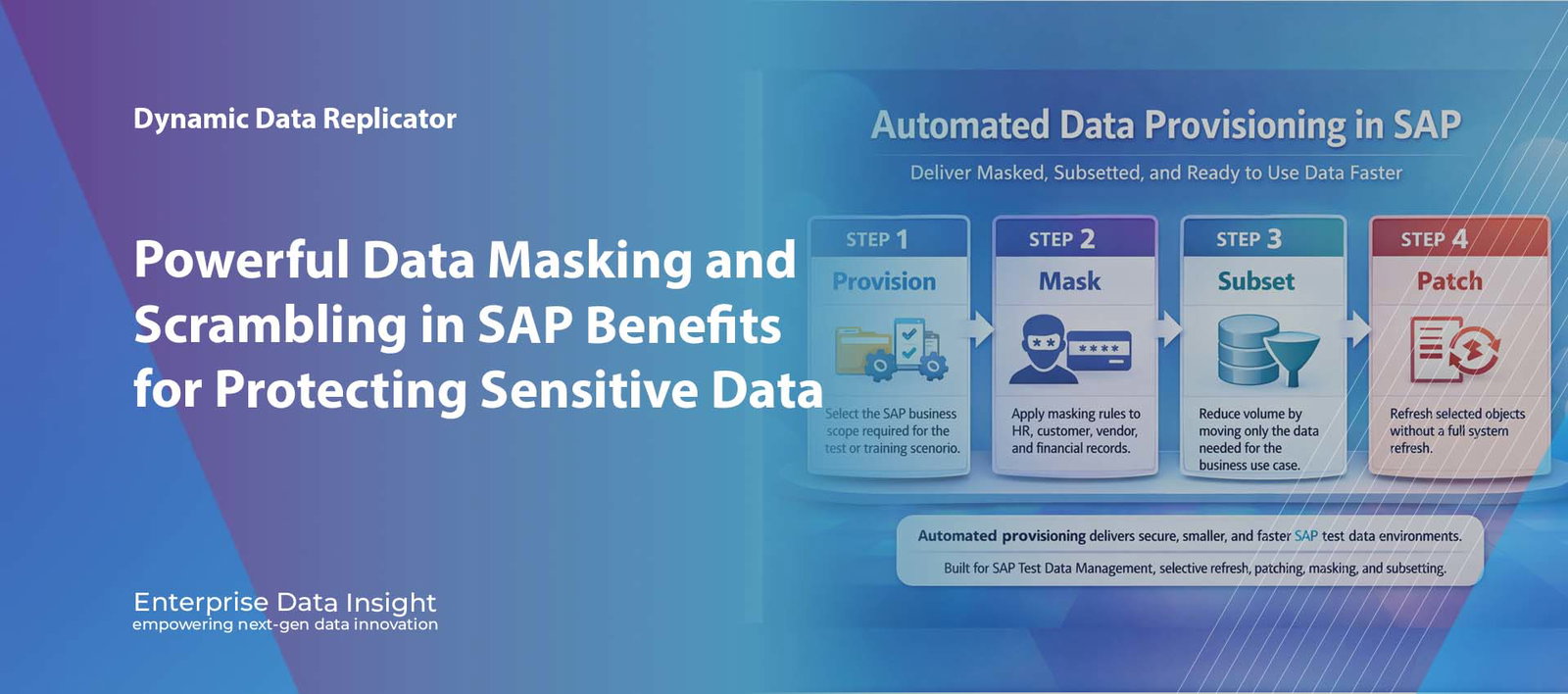
Automated Data Provisioning in SAP: Faster, Masked, and Subsetted Test Data with DDR
Automated Data Provisioning in SAP: How Masking, Subsetting, and Patching Deliver Faster and Safer Test Data
Automated Data Provisioning in SAP is changing how organisations prepare non production systems for testing, training, development, and project delivery. Instead of waiting for manual system copies, large refresh cycles, and post copy clean up activities, SAP teams can now automate the movement of the right data into the right environment at the right time. When this process includes data masking, data subsetting, and automated patching, the result is faster refresh readiness, reduced privacy risk, smaller target systems, and much more efficient SAP Test Data Management.
What this solves technically
Automated provisioning reduces dependency on full refreshes, supports selective updates, enables controlled masking, and keeps SAP data usable for testing while lowering operational effort.
Automated Data Provisioning in SAP is no longer just about copying large volumes of data from one system to another. Modern SAP teams need a faster and more controlled way to prepare development, QA, training, and sandbox environments without relying on full system refreshes. When provisioning is automated, business relevant data can be delivered with less delay, less manual effort, and less unnecessary volume. When that process also includes masking, subsetting, and patching, the quality and usability of the resulting environment improve significantly.
Why Traditional SAP Data Provisioning Slows Delivery
Traditional SAP data provisioning is often based on full system copies or large refresh activities. While these approaches deliver complete data, they are usually slow, heavy, and inefficient. They move everything, including data that adds no value to the target scenario. This increases system size, extends refresh duration, and creates unnecessary operational work before the environment is usable.
It also introduces a major security and privacy issue. Sensitive HR, customer, vendor, and financial data is frequently copied into non production systems that do not need to hold raw live values.
- long refresh windows delay projects and releases
- large data volumes increase target system footprint
- manual post copy clean up slows test readiness
- sensitive data is exposed in non production
- teams cannot easily provision scenario specific data
The more data you move than you actually need, the slower, larger, and riskier the SAP provisioning process becomes.
What Automated Data Provisioning in SAP Changes
Automated Data Provisioning in SAP changes the model from bulk movement to controlled delivery. Instead of copying complete clients or full productive datasets, organisations can define the data they need and automate how it is prepared for the target system.
This approach allows teams to provision environments with data that is:
- relevant to the specific test or business process
- masked where sensitive data exists
- subsetted to reduce size and overhead
- patched or refreshed selectively without full re-copy
The result is faster environment readiness, lower database growth, and greater control over how SAP test data is managed across the landscape.
Data Masking Built Into Provisioning
One of the strongest benefits of automation is the ability to apply data masking during the provisioning process itself. This means sensitive values are transformed before they reach the non production environment rather than being copied raw and cleaned later.
For example, employee personal details can be anonymised, customer email addresses can be converted to safe values, and financial records can be scrambled while retaining technical structure.
What masking protects
- HR names, dates of birth, salary values
- customer identities and contact information
- vendor and business partner details
- financial and banking information
Why built in masking matters
- reduces privacy exposure immediately
- avoids post refresh clean up effort
- keeps target systems safer by design
- supports realistic but protected data use
Data Subsetting for Faster and Leaner SAP Systems
Data subsetting is essential to modern SAP provisioning because not every use case requires a full production sized dataset. In many cases, teams need only a portion of the business scope. By moving just the relevant data, organisations reduce load size, improve refresh speed, and lower storage demand in the target system.
This is especially valuable in S/4HANA programmes and in non production landscapes where database growth and performance have a direct operational cost.
- reduce unnecessary volume in target systems
- accelerate data provisioning cycles
- deliver smaller, more focused environments
- support use case based testing and training
Automated Patching and Selective Refresh
Full refreshes are not always necessary. In many situations, SAP teams only need to update a selected dataset or a defined business object. Automated patching supports this model by refreshing parts of the environment without disrupting the entire target system.
This is a major advantage for continuous testing, agile delivery, and support landscapes where frequent selective updates are more useful than repeated full copies.
- patch specific business objects instead of everything
- refresh the required scope with less disruption
- improve responsiveness for project teams
- support repeatable object level updates
Where automated provisioning creates value
The value comes from speed, control, security, and reduced data volume. The business case is not just about faster copies. It is about delivering better SAP non production environments with less waste.
A Practical SAP Example
Consider a project team preparing a QA environment for a finance and customer service scenario. Under a traditional model, the team might request a large refresh, wait for Basis scheduling, receive a heavy dataset, and then spend additional time masking sensitive fields or cleaning unnecessary records.
With automated provisioning, the organisation can define the exact scope needed, apply data masking during transfer, subset the data to only the relevant business slice, and patch the target with the required objects. The environment becomes usable faster, the system remains smaller, and privacy risk is lower.
Automated Data Provisioning in SAP works best when data is delivered selectively, protected automatically, and refreshed intelligently rather than copied in full every time.
Why This Matters for SAP Test Data Management
SAP Test Data Management is evolving from bulk data movement towards controlled, repeatable, and scenario specific data delivery. Automated provisioning supports this change by enabling organisations to prepare realistic environments without relying on the old model of full refresh dependency.
A stronger SAP Test Data Management strategy should support:
- automated provisioning instead of manual cycles
- masking built into the data movement process
- subsetting to reduce system size and waste
- patching to refresh selected data intelligently
- faster environment readiness for delivery teams
For broader context, explore SAP, review SAP DevOps practices, and visit Dynamic Data Replicator.
Conclusion
Automated Data Provisioning in SAP helps organisations move beyond slow and inefficient refresh practices by delivering masked, subsetted, and ready to use data with greater speed and control. When automation is combined with data masking, data subsetting, and selective patching, SAP teams gain smaller target systems, safer data handling, and much faster environment readiness.
Dynamic Data Replicator supports this modern provisioning model by helping organisations automate data delivery while protecting sensitive information and reducing operational overhead. That creates a stronger foundation for SAP Test Data Management across development, QA, training, and project landscapes.
#tdms #datamanagement #datasync #datasecurity #datascrambling #datasecure #clientrefresh #clientcopy