


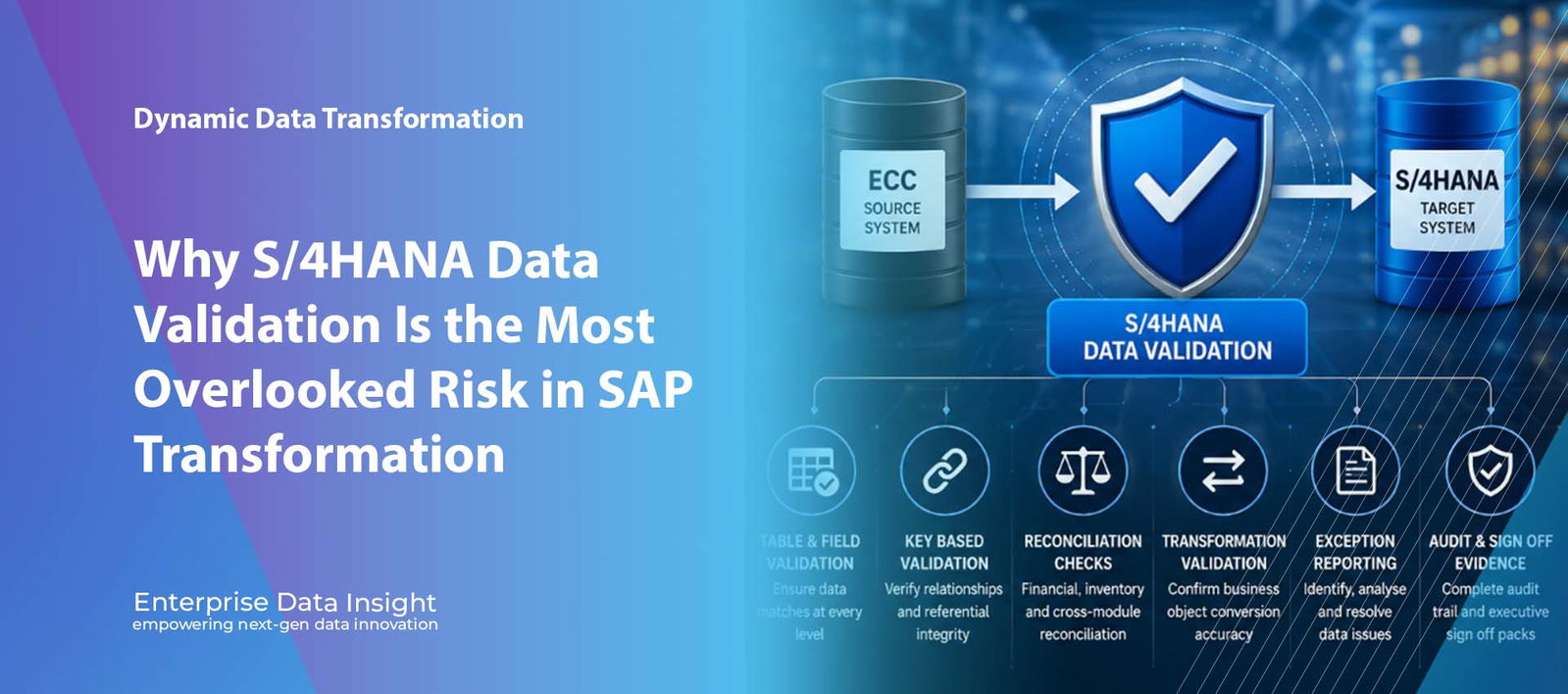
S/4HANA Data Validation: Powerful ROI Protection for SAP Migration
S/4HANA Data Validation: Powerful ROI Protection for SAP Migration
S/4HANA Data Validation is the control that proves whether an SAP migration has delivered a trusted business outcome, not just a successful data load. Enterprise Data Insight helps organisations validate ECC to S/4HANA migration results across finance, procurement, inventory, Business Partner, master data, transactional data, custom tables, reconciliation rules, and cross module dependencies so executives can sign off the migration with evidence instead of assumptions.
The executive question
The real question is no longer whether ECC data was loaded into S/4HANA. It is whether the organisation can trust the S/4HANA data enough to run finance, supply chain, procurement, analytics, and reporting.
S/4HANA Data Validation has quietly become one of the most critical success factors in SAP transformation programmes. Yet despite organisations investing millions in SAP S/4HANA migration initiatives, validation often receives only a fraction of the attention given to migration strategy, data extraction, infrastructure planning, testing, and cutover execution.
The assumption is simple. If the migration completed successfully, the data must be correct. Unfortunately, experience shows otherwise. Some of the most expensive post go live issues are not caused by failed migrations. They are caused by migrations that appeared successful but introduced undetected data quality, reconciliation, transformation, and integrity issues into the target SAP S/4HANA environment.
Why S/4HANA Data Validation Is the Missing Control
Most SAP migration programmes measure success using technical metrics. How many objects were migrated. How many records were loaded. Whether the migration completed within the planned cutover window. Whether interfaces restarted successfully. Whether users could log into the new system.
These metrics matter, but they do not answer the question executive leadership ultimately cares about: can the business trust the information inside SAP S/4HANA?
A migration programme can move hundreds of millions of records from SAP ECC into SAP S/4HANA. The migration logs may show completion. Record counts may match. Yet financial balances can still fail to reconcile, inventory valuations can still be incorrect, Business Partner relationships can still be incomplete, and management reports can still produce different results from the numbers the organisation relied upon for years.
A migration that completed and a migration that can be trusted are not the same thing. S/4HANA Data Validation is the control that proves the difference.
The Cost of Getting Data Validation Wrong
Data defects are most expensive when they are discovered after go live. At that stage, business users are already operating in the new system, project teams may have moved on, original migration evidence can be difficult to reconstruct, and urgent remediation activity competes with normal production support.
The financial impact is not limited to technical rework. Poor migration validation can create delayed month end close, inaccurate management reporting, inventory write offs, procurement disruption, payment delays, manual reconciliation effort, loss of user confidence, and additional consulting cost.
This is where the ROI case for validation becomes clear. S/4HANA Data Validation protects the migration investment by finding defects when they are cheaper to fix, easier to explain, and less disruptive to the business.
Why SAP S/4HANA Introduces New Validation Challenges
S/4HANA Data Validation becomes significantly more important because organisations are not simply transferring data between databases. They are moving into a fundamentally different business architecture.
- Traditional customer and vendor records are transformed into Business Partner.
- Financial data is consolidated into ACDOCA and the Universal Journal.
- Reporting structures and analytical models change.
- Business relationships and object dependencies evolve.
- Custom developments, custom tables, and extensions must be redesigned or adapted.
- Historical data, open items, and transformed records must remain usable and reconcilable.
The challenge is not only technical. It is logical, relational, financial, and operational. A technically successful data load can still produce an unreliable business outcome if the transformed information is not validated properly.
Why Record Counts Alone Are Dangerous
One of the most common mistakes in SAP migration projects is treating record counts as proof of success. If ten million records exist in SAP ECC and ten million records exist in SAP S/4HANA, the migration is often considered validated.
This creates a dangerous false sense of confidence. Ten million incorrect records are still ten million records. A Chief Financial Officer does not care whether table counts match. They care whether financial statements remain accurate. A Supply Chain Director does not care whether a migration log completed. They care whether inventory positions can be trusted. A Procurement Director does not care whether a conversion job finished on time. They care whether supplier information remains complete and usable.
S/4HANA Data Validation must therefore move beyond simple counting exercises and validate values, relationships, balances, open items, statuses, field transformations, business rules, and reconciliation outputs.
Weak validation evidence
- source and target record counts only
- migration job completion status only
- manual spreadsheet sampling
- one time testing shortly before go live
- limited business sign off evidence
Strong validation evidence
- field by field comparison
- key based object matching
- financial and inventory reconciliation
- relationship and dependency validation
- exception logs with audit ready sign off
What True S/4HANA Data Validation Proves
True S/4HANA Data Validation confirms far more than whether data exists in the target system. It proves business integrity. It provides evidence that migrated data remains complete, accurate, reconciled, transformed correctly, and usable for real SAP processes.
A robust validation model should prove:
- all required records were transferred into the correct S/4HANA scope
- key fields and business critical values match the expected target outcome
- financial balances, open items, and transactional totals reconcile
- inventory quantities and valuation positions remain accurate
- customer, vendor, and Business Partner relationships are transformed correctly
- custom tables and bespoke fields are validated against agreed business rules
- exceptions are recorded, prioritised, corrected, and evidenced before sign off
How EDI Supports S/4HANA Data Validation
Enterprise Data Insight supports S/4HANA Data Validation through a practical SAP validation framework that is designed for real migration programmes, not generic testing activity. The objective is to give programme teams automated, repeatable, and auditable evidence that ECC source data and S/4HANA target data remain aligned after extraction, transformation, loading, and conversion.
EDI supports migration assurance through four connected capabilities: Dynamic Data Validation, Dynamic Data Transformation, Dynamic Data Insight, and Dynamic Data Replicator. Together, these capabilities help organisations understand the source data, transform it correctly, replicate controlled datasets for testing, and validate the target outcome against business rules.
EDI validation capabilities
- Dynamic Data Validation: source to target comparison, key based validation, field level checking, hash validation, reconciliation rules, exception reporting, and audit logs.
- Dynamic Data Transformation: ECC to S/4HANA transformation logic, mapping control, migration object readiness, object conversion, and wave based migration support.
- Dynamic Data Insight: data profiling, dependency analysis, data quality assessment, duplication identification, and business object relationship discovery.
- Dynamic Data Replicator: selective dataset replication for mock migration, cutover rehearsal, validation cycles, test data creation, and delta comparison.
Business outcomes EDI helps prove
- finance balances reconcile before sign off
- material, customer, vendor, and Business Partner records remain complete
- transactional history and open items are transferred correctly
- custom tables and bespoke fields are validated
- migration defects are visible with ownership and remediation status
- executives receive evidence based migration confidence
Why S/4HANA Data Validation Protects Migration ROI
SAP S/4HANA programmes often represent investments measured in millions of pounds. The objective is not simply to deploy a new platform. The objective is to improve business performance, increase agility, modernise operations, reduce technical debt, and create a foundation for future digital capability.
Poor data quality undermines every one of those objectives. Incorrect information impacts reporting. Reporting impacts decisions. Decisions impact business performance. Validation therefore becomes one of the highest return controls within the transformation programme because it protects the investment already made.
Where S/4HANA Data Validation creates measurable ROI
The financial value of validation comes from reducing remediation, protecting operational trust, and giving executives confidence that the migration outcome is commercially safe.
Validation Should Be Continuous, Not Final
Validation is often treated as the final activity in a migration programme. Something performed shortly before go live. Something delegated to testing teams. Something completed once and forgotten.
The strongest S/4HANA programmes treat S/4HANA Data Validation as a continuous discipline that starts early and runs throughout the full programme lifecycle.
- Before migration: define validation rules, business critical fields, reconciliation logic, and sign off criteria.
- During mock loads: compare source and target data, identify defects, and tune migration rules.
- During testing: validate business process usability, object relationships, and transformed structures.
- During cutover: prove completeness, reconciliation, and exception status before production release.
- After go live: monitor business critical datasets and confirm operational trust.
Technical Validation Patterns for SAP Migration
A mature S/4HANA Data Validation framework should combine technical comparison with business reconciliation. It should support both high volume automation and business level review.
- Record completeness: source to target count comparison by object, table, company code, plant, period, and migration wave.
- Field level comparison: validation of key business fields, transformed values, mandatory fields, and derived fields.
- Hash validation: checksum based comparison for large datasets where row level reporting would be inefficient.
- Reconciliation rules: balance, quantity, value, and open item reconciliation across FI, MM, SD, HR, and custom areas.
- Relationship validation: checks across Business Partner, materials, plants, accounting documents, open items, and document flow.
- Exception management: defect reporting with severity, owner, root cause, remediation status, and sign off evidence.
Why This Matters for Analytics, Automation, and Future SAP Investment
S/4HANA Data Validation is not only a migration control. It is also a foundation for trusted analytics, automation, operational reporting, and future SAP innovation. If migrated SAP data is incomplete, inconsistent, duplicated, or unreconciled, every downstream business initiative becomes weaker.
Clean and validated data supports better reporting, stronger automation, more reliable analytics, and higher confidence in executive decision making. Organisations that validate migration data properly are not just reducing go live risk. They are protecting the value of the entire transformation investment.
External SAP transformation guidance and enterprise governance frameworks continue to reinforce the importance of trusted information, controlled data processing, and auditability. For broader context, review SAP S/4HANA, ISO 27001, and GDPR.
Migration moves data. Validation protects the business. Trust in S/4HANA is not created by a successful load. It is created by evidence.
Frequently Asked Questions About S/4HANA Data Validation
What is S/4HANA Data Validation?
S/4HANA Data Validation is the process of proving that data migrated from SAP ECC or another source system into SAP S/4HANA is complete, accurate, reconciled, transformed correctly, and usable for business operations.
Why is record count validation not enough?
Record counts only confirm that the expected number of records exists. They do not prove that financial values, inventory positions, Business Partner relationships, custom fields, open items, or transformed business objects are correct.
How does EDI help with S/4HANA migration validation?
EDI helps by combining Dynamic Data Validation, Dynamic Data Transformation, Dynamic Data Insight, and Dynamic Data Replicator to validate source and target datasets, reconcile business values, identify exceptions, and provide audit ready evidence for sign off.
What is the ROI of S/4HANA Data Validation?
The ROI comes from reducing post go live remediation, avoiding business disruption, protecting reporting accuracy, improving user confidence, accelerating sign off, and reducing the cost of finding defects after production cutover.
Conclusion
S/4HANA Data Validation is the difference between a migration that completes and a transformation that the business can trust. As organisations accelerate SAP S/4HANA programmes, the conversation must move beyond how data is moved and focus on how data quality, accuracy, reconciliation, and business trust are proven.
Executives rarely remember how quickly a migration completed. They remember whether the organisation could trust the system afterwards. Trust is not created by migration. Trust is created by validation.
For broader EDI context, explore Dynamic Data Transformation for SAP S/4HANA, Dynamic Data Insight, and DDR Object Replicator.