


ECC and S/4HANA Synchronisation: Powerful SAP Migration Strategy for Reduced Cutover Risk

S/4HANA Data Export Approval: Powerful Governance for Secure SAP Migration
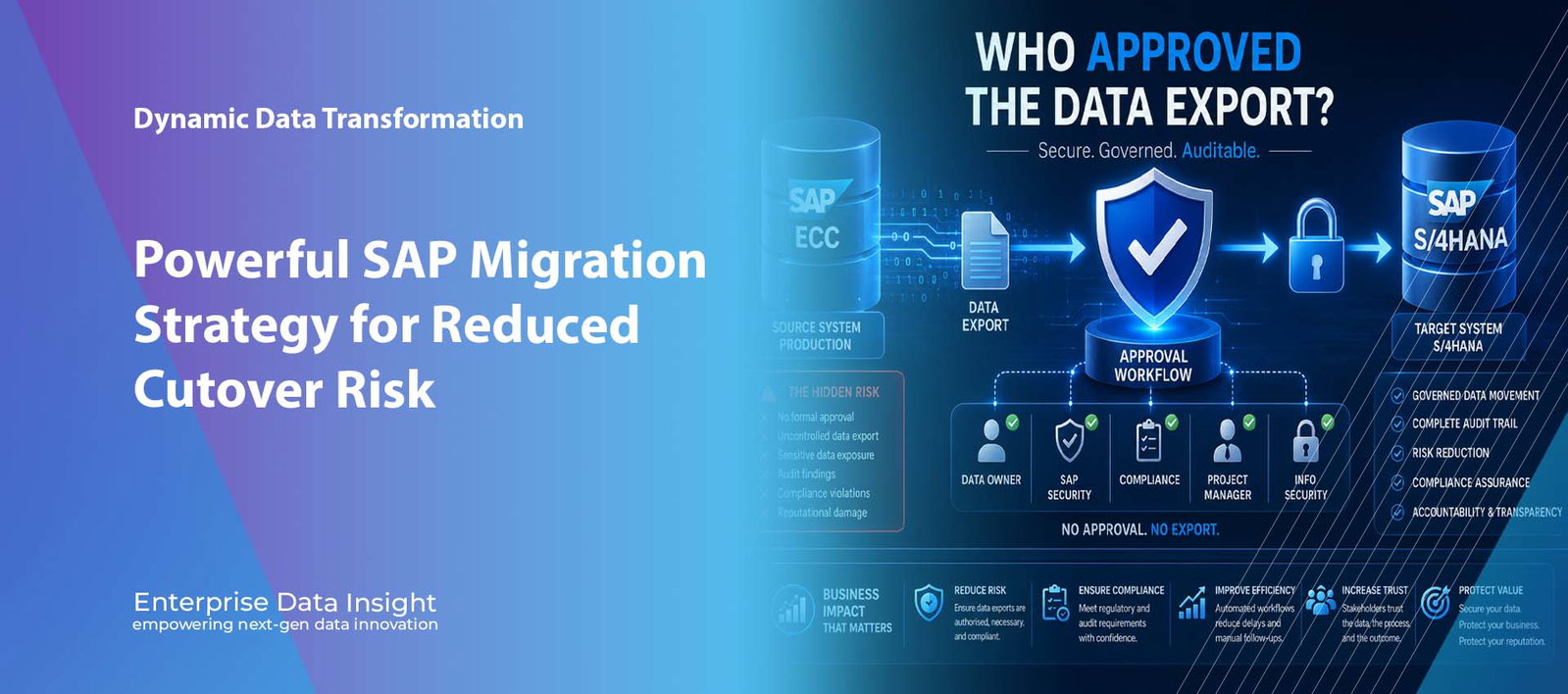
S/4HANA Data Export Approval is one of the most overlooked governance controls in SAP transformation programmes. Organisations spend millions securing SAP access, privileged users, segregation of duties, cloud environments, and cyber security, yet many cannot quickly prove who authorised production data to be exported during migration. Dynamic Data Replicator Workflow Approval gives CIOs, CISOs, Data Owners, and audit teams a controlled, documented, and enforceable approval process before sensitive SAP data is extracted, replicated, or moved.
The C level question
The critical question is not which tool exported the data. It is who approved production data to leave the source system, what scope was approved, and where that approval evidence is stored.
S/4HANA Data Export Approval is now a critical governance requirement because every SAP migration begins before data reaches the target S/4HANA system. It begins when production data is extracted from the source environment. That export can include customer records, supplier data, employee information, financial transactions, material master data, purchase orders, sales orders, historical postings, and business partner information.
For many organisations, the export is treated as a technical activity. A migration request is raised, a consultant or administrator extracts the data, files are transferred, the target system is populated, and testing begins. From a programme perspective, this may look normal. From a governance, audit, privacy, and cyber security perspective, it leaves a serious question unanswered.
Why S/4HANA Data Export Approval Matters
The question is simple: who approved the production data export? Not who executed it. Not which tool moved it. Not how quickly it completed. Who authorised millions or billions of records of production data to leave the source SAP system, and where is that approval recorded?
For CIOs, CISOs, Data Protection Officers, SAP Security leaders, and audit teams, this distinction matters. Data export is the first security event in a migration programme. Once data leaves the production environment, the organisation becomes responsible for where it goes, who can access it, whether it should be masked, whether the scope was justified, and whether the movement can be defended during an audit.
Data export is not a technical task. It is a business decision with security, privacy, compliance, operational, and audit consequences.
The Governance Gap Most SAP Programmes Never Address
Many SAP S/4HANA migration programmes have strong controls around system access, user roles, privileged accounts, segregation of duties, change management, and production support. However, the same level of control is often missing from the movement of production data into migration environments, test systems, development systems, cloud platforms, or third party project landscapes.
A typical programme may struggle to answer:
- Which business owner approved the export?
- Which source and target systems were authorised?
- What data scope was approved?
- Was personal or commercially sensitive information included?
- Was masking, scrambling, or minimisation required?
- Did SAP Security, Information Security, or Compliance review the request?
- Was the approval documented in a way that can be produced during audit?
- Can the organisation prove that the export matched the approved scope?
If the answer depends on emails, meeting notes, spreadsheet comments, or informal project conversations, the organisation does not have strong governance. It has fragmented evidence and operational trust.
Why S/4HANA Migration Increases Data Export Risk
SAP S/4HANA programmes often involve more environments, more data copies, more project participants, and more external stakeholders than traditional upgrades. Migration programmes may include cloud infrastructure, sandbox systems, development environments, quality assurance environments, migration staging areas, integration testing systems, user acceptance testing systems, offshore teams, third party consultants, and temporary project access.
Each movement of production data increases exposure. Production to sandbox. Production to development. Production to quality assurance. Production to migration system. Production to S/4HANA test. Production to S/4HANA production. Each export should be governed. Each export should have a business reason. Each export should be approved.
The Auditor’s Question
Imagine an internal audit review six months after go live. The migration has completed. The programme has closed. Consultants have moved on. The audit team asks one direct question: who authorised the export of production customer, vendor, employee, and financial data into the migration environment?
If the programme team has to search through emails, ticket comments, project folders, meeting minutes, and chat messages, the governance process has already failed. The issue is no longer whether the migration technically succeeded. The issue is whether the organisation maintained appropriate control over sensitive data throughout the transformation.
Weak evidence
- approval hidden in emails
- ticket comments without data scope
- informal project meeting decisions
- unclear data owner responsibility
- no link between approval and actual export
- no complete export audit trail
Strong evidence
- structured export request
- defined source and target systems
- approved data scope and justification
- named approvers and timestamps
- approval linked to execution
- audit ready workflow history
Data Export Is a Business Decision
One of the most common mistakes in migration governance is allowing data export to be treated as an IT execution step. Technical teams should execute approved decisions. They should not be the only control point deciding whether production data is allowed to leave the source system.
A proper S/4HANA Data Export Approval process should involve the stakeholders who own the risk, including Business Owners, Data Owners, SAP Security, Information Security, Compliance, Data Protection Officers, Project Leadership, and Business Process Owners.
What a Strong Export Approval Control Model Requires
Governance must move closer to the export process itself. Approval should not sit outside the migration platform as an email chain or spreadsheet tab. It should be embedded directly into the data movement process, so the export cannot proceed until the correct approval path is complete.
A strong S/4HANA Data Export Approval model should capture:
- source system and target system
- requestor details and business justification
- data scope, business object scope, and selection criteria
- data classification and sensitivity
- masking, scrambling, or minimisation requirements
- approval route and required approvers
- approval timestamps, comments, decisions, and rejection reasons
- execution details linked to the approved request
- audit history that can be produced on demand
How DDR Workflow Approval Helps
Dynamic Data Replicator introduces Workflow Approval directly into the SAP data movement process. Before data is extracted, replicated, or transferred, DDR can enforce a controlled approval workflow so the right stakeholders review and authorise the request.
Instead of relying on informal project approvals, DDR Workflow Approval gives organisations structured governance over production data export. The request can define the source system, target system, business justification, object scope, filters, environment, sensitivity, and approval path before execution is allowed.
| Governance requirement | Manual project process | DDR Workflow Approval |
|---|---|---|
| Export request | Often raised by email, ticket, project note, or informal request. | Structured request with source, target, scope, justification, and requestor details. |
| Approval control | Approvals may be inconsistent, incomplete, or outside the data movement tool. | Approval workflow is embedded before export execution. |
| Segregation of duties | Requestor, executor, and approver responsibilities may be unclear. | Request, approval, and execution roles can be separated and evidenced. |
| Audit evidence | Evidence may be fragmented across emails, spreadsheets, tickets, and meeting notes. | Workflow history, approval comments, timestamps, and execution details are recorded centrally. |
| Risk reduction | Exports can proceed before all stakeholders have reviewed the data movement. | No approval means no export, reducing unauthorised or poorly justified data movement. |
The ROI Case for Data Export Approval
Governance controls are often viewed as compliance overhead. In SAP migration programmes, that view is too narrow. S/4HANA Data Export Approval protects ROI by reducing audit rework, avoiding uncontrolled data exposure, improving stakeholder confidence, preventing unauthorised project data copies, and reducing the cost of reconstructing evidence after go live.
The financial value is created by preventing expensive failures. If an organisation cannot prove why production data was exported, who approved it, where it went, and whether the export matched the approved scope, the programme may face remediation cost, audit findings, data protection concerns, project delays, and reputational risk.
Where S/4HANA Data Export Approval creates measurable value
DDR Workflow Approval helps organisations reduce governance risk and improve audit readiness before sensitive production data movement occurs.
Technical Control Patterns for Secure SAP Data Export
A mature SAP migration governance model should treat data export as a controlled workflow, not a background technical step. DDR Workflow Approval can support a stronger control model when combined with project governance, SAP Security, data classification, and validation procedures.
- Approval before execution: exports are blocked until the required workflow is completed.
- Scope based control: approval is linked to specific systems, objects, filters, and business justification.
- Role based review: Data Owners, SAP Security, Compliance, and Project Leadership review the request.
- Segregation of duties: requestors, approvers, and executors are separated where required.
- Audit logging: request, decision, comment, timestamp, user, execution, and result history is recorded.
- Exception management: rejected or amended requests are recorded with reasons and decision history.
- Compliance alignment: approval evidence supports internal audit, data protection, ISO 27001, GDPR, SOX, and cyber governance expectations.
Why This Matters for Future SAP Governance
S/4HANA Data Export Approval is not only a migration control. It is part of a broader move towards stronger SAP data governance, accountable data movement, and evidence based transformation management. As organisations increase reliance on cloud platforms, analytics, automation, external delivery teams, and complex project landscapes, production data movement must be governed with the same seriousness as user access and production change.
Search engines and AI answer engines increasingly reward content that clearly answers direct business questions. The direct answer is this: SAP migration programmes need data export approval because production data movement creates security, compliance, privacy, and audit risk before the data even reaches S/4HANA.
For broader governance context, review SAP S/4HANA, ISO 27001, and GDPR.
When auditors review a migration, they rarely ask how fast the export completed. They ask who approved it, what was approved, and whether the organisation can prove it.
Frequently Asked Questions About S/4HANA Data Export Approval
What is S/4HANA Data Export Approval?
S/4HANA Data Export Approval is the governance process used to review, authorise, document, and audit production data exports before data is extracted from SAP ECC or another source system during an SAP S/4HANA migration programme.
Why is data export approval important in SAP migration?
Data export approval is important because production data movement can include sensitive customer, employee, financial, supplier, material, and transactional information. Organisations must prove that the movement was authorised, justified, controlled, and auditable.
How does DDR Workflow Approval help?
DDR Workflow Approval helps by embedding approval controls into the data movement process. It records the requestor, source system, target system, data scope, justification, approvers, decisions, comments, timestamps, and execution evidence.
What is the ROI of export approval governance?
The ROI comes from reduced audit rework, lower compliance risk, stronger executive confidence, fewer unauthorised exports, better segregation of duties, and less time spent reconstructing approval evidence after go live.
Conclusion
S/4HANA Data Export Approval is one of the hidden governance risks in SAP transformation. Organisations may secure users, systems, roles, privileged accounts, and infrastructure, but still fail to control the point where production data first leaves the source system.
Modern SAP migration programmes need more than technical extraction. They need evidence that every production data movement was requested, reviewed, approved, justified, executed, and audited.
With DDR Workflow Approval, organisations can move from informal trust to controlled governance. No approval. No export. No uncertainty.
For broader EDI context, explore DDR Object Replicator, Dynamic Data Transformation for SAP S/4HANA, and Dynamic Data Enforcement.