


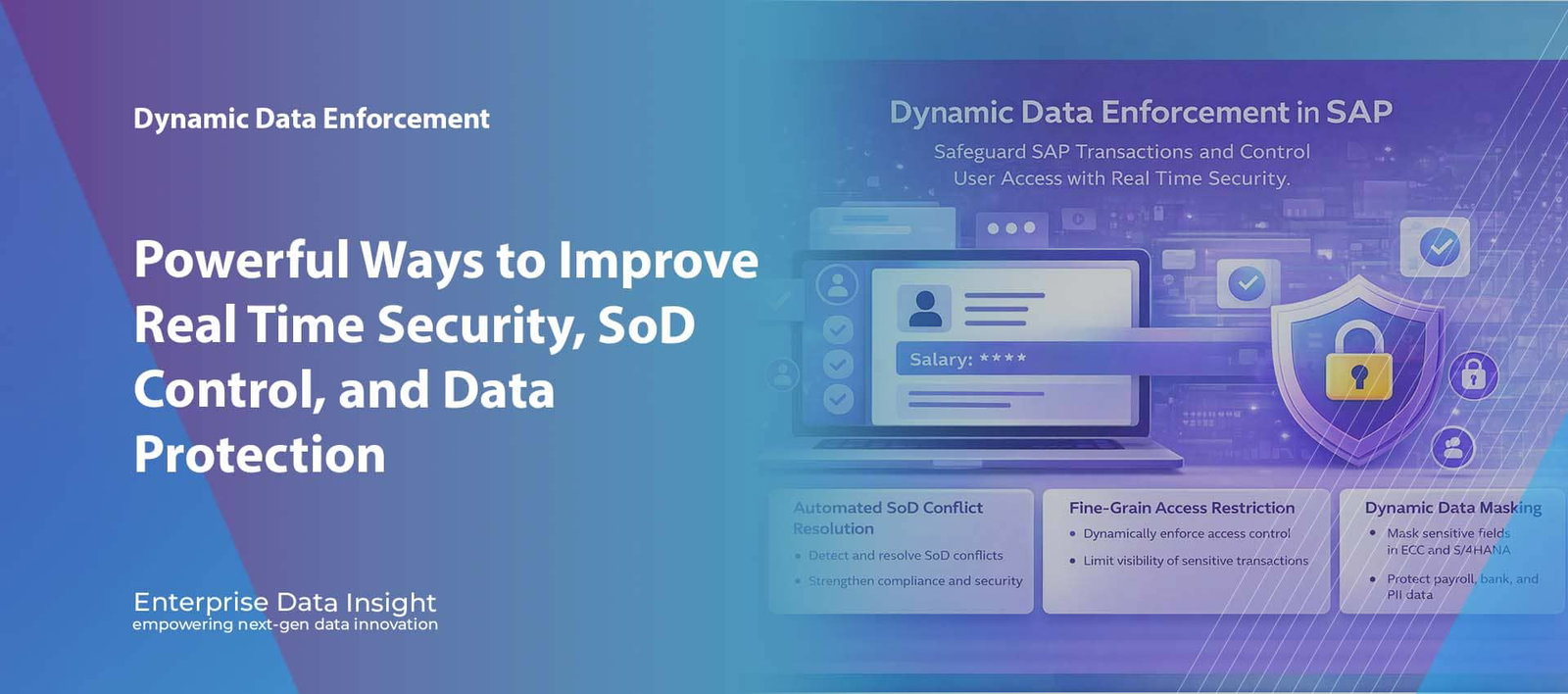
Powerful Ways to Improve Real Time Security and Reduce Risk
Dynamic Data Enforcement in SAP: 7 Powerful Ways to Improve Real Time Security, SoD Control, and Data Protection
Dynamic Data Enforcement in SAP gives organisations a single security platform to reduce access risk, business process exposure, and data privacy gaps across both ECC and S/4HANA. Dynamic Data Enforcement in SAP replaces slow, fragmented, and reactive control models with continuous policy enforcement, behavioural visibility, context-aware decisioning, and fine-grain runtime control at the exact moment a user attempts to access or process data. This creates a stronger operating model for zero trust access, least privilege, policy orchestration, segregation of duties governance, transaction surveillance, and dynamic data protection at enterprise scale.
Before
- Static roles with accumulated access debt
- Manual SoD analysis and delayed remediation
- Periodic reviews with weak follow through
- Sensitive fields visible to broad user groups
During
- Continuous transaction monitoring and policy checks
- Context-aware runtime decisioning
- Dynamic masking and fine-grain access restriction
- Automated certification and lifecycle control
After
- Lower access exposure and cleaner entitlements
- Reduced business process risk and audit findings
- Stronger privacy controls for regulated data
- Higher confidence in SAP security operations
Dynamic Data Enforcement in SAP Matters for Modern SAP Security
Dynamic Data Enforcement in SAP matters because most SAP environments still rely heavily on traditional role based access control, supported by scheduled reviews and retrospective audit checks. That model was built for a very different era. Today’s SAP landscape is more distributed, more integrated, more exposed to internal and external threat vectors, and far more dependent on timely governance decisions. ECC and S/4HANA systems process payroll, finance, procurement, vendor, customer, and operational data that cannot simply be secured by broad roles and occasional certification exercises.
The problem is not only who has access. The deeper problem is how that access is used, when it is used, what data is being viewed, whether the user context is appropriate, and whether the transaction path introduces fraud, privacy, or control risk. Dynamic Data Enforcement in SAP closes that gap by pushing governance closer to runtime execution. It gives security and compliance teams the ability to enforce policies continuously rather than discovering exposure long after the fact.
Dynamic Data Enforcement in SAP turns SAP security from a static entitlement model into a live control framework built around continuous monitoring, policy orchestration, least privilege, runtime masking, and adaptive governance.
What the Dynamic Data Enforcement in SAP Security Platform Includes
Enterprise Data Insight positions Dynamic Data Enforcement in SAP as a consolidated security platform, not a fragmented collection of point controls. The platform combines multiple control domains that are usually handled separately, enabling a more coherent and more scalable governance architecture across the SAP estate.
Automated SoD Conflict Resolution
Traditional segregation of duties control is often retrospective, spreadsheet driven, and too slow to reduce active business risk. Dynamic Data Enforcement in SAP introduces automated SoD detection and response so that high-risk combinations can be identified, escalated, and remediated with greater speed and precision. This improves preventive control coverage across finance, procurement, vendor maintenance, payments, master data, and other sensitive process chains.
Automated Periodic Review of Access Certifications
Access certification should not be a disconnected compliance exercise. The platform automates recurring certification workflows, improving entitlement visibility, reviewer accountability, decision traceability, and audit readiness. It helps organisations challenge legacy access, remove entitlement drift, and maintain stronger alignment between business responsibility and granted permissions.
Automated User Provisioning and De-Provisioning Across Applications
Manual user lifecycle management creates inconsistency, delay, and orphaned access. Dynamic Data Enforcement in SAP automates provisioning and de-provisioning across application boundaries, helping to enforce joiner, mover, and leaver controls with stronger consistency. This is especially valuable in complex enterprise environments where SAP access must stay synchronised with business roles, organisational changes, and connected platforms.
Continuous Transaction Monitoring and Fine-Grain Access Control
The platform continuously monitors SAP transactions to identify suspicious, abnormal, or policy-sensitive activity as it happens. Combined with fine-grain access control, this enables highly targeted enforcement down to the transaction, field, object, or contextual level. Security teams can therefore move beyond coarse role restrictions and apply control logic that is more intelligent, more adaptive, and more aligned with actual business risk.
Dynamic Data Masking of Any SAP Field in ECC and S/4HANA
Sensitive data protection in SAP is often binary. Either a user sees the full value or they are blocked entirely. Dynamic Data Enforcement in SAP changes that model by allowing controlled visibility of specific fields based on role, context, policy, and business need. Any SAP field can be masked dynamically in ECC and S/4HANA, which is critical for protecting payroll, bank data, personally identifiable information, health related data, commercial pricing, and other sensitive values.
Single Platform Governance Model
The real strength of the platform is consolidation. Instead of operating separate tools for SoD, access reviews, lifecycle management, monitoring, and masking, organisations can enforce security through a single control framework. That reduces control fragmentation, improves operational efficiency, and creates stronger alignment between security operations, audit, compliance, and SAP application teams.
How Dynamic Data Enforcement in SAP Delivers Technical Architecture and Control Depth
From a technical standpoint, Dynamic Data Enforcement in SAP introduces an enforcement layer that can evaluate access requests, user actions, and data exposure paths in real time. This is where the platform becomes materially different from standard static authorisation approaches. Instead of evaluating only whether a user technically has an authorisation object, the platform can incorporate dynamic policy logic that considers the transaction being executed, the business context, the sensitivity of the data involved, the process risk, and the intended outcome.
That creates a richer control plane for SAP security. Security policies become more granular. Data visibility can be reduced without disabling process participation. High-risk transactions can be monitored continuously. Business process abuse can be identified earlier. Entitlement reviews become more actionable because they are supported by better operational intelligence. In practical terms, this means the platform helps move SAP security towards principles such as zero trust, micro-segmentation of access, runtime governance, adaptive control enforcement, and data-centric protection.
Technical outcomes delivered by the platform
Dynamic Data Enforcement in SAP creates measurable value by tightening operational control without forcing businesses to compromise system usability, process continuity, or user productivity.
How Dynamic Data Enforcement in SAP Strengthens Data Security in ECC and S/4HANA
Data security in SAP is not only about preventing unauthorised entry. It is about limiting unnecessary visibility, reducing privilege abuse, protecting sensitive fields, and controlling how business critical information is used throughout a process. Dynamic Data Enforcement in SAP is especially powerful because it works at the point where data exposure becomes real. That is where monitoring, masking, and fine-grain access controls become operationally meaningful.
In ECC and S/4HANA, many of the highest-value datasets are deeply embedded in ordinary transactions. HR master data, payroll values, supplier banking details, customer commercial terms, payment instructions, pricing data, and financial postings may all sit within business processes that legitimate users must still perform. Blocking access entirely is often not practical. Dynamic Data Enforcement in SAP allows organisations to preserve business functionality while reducing the visibility of the most sensitive elements within those processes.
- mask salary and payroll fields for users who do not require full visibility
- limit exposure of vendor bank data and customer commercial details
- reduce insider risk through continuous transaction surveillance
- enforce privacy safeguards without creating process disruption
- support stronger control over privileged and high-risk access paths
The strongest SAP security model is not the one that blocks everything. It is the one that allows the business to operate while dynamically controlling what each user can see, do, and extract at the moment of access.
A Practical SAP Example
Consider a payroll and HR administration scenario. A group of HR users may need access to employee records, organisational data, and master information to perform day to day activities. However, not every HR user should see salary amounts, bank details, tax information, or compensation changes. In a conventional SAP security model, these users may end up sharing a broad role that exposes more data than necessary simply because the process requires access to the broader transaction.
With Dynamic Data Enforcement in SAP, that model becomes much tighter. The same HR process can continue, but salary fields can be dynamically masked for general administrators while remaining fully visible to the payroll team or designated approvers. If a user attempts an unusual transaction path, that activity can be monitored in real time. If a high-risk combination emerges, SoD controls can trigger investigation or remediation. If an employee leaves the organisation or changes function, automated de-provisioning can reduce the lingering entitlement risk immediately.
This is the essence of a data-centric control strategy. Business continuity is preserved, but risk is materially reduced through policy driven runtime enforcement rather than broad static trust.
Why This Matters for Security Leaders, SAP Teams, and Compliance Stakeholders
For CIOs, CISOs, SAP security leads, and compliance owners, Dynamic Data Enforcement in SAP provides more than tactical control. It offers a strategic platform for reducing the operational burden of fragmented governance while simultaneously improving the maturity of security control execution. Instead of waiting for audit cycles, spreadsheet reviews, and manual SoD clean up, teams gain a more continuous and more resilient operating model for SAP security.
This matters because modern enterprises are under pressure from every direction. Regulatory expectations are rising. Privacy obligations are broader. Internal control scrutiny is higher. Business users expect faster access. Transformation programmes demand tighter governance. SAP environments are more interconnected than ever. A platform that can reduce access risk, automate governance activity, protect sensitive fields, and monitor transaction behaviour in real time becomes a significant force multiplier for security and compliance teams.
Dynamic Data Enforcement in SAP Conclusion
Dynamic Data Enforcement in SAP gives organisations a far more advanced security posture than static authorisation models can provide on their own. By combining automated SoD conflict resolution, periodic access certification, cross-application provisioning and de-provisioning, continuous transaction monitoring, fine-grain access control, and dynamic field-level masking, the platform reduces both access risk and business process risk through a single integrated control framework.
For enterprises running ECC and S/4HANA, the opportunity is clear. Security can become more intelligent, more adaptive, more data-centric, and far more aligned to real operational risk. That is exactly where Enterprise Data Insight positions Dynamic Data Enforcement in SAP: as a unified SAP security platform built to improve governance, protect sensitive data, and help organisations move from reactive control to continuous enforcement.
For broader context, explore SAP S/4HANA, review SAP Governance, Risk and Compliance, and read more about modern privacy expectations at GDPR.eu.