


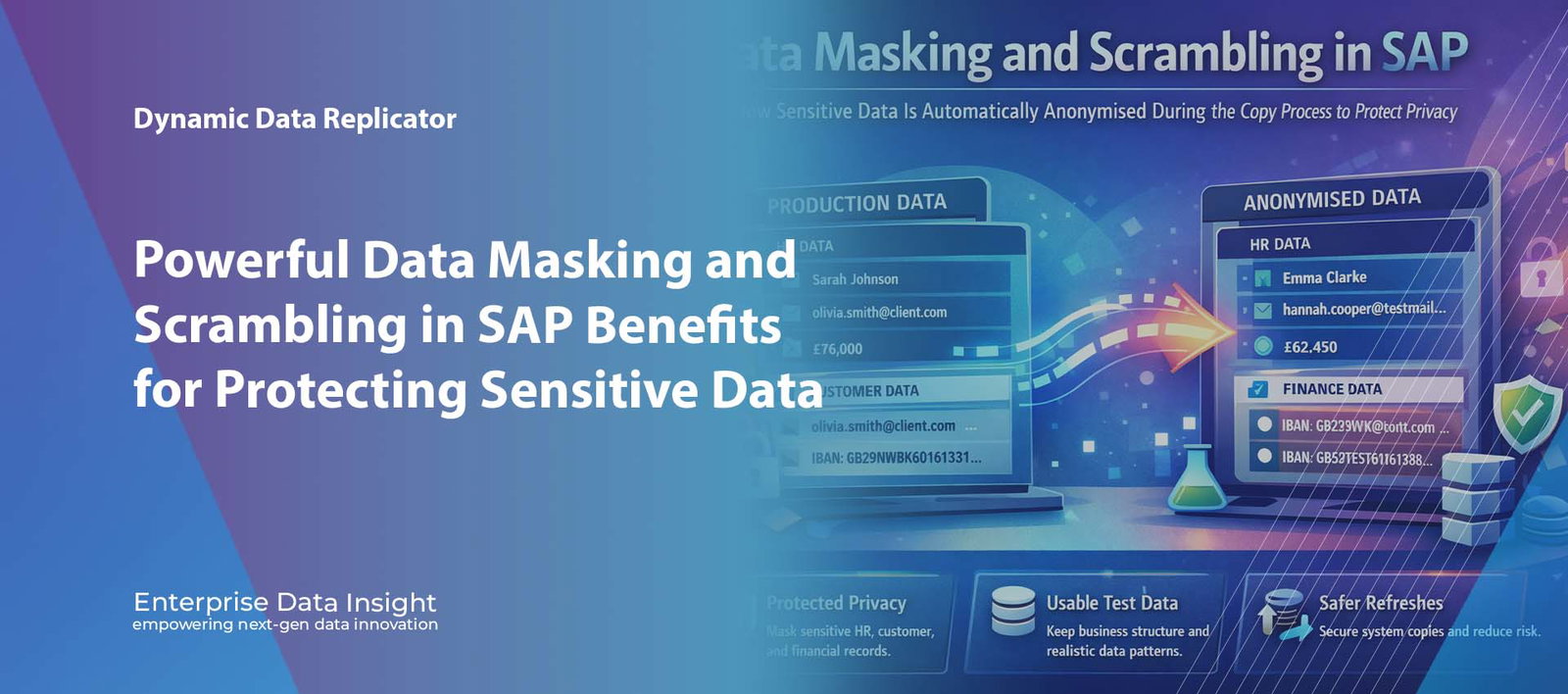
Powerful Data Masking and Scrambling in SAP Benefits for Protecting Sensitive Data
Data Masking and Scrambling in SAP: How Sensitive Data Is Automatically Anonymised During the Copy Process to Protect Privacy
Data Masking and Scrambling in SAP are essential for organisations that need realistic business data in non production environments without exposing live employee records, customer information, vendor details, payroll values, contact data, or financial identities. During a copy, refresh, or selective replication process, sensitive information can be anonymised automatically so project teams can test, train, validate, and innovate safely. Dynamic Data Replicator supports this approach by embedding Data Masking and Scrambling in SAP directly into the copy process, protecting privacy while preserving business structure, referential integrity, and technical usability.
What this solves technically
DDR helps SAP teams anonymise sensitive values during the copy process, reduce privacy risk in non production systems, and keep data technically useful for realistic business testing.
Data Masking and Scrambling in SAP provide a practical and secure way to use realistic business data in non production systems without exposing live personal or confidential information. Instead of copying raw production records into development, QA, sandbox, or training environments, sensitive fields can be anonymised automatically during the copy process. This means teams still work with meaningful data, but the privacy risk of exposing real employees, customers, vendors, or financial identities is significantly reduced.
Why Unmasked SAP Copies Create Privacy and Security Risk
In many SAP landscapes, production data remains the most useful source of test data because it reflects genuine business relationships, process flows, and organisational complexity. However, copying production data into non production systems without protection introduces serious privacy and security risks. These target systems often have broader access, lower controls, and wider visibility across technical teams, project teams, consultants, and support users.
This creates a situation where data that was originally controlled in production becomes far more exposed outside production. HR records may include names, addresses, dates of birth, payroll values, tax identifiers, and personal contact details. Customer records may include names, emails, phone numbers, delivery addresses, and account histories. Financial data may expose bank details, payment references, and commercially sensitive transactions.
The result is predictable:
- sensitive information is copied into systems where it is not needed in live form
- non production environments become an avoidable privacy risk
- security teams must manage larger exposure surfaces
- project teams test against live personal data unnecessarily
- governance and compliance pressure increase across the landscape
In SAP, this is not simply a compliance concern. It is also an operational design problem. If sensitive data can be anonymised during the copy process, there is no reason for raw live values to appear in downstream systems at all.
The safest SAP test data is not data that is hidden after the copy. It is data that arrives in the target system already protected, already anonymised, and already fit for secure use.
Why Data Masking and Scrambling Matter in SAP Landscapes
Data masking and scrambling matter because SAP systems are deeply interconnected. Test scenarios rarely depend on isolated rows from one table. They depend on business objects, document flow, organisational context, master data dependencies, transactional history, and related records across modules. If organisations simply delete sensitive fields or remove too much data, the test value drops sharply. If they copy everything raw, the privacy risk becomes unacceptable.
The answer is controlled anonymisation. This means sensitive values are changed while the technical and business usefulness of the dataset is retained. A name can still look like a name. An email address can still behave like an email address. A bank account number can still match expected structure. A business partner can still remain linked across related objects. Good masking protects the identity without breaking the process.
This matters especially for SAP teams that rely on realistic testing for integrations, end to end processes, user acceptance, support simulations, and training. The stronger the dataset quality, the better the downstream validation. The stronger the masking quality, the lower the privacy exposure.
Technical weaknesses of unmasked copies
- expose live personal data in non production systems
- increase privacy and security risk unnecessarily
- create governance concerns during refresh cycles
- expand the scope of sensitive data access
- make downstream systems harder to justify from a privacy perspective
Practical value of masking and scrambling
- protect identities while keeping data useful
- support realistic end to end testing
- reduce exposure of HR and customer information
- improve trust in non production data operations
- strengthen the security posture of SAP refresh activity
How Data Masking and Scrambling Work During the Copy Process
The most effective approach is to apply masking and scrambling rules during the copy, refresh, or replication activity itself. Instead of moving raw production values first and cleaning them afterwards, the transformation happens as part of the controlled data movement process. This reduces risk and simplifies operations because the target environment receives protected data from the beginning.
For example, employee names may be replaced with realistic fictional alternatives. Customer email addresses may be converted into safe test addresses. Phone numbers may be altered while preserving expected formatting. Payroll values may be shifted. Financial identifiers may be scrambled so the original details are no longer visible, while the record remains technically usable.
The quality of the outcome depends on preserving business usability. This means the masked values should still support realistic testing. It is not enough to anonymise the data. The data must still work for process validation, application behaviour, downstream checks, and user testing.
DDR supports this model by integrating scrambling and masking into SAP Test Data Management activities so that copied data remains useful but safer by design.
Practical Examples of Sensitive Data Protection in SAP
The strongest way to understand the value of masking is to look at real SAP scenarios. Sensitive information appears in many business areas, and the masking rules need to reflect the nature of the data being protected.
- HR records may include names, dates of birth, salary values, tax references, and contact information
- customer master data may include names, emails, addresses, and communication details
- vendor records may contain contact details, banking information, and payment identities
- business partner objects may need consistent masking across linked records and transactions
- training environments may need realistic data without exposing real people or live organisations
Detailed Example: HR Data Masking During SAP Copy
HR data is one of the most sensitive categories in any SAP landscape. Employee master data can contain names, dates of birth, addresses, personal contact information, payroll values, tax identifiers, bank details, and emergency contact records. When production HR data is copied into non production systems without protection, the privacy exposure can become significant very quickly.
A stronger approach is to apply masking rules as part of the copy process. Names can be replaced with realistic but fictitious alternatives. Dates of birth can be shifted within a controlled range. Personal email addresses can be replaced with test addresses. Salary values can be adjusted so the structure remains useful for testing but the original value is no longer exposed. Bank details and national identifiers can be scrambled entirely.
Example 1: HR personal data masking
Employee information can be anonymised so personal identities are protected before records reach QA, development, or training systems.
Before:
Employee Name: Sarah Johnson
Date of Birth: 14/03/1988
Email: sarah.johnson@company.com
Salary: £76,000
NI Number: QQ123456C

After:
Employee Name: Emma Clarke
Date of Birth: 21/07/1987
Email: emma.clarke@testmail.local
Salary: £62,450
NI Number: XX908172P
Example 2: HR address and banking masking
Sensitive address and payroll banking data can be transformed while the record remains useful for process and payroll testing.
Before:
Address: 28 Brook Lane, Solihull
Bank Account: 33441256
Sort Code: 20-44-55

After:
Address: 17 Willow Close, Bristol
Bank Account: 88210549
Sort Code: 66-10-41
Detailed Example: Customer and Business Partner Data Masking
Customer and business partner records often contain names, contact information, addresses, account numbers, and relationship data used across sales, service, distribution, and support processes. If this data is copied raw into testing environments, real customer identities are exposed when there is no business need for them to remain visible.
Good data masking protects the individual while preserving process realism. A sales order scenario still needs a customer record, address structure, contact channel, and sometimes communication history. The objective is not to destroy the dataset. The objective is to keep the record usable without keeping the original live identity.
Example 3: Customer identity masking
Customer records can be scrambled while maintaining realistic structures for order to cash, support, or service testing.
Before:
Customer Name: Olivia Smith
Email: olivia.smith@client.com
Phone: +44 7700 123456
Address: 12 Green Street, London

After:
Customer Name: Hannah Cooper
Email: hannah.cooper@testmail.local
Phone: +44 7700 884521
Address: 42 River Close, Birmingham
Example 4: Business partner consistency
The same customer or partner can remain consistently masked across related records, transactions, and linked tables.
Original Customer: CUST100045
Original Name: Robert Adams

Masked Across Related Records:
Customer: CUST100045
Masked Name: Daniel Foster
Masked Email: daniel.foster@testmail.local
Detailed Example: Financial and Vendor Data Scrambling
Financial and vendor data often contains highly sensitive information such as bank details, account numbers, payment references, vendor names, remittance information, and invoice relationships. In testing environments, the process logic may still be needed, but the original financial identities should not remain visible.
Scrambling ensures the format, length, and structural usefulness remain intact while the live values are replaced. This is especially important in payment testing, vendor reconciliation scenarios, and finance validation flows where realistic data patterns matter, but real payees or bank identities do not.
Example 5: Financial identity scrambling
Banking and payment information can be transformed while document flow remains useful for finance testing.
Before:
IBAN: GB29NWBK60161331926819
Account Number: 45671234
Payee: Jane Miller
Reference: INV-48392

After:
IBAN: GB52TEST60161388451273
Account Number: 91386420
Payee: Claire Hudson
Reference: INV-48392-T
Example 6: Vendor record masking
Vendor details can be scrambled while preserving the record for procurement and invoice testing.
Before:
Vendor Name: Apex Electrical Ltd
Contact: Mark Benson
Phone: +44 161 555 0199
Bank Key: 11223344

After:
Vendor Name: Nova Technical Ltd
Contact: Liam Carter
Phone: +44 161 555 8802
Bank Key: 77441103
Before and After Masking Overview
The examples below show how different categories of sensitive data can be transformed during the copy process while still remaining useful for functional, technical, and business testing.
| Data Type | Original Value | Masked Value | Purpose |
|---|---|---|---|
| Employee Name | Sarah Johnson | Emma Clarke | Protect personal identity |
| Customer Email | olivia.smith@client.com | hannah.cooper@testmail.local | Keep realistic email pattern |
| Phone Number | +44 7700 123456 | +44 7700 884521 | Preserve format without exposing live contact |
| Salary | £76,000 | £62,450 | Protect confidential compensation values |
| IBAN | GB29NWBK60161331926819 | GB52TEST60161388451273 | Scramble live financial identity |
Technical Benefits of Built In Masking and Scrambling
The strongest advantage of built in masking is that it improves the technical quality of the refresh model itself. Instead of treating data privacy as a separate clean up step, it becomes part of the controlled data movement process. This reduces process complexity and lowers the chance of raw sensitive data being exposed in transit or after load.
From a technical perspective, this brings multiple benefits:
- reduced privacy exposure in development, QA, training, and sandbox systems
- stronger control over sensitive data movement across the SAP landscape
- realistic and usable datasets for testing without disclosing live identities
- consistent anonymisation across related records and business objects
- better alignment between SAP Test Data Management and security expectations
- less manual effort after a refresh or selective copy process
This matters to security teams, testing teams, SAP delivery leads, and platform owners alike. The more controlled the masking process is, the safer and more efficient the entire refresh model becomes.
Where masking and scrambling create measurable value
The value is not only compliance related. It comes from lower exposure, safer testing, stronger operational control, and reduced dependence on raw production data in non production systems.
Why This Matters for Modern SAP Privacy Strategy
Modern SAP data strategies must address both usability and protection. It is no longer enough to move data quickly or selectively. Organisations also need confidence that copied data is safe to use in downstream environments. This is particularly important where HR data, customer information, or financial records are involved.
Data protection principles increasingly emphasise minimisation, controlled use, and secure handling of personal information. SAP teams that continue to rely on raw production copies for non production use are likely carrying more exposure than necessary. A stronger model is to combine selective replication, scope control, and built in anonymisation so that the target environment receives only what it needs and only in protected form.
Modern engineering and privacy practices both point in the same direction: realistic data should be made available earlier and more efficiently, but without broad exposure of live sensitive values. For wider context on privacy and secure enterprise delivery, see GDPR guidance, SAP DevOps practices, and SAP Business Technology Platform.
Data Masking and Scrambling in SAP are most effective when sensitive values are anonymised during the copy process itself, so the target environment receives data that is already safe, already usable, and already aligned to secure testing needs.
A Practical SAP Example
Consider an SAP team preparing a training or QA environment for testing an HR or customer related process. Under a traditional model, the team may copy a broad production dataset into the target system and then attempt to manage the privacy risk afterwards. This creates extra effort and leaves a period where raw sensitive data exists in the target environment.
With integrated masking and scrambling, the same environment can be prepared using realistic business scope while sensitive information is protected as part of the transfer itself. HR records remain structurally useful, customer data remains process relevant, and financial data remains technically valid for testing, but the real identities behind those values are no longer exposed.
That is the core practical value of Data Masking and Scrambling in SAP. It reduces the distance between realistic testing and secure testing. Instead of choosing between one or the other, organisations can achieve both together.
Why This Topic Matters for SAP Test Data Management Strategy
Many organisations still view data masking as a secondary activity rather than a core capability within SAP Test Data Management. In reality, it directly affects security posture, privacy risk, refresh quality, system usability, and organisational trust in non production operations.
A modern SAP Test Data Management strategy should support:
- selective replication instead of broad refresh dependency where possible
- built in masking and scrambling for sensitive data categories
- preservation of business relationships and referential logic
- safer training, QA, and development environments
- better balance between data realism and data protection
When organisations embed Data Masking and Scrambling in SAP into their operational refresh and copy model, they strengthen both technical delivery and privacy governance at the same time.
Conclusion
Data Masking and Scrambling in SAP are no longer optional for organisations that want realistic testing without unnecessary privacy exposure. When sensitive information is anonymised during the copy process, teams can work with useful business data while reducing the risk of exposing live employee, customer, vendor, and financial identities across non production systems.
Dynamic Data Replicator supports this model by enabling selective replication, realistic business scope, referential consistency, and built in data masking and scrambling as part of the SAP Test Data Management process. That helps organisations improve security, reduce manual effort, and maintain meaningful downstream environments for validation, support, and training.
If your SAP landscape still relies on copying raw production data into development, QA, sandbox, or training systems, the operating model is likely carrying unnecessary risk. A stronger, safer, and more modern approach begins with integrated masking, controlled replication, and secure SAP Test Data Management.
Explore Dynamic Data Replicator to see how Enterprise Data Insight helps SAP teams deliver safer, more controlled, and more useful non production environments.