


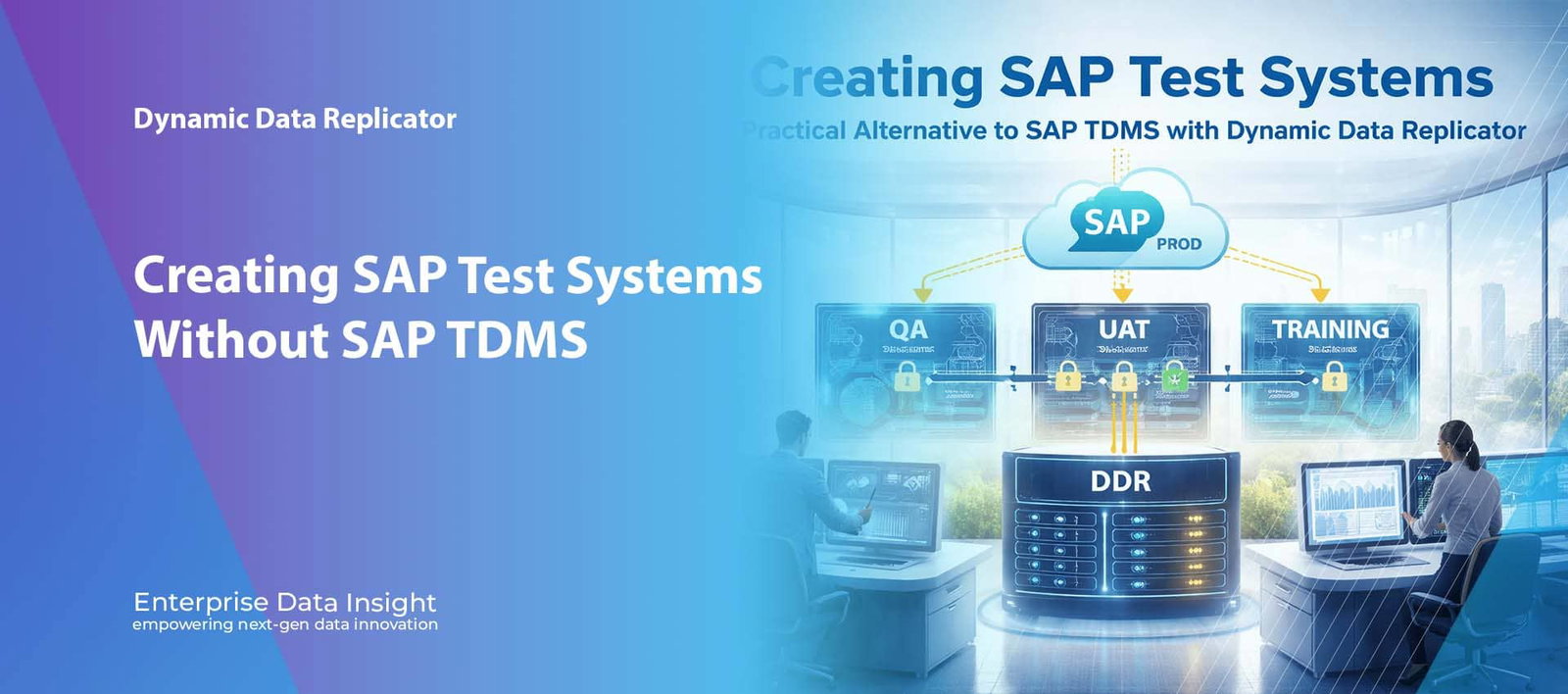
Creating SAP Test Systems

Creating SAP Test Systems: a practical alternative to SAP TDMS
Creating and maintaining SAP test systems has become significantly more complex over the last decade. Larger data volumes, stricter regulatory requirements, shorter delivery cycles, and the shift to S 4HANA have exposed the limitations of traditional approaches. SAP TDMS was introduced to address these challenges, yet it often proves heavyweight, infrastructure intensive, and difficult to operationalise at scale. This article explains a modern alternative model and how Dynamic Data Replicator provides a flexible, cost effective, and sustainable approach to non production system creation.
Why Creating SAP Test Systems is no longer straightforward
Historically, creating a SAP test system involved a client copy or system copy, followed by manual adjustments and occasional data clean up. That approach no longer scales. Modern SAP landscapes include large historical datasets, integrated systems, external users, and sensitive personal data subject to GDPR and internal security controls.
Test systems must now be realistic, secure, refreshable, and auditable. They must support frequent rebuilds, parallel testing streams, and selective data scope. When these requirements are not met, test systems become expensive to operate and unreliable as delivery tools.
The limitations of SAP TDMS for test system creation
SAP TDMS is often implemented as a project rather than an operational capability. It typically requires dedicated servers, additional landscape components, and specialist expertise to configure and execute. As a result, organisations tend to use it infrequently, which limits the ability to refresh test systems regularly.
In many cases, TDMS driven systems still end up oversized because scoping is hard to refine over time. Masking is often treated as a separate step, and repeatability across refresh cycles can be challenging to maintain. These limitations become particularly visible during S 4HANA programmes, where faster iteration, smaller systems, and stronger governance are essential.
A different approach to creating SAP test systems
A modern alternative treats test system creation as a repeatable, controlled process embedded directly within SAP, rather than a standalone project or external toolset. This model is based on four core principles.
Create smaller, faster systems with scope matched to the test objective.
Scramble sensitive values during replication, before they reach the target.
Define scope and rules once, then execute consistently across refresh cycles.
Record what moved, when it moved, how it was protected, and who ran it.
Selective data replication instead of full copies
Rather than copying entire production datasets, a selective approach replicates data by business object, organisational structure, and time periods. Test systems are created with relevant and realistic data while excluding unnecessary history.
This results in smaller systems that are easier to refresh and cheaper to operate. It also supports different environment types such as UAT, regression, training, and integration testing, each with the right data scope. Dynamic Data Replicator enables this selectivity directly within SAP, avoiding additional infrastructure.
Built in data scrambling for secure test systems
Production data frequently contains personal, payroll, financial, and commercially sensitive information. Unlike approaches where masking is applied after copying, Dynamic Data Replicator applies scrambling during replication. Sensitive fields are anonymised before they reach the target system, making test systems secure by default.
This reduces compliance risk and supports a preventative control under GDPR and internal security frameworks while preserving functional integrity for realistic testing.
Repeatable test system creation and refresh
A major weakness of project based approaches such as SAP TDMS is the lack of operational repeatability. A modern alternative treats test system creation as a repeatable operation. Scope definitions, scrambling rules, and execution logic are defined once and reused consistently. Systems can be rebuilt or refreshed on demand, supporting agile delivery and parallel testing streams.
Define scope
Business objects, organisational filters, and time periods aligned to the environment purpose.
Apply protection
Scrambling rules applied during replication so data arrives protected by default.
Execute consistently
Repeatable refresh across QA, UAT, training, and regression without reinvention.
Keep evidence
Logs and audit detail to support security, governance, and operational control.
Governance and auditability by design
Creating SAP test systems is no longer just a technical activity. Security teams, auditors, and regulators expect evidence of how data is selected, protected, and refreshed. A strong alternative to SAP TDMS provides built in governance that records what data was copied, when it occurred, how it was scrambled, and who initiated the process.
Dynamic Data Replicator maintains this audit trail within SAP, reducing reliance on manual documentation and strengthening overall control.
Why Creating SAP Test Systems is no longer straightforward
A SAP native, selective replication approach provides greater flexibility, lower operational cost, and stronger security than TDMS driven projects. It supports frequent refreshes, smaller systems, and consistent governance across the landscape.
Dynamic Data Replicator, developed by Enterprise Data Insight, enables controlled test system creation directly within SAP, without additional infrastructure and without compromising security or compliance. As SAP landscapes evolve, organisations that move beyond heavyweight TDMS style approaches will be better positioned to deliver faster, safer, and more predictable outcomes.
Tip: Share your target environment types, refresh frequency, and data scope needs. We will recommend a selective replication and scrambling strategy.