


Automated Data Provisioning in SAP
Automated Data Provisioning in SAP: How DDR Delivers Masked, Subsetted, and Ready to Use Test Data Faster
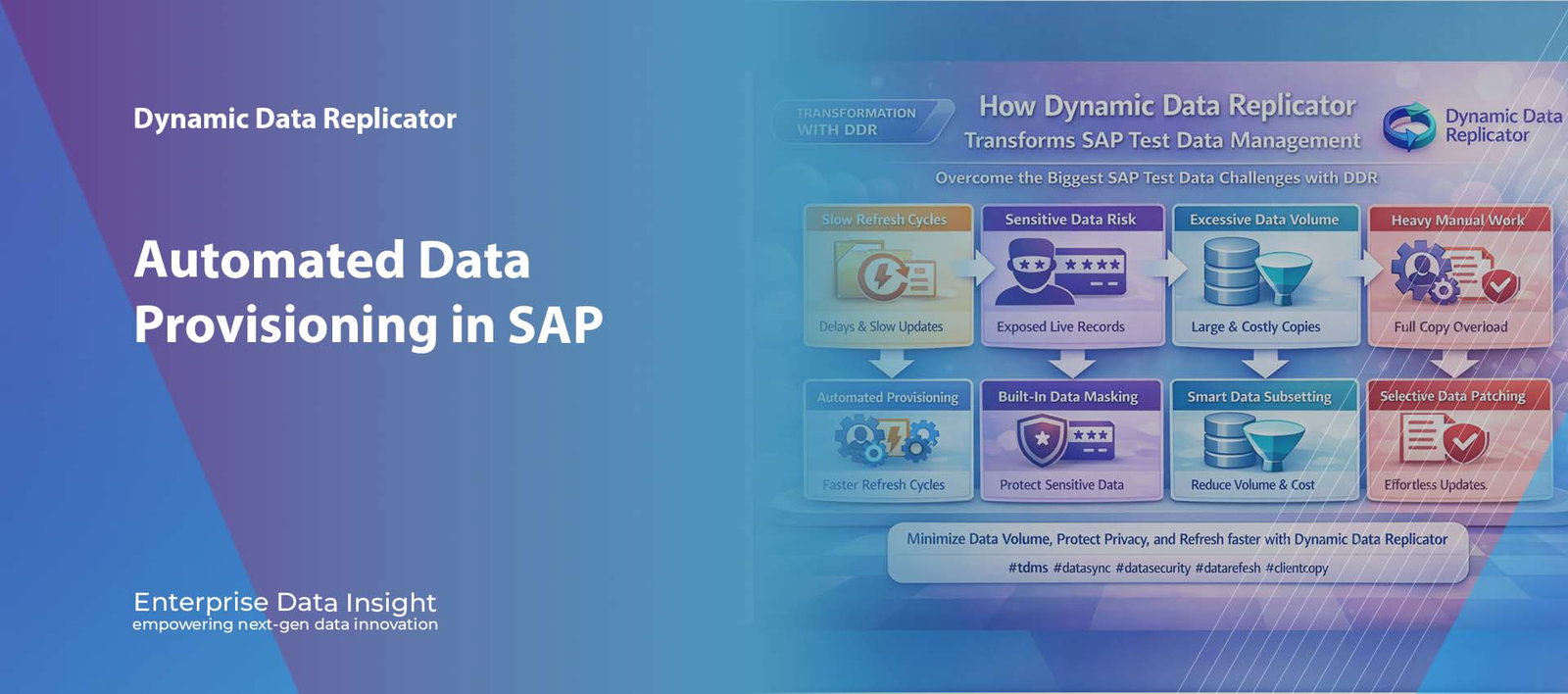
Automated Data Provisioning in SAP is becoming essential for organisations that need faster test readiness, smaller non production systems, and better control over sensitive information. Traditional refresh methods often depend on heavy full copies, manual clean up, delayed masking, and large datasets that do not reflect the actual business scenario being tested. Dynamic Data Replicator changes this model by automating the delivery of relevant SAP data, applying masking during movement, supporting subsetting to reduce volume, and enabling selective patching where full refreshes are unnecessary.
What this solves technically
DDR automates provisioning, integrates masking, supports data subsetting, and enables selective patching so SAP teams can deliver better non production environments with less delay and less risk.
Automated Data Provisioning in SAP is about delivering the right dataset into the right environment without the delay and overhead of repeated full system copies. In many SAP landscapes, test environments depend on manual refresh processes that are slow, operationally heavy, and difficult to align with agile delivery timelines. When provisioning is automated, SAP teams can improve refresh speed, reduce manual effort, and deliver more relevant data to development, QA, sandbox, and training systems.
Why Traditional SAP Data Provisioning Slows Delivery
Traditional SAP test data preparation often relies on copying large production datasets into non production systems. While this can provide realism, it also creates problems. The refresh takes longer, the target system becomes larger, sensitive data is copied more widely than necessary, and manual clean up is often required after the copy is complete.
This slows down project teams and makes every test cycle more expensive than it needs to be.
- long refresh cycles delay development and QA work
- large target systems consume more storage and support effort
- unnecessary business data is moved for small use cases
- sensitive records can be exposed in non production
- manual masking and clean up increase operational effort
The ideal SAP provisioning model does not move everything. It moves only what is needed, protects it in flight, and makes it usable faster.
What Automated Data Provisioning in SAP Changes
Automated provisioning changes the operating model from heavy refresh dependency to controlled, repeatable delivery. Instead of treating every test cycle as a full environment event, SAP teams can provision selected data on demand and align data movement more closely to project need.
This means organisations can:
- deliver relevant data more quickly
- reduce refresh frequency and scale
- avoid unnecessary copy activity
- support better test readiness across teams
Built In Data Masking During Provisioning
One of the most important advantages of a modern provisioning approach is that masking can be applied during the delivery process itself. Sensitive values do not need to land raw in the target system first. Instead, they can be anonymised in flight so the non production environment receives protected data from the start.
This is especially important for:
- HR master and payroll related records
- customer and business partner information
- vendor and financial data
- personally identifiable or commercially sensitive values
Why in flight masking matters
- reduces privacy exposure immediately
- removes post refresh clean up dependency
- keeps target systems safer by design
- supports compliant SAP test data delivery
What masking preserves
- technical structure of the dataset
- realistic field formats and behaviours
- business usability for testing
- referential integrity across related objects
Data Subsetting for Smaller and Faster Target Systems
Data subsetting is a core part of efficient SAP provisioning. Not every project or test scenario needs a full production sized copy. In many cases, only a business relevant slice of data is required. Subsetting enables SAP teams to provision just the scope needed for the task, which helps reduce target system growth and improve performance.
This matters because smaller target datasets are easier to manage, faster to refresh, and more practical for non production use.
- reduce unnecessary storage demand
- improve refresh speed
- deliver focused data for specific use cases
- support leaner development and QA systems
Automated Patching and Selective Refresh
Full refreshes are not always necessary. In many SAP projects, the team only needs to update a selected object, a particular business slice, or a defined set of records. Automated patching allows this type of targeted update without forcing the entire target environment to be recreated.
This brings practical benefits for agile delivery and continuous testing because teams can update what matters rather than waiting for another large refresh event.
- refresh selected business objects only
- reduce disruption to ongoing testing
- support faster turnaround between cycles
- improve flexibility in non production management
Where DDR creates measurable value
The value of automated provisioning is not just speed. It comes from delivering smaller, safer, and more relevant SAP data environments with less waste and less manual effort.
A Practical SAP Example
Imagine a team working on a customer service and finance related test cycle. Under a traditional approach, the team may request a broad refresh, wait for scheduling, receive a large dataset, and then spend more time masking or cleaning records that are not relevant to the immediate scenario.
With DDR, the team can provision a more focused dataset, apply masking as the data moves, subset only the required scope, and selectively patch the target where updates are needed. This reduces waiting time, keeps the target smaller, and improves confidence that the data is usable and protected.
Automated Data Provisioning in SAP is strongest when it combines speed, selective scope, built in protection, and the ability to refresh intelligently without depending on full copies every time.
Why This Matters for SAP Test Data Management
SAP Test Data Management is no longer just about moving data between systems. It is about controlling how data is provisioned, protected, reduced, and refreshed so that business teams get realistic data without unnecessary operational burden.
A stronger SAP Test Data Management strategy should support:
- automated provisioning instead of manual dependency
- masking built into the transfer process
- subsetting to control volume and cost
- patching to avoid excessive full refreshes
- faster and more practical non production readiness
For broader context, see SAP DevOps practices, explore SAP, and review Dynamic Data Replicator.
Conclusion
Automated Data Provisioning in SAP helps organisations move away from slow, oversized, and risky refresh processes by delivering more relevant data with greater speed and control. When provisioning is combined with built in masking, intelligent subsetting, and selective patching, SAP teams gain safer non production environments, smaller target systems, and much faster readiness for testing and project work.
Dynamic Data Replicator supports this modern operating model by helping SAP teams provision the right data more intelligently while preserving technical usability and protecting sensitive information throughout the process.