


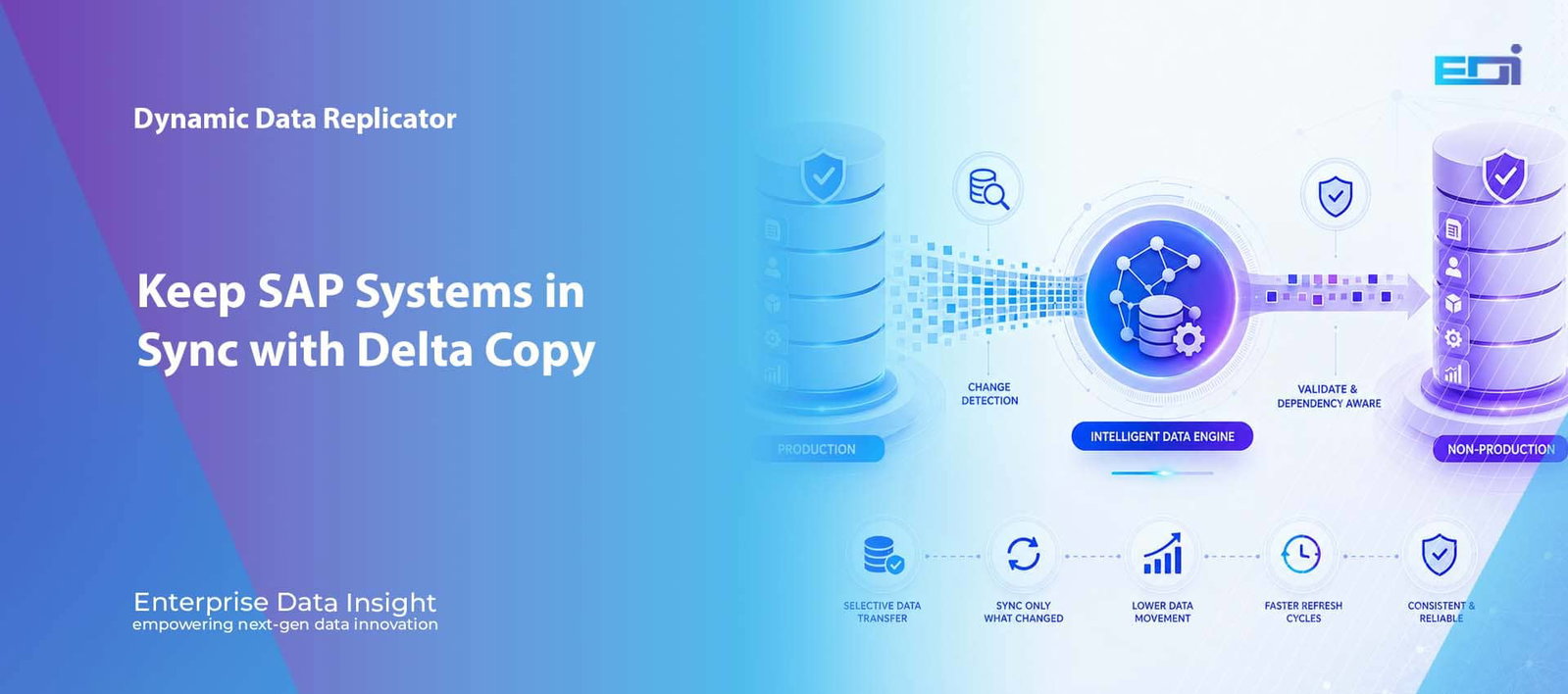
Powerful SAP Delta Replication with DDR: Keep Non-Production Systems in Sync
Powerful SAP Delta Replication with DDR: Keep Non-Production Systems in Sync
SAP delta replication is designed for a very practical problem: once a QA, Test, Development, Training or project environment already exists, why repeatedly move everything just to pick up what changed? DDR Delta Copy takes a baseline-and-delta approach, transferring new and changed data since the last successful run while bringing across the related dependencies required to keep the target usable, consistent and meaningful.
Start from the last successful replication point and identify the new, changed or otherwise relevant delta that must be considered for the next cycle.
Expand the selected delta to the master data, documents, hierarchies, configuration and cross-module dependencies required by the target process.
Apply validation, transformation, security and compliance controls before the selected data is provisioned into the target environment.
Run daily, weekly, monthly, quarterly, yearly or to a project schedule without rebuilding the entire target every time.
What Is SAP Delta Replication?
SAP delta replication is a controlled refresh method that keeps an existing target environment aligned by moving only the data that is new, changed or otherwise required since a defined previous replication point. With DDR Delta Copy, the delta is treated as a business-data set rather than a simple list of changed database rows: related records and dependencies can be included so that the resulting QA, Test, Development, Training or project environment remains coherent and testable.
- DDR Delta Copy is an intelligent extension of Dynamic Data Replicator for repeat refresh cycles.
- SAP delta replication reduces repeat data movement after the initial baseline has been established.
- The technical challenge is not only change detection; it is dependency resolution, preparation, controlled delivery and validation.
- Delta Copy is particularly useful for QA, regression testing, development, defect reproduction, S/4HANA programmes, integration testing, training and project systems.

Why Repeating a Full Refresh Can Become the Wrong Operating Model
A full refresh has a clear purpose. It can create an initial target, reset an environment to a known state or rebuild a system when the entire source footprint genuinely needs to be reproduced. The problem begins when a team uses the same full-copy pattern every time it wants a relatively small amount of new production activity in QA or another non-production system. That is precisely where SAP delta replication becomes an architectural alternative rather than simply another refresh option.
If yesterday’s target is already valid and only a fraction of the source has changed, repeatedly moving the full data footprint creates avoidable work. More data has to be read, transferred, processed, protected and validated. The refresh window can become larger than the actual business need, while test teams continue waiting for a current environment.
SAP delta replication changes that operating model. Instead of treating every refresh as a new beginning, it treats the previous successful run as a trusted point from which the next change set can be calculated, expanded to the required dependencies and delivered as a controlled incremental refresh.
A full refresh asks, “How do we reproduce the target again?” SAP delta replication asks, “What has changed since the last trusted state, what does that change depend on, and what is the minimum complete dataset needed to keep the target current?”
Delta Copy Starts with a Known Baseline, Not with Guesswork
The safest way to think about SAP delta replication is as a sequence of state transitions. The first successful replication establishes a baseline. Each later Delta Copy run then advances that target from one known state to the next by processing the changes that occurred after the previous successful run.
The phrase last successful run matters. A delta boundary should not advance merely because a job started, because a partial execution can otherwise create a gap. If a run fails during preparation, transfer or validation, the next run must still know which business changes have not yet been safely represented in the target.
That makes run-state management a core part of a serious SAP delta replication design. A robust implementation needs a durable record of the source scope, previous successful boundary, current execution, selected objects, transfer result and validation outcome. The exact technical markers used to identify change can vary by SAP object and implementation, but the operating principle remains the same: the delta must be anchored to a trustworthy state.
How DDR SAP Delta Replication Works End to End
The useful part of SAP delta replication is not simply identifying a changed record. The value comes from turning that change into a complete, controlled and repeatable business-data package. The supplied DDR model can be understood as six connected engineering stages: identify, relate, protect, replicate, validate and repeat.
1. Identify the change set
The first stage of SAP delta replication is change detection. DDR Delta Copy identifies the data that is new or changed since the last successful replication and can account for deletion-related change where the selected object and target handling require it. The important point is that this is a scoped technical decision: the system should calculate change inside the approved object and organisational perimeter rather than treating the entire source as one undifferentiated stream.
2. Resolve the relationships
A delta rarely exists in isolation. A new sales order can depend on customer master data, material master data, pricing or organisational structures. A changed delivery can be related to an order, goods movement and billing chain. A financial posting can require master and reference data that may not itself have changed during the same window.
This is why SAP delta replication must be dependency-aware. DDR’s supplied Delta Copy model explicitly includes relevant dependent records, hierarchies, related master data, reference data, connected documents, custom tables, Z/Y objects, configuration and cross-module dependencies. The target needs the context around a change, not just the row that triggered the delta.
3. Prepare and protect the delta
Before data moves, the selected SAP delta replication package should be validated and prepared for the target environment. Depending on the use case, this can include technical checks, transformation, security controls, data masking or scrambling policies, packaging and transport preparation. The objective is to ensure that the delta reaching a non-production system is both technically usable and appropriate for that environment.
4. Replicate through the appropriate delivery channel
The supplied DDR architecture shows multiple delivery options, including RFC, file export/import, web services and flexible integration. That matters because SAP delta replication should fit the customer’s connectivity, security and operational model rather than forcing every landscape through a single route.
5. Validate before advancing the run state
A transfer that completes without an error is not automatically a successful refresh. The target should be checked for expected data, integrity and consistency before the run becomes the new trusted boundary. This protects the next delta cycle from building on an incomplete state.
From Production Change to a Current Non-Production Environment
The second DDR view shows the operating pattern clearly. An initial full copy establishes the target. Later daily, weekly, monthly, quarterly or yearly delta runs process only the data required to move the non-production environment forward, with DDR handling change detection, dependency analysis, data preparation and delivery between source and target.
For SAP delta replication, the schedule is not the architecture; it is a policy applied to the architecture. A QA environment used for continuous regression testing may need a daily cadence, while a training system may need controlled monthly updates and a long-lived project reference system may only need periodic alignment. The same delta model can support very different operating rhythms.
SAP Delta Replication Is More Than Generic Database Change Data Capture
It is tempting to compare every delta mechanism with database change data capture, but they solve different levels of the problem. Database CDC is concerned with technical changes to database records or logs. A business-aware SAP delta replication process has to answer an additional question: what other data must accompany those changes so that the target business object remains usable?
Consider a newly created purchase order. The transaction may reference a supplier, material, plant, purchasing organisation, company code, account assignment, pricing or other master and configuration data. If only the technically changed rows are copied, the target can contain a transaction that is present but not operationally complete.
DDR Delta Copy therefore treats relationship and dependency analysis as part of SAP delta replication. This is especially important in SAP because a business process often crosses application modules and document types. The useful unit of replication is not always a table row; it can be a connected business-data graph that has to remain coherent in the target.
DDR Delta Copy should not be described as “just database CDC”. Its supplied design combines change detection with dependency analysis, data preparation, controlled delivery and validation so that the increment is usable as SAP business data.
The Hard Part Is Often What Did Not Change
One of the most interesting engineering characteristics of SAP delta replication is that the final delta package can legitimately contain records that did not themselves change during the window. They are included because newly changed business data depends on them.
For example, a customer master record may have been created months ago, but a new order created today still requires that customer to exist in the target. Likewise, a material, plant relationship, configuration entry or custom reference record can be essential to the new transaction even when its own source timestamp predates the delta period.
This is why a naive “changed-after timestamp” filter is rarely enough for enterprise SAP test data. In SAP delta replication, the identification phase finds the change anchors and the dependency phase expands those anchors to the related records needed for semantic completeness, referential consistency and realistic testing.
The order belongs in the delta because it was created after the previous successful run.
These records may be older, but the order can depend on them and therefore they may need to accompany the delta.
Custom Tables, Z/Y Objects and Cross-Module Dependencies Matter
Real SAP systems are rarely standard-only landscapes. Customer extensions, custom tables, Z/Y objects, interfaces and business-specific reference data often sit directly in the critical path of testing. A delta process that ignores those dependencies can produce a target that looks current at a high level while still failing the scenarios users actually need to execute.
The supplied DDR Delta Copy capability explicitly includes custom tables and Z/Y objects as part of the selectable scope. For SAP delta replication, this is important because the delta model has to reflect the customer’s business architecture, not an idealised catalogue of standard objects.
A sensible implementation therefore maintains explicit rules for how custom objects relate to standard SAP data, how change is identified, what dependent records must be included and how the target result is validated. Custom-data support should be engineered with the same discipline as standard-object support rather than added as a final exception.
A Smaller Delta Still Needs the Same Governance Discipline
Moving less data does not remove the need for security controls. If production-derived information is being delivered into QA, Test, Development or Training, the organisation still needs to determine what sensitive data is permitted, which protection rules apply and who is authorised to execute the refresh.
A well-governed SAP delta replication cycle should therefore preserve the same policy model across repeated runs. If a field was protected during the baseline, a later delta should not accidentally reintroduce an unprotected production value. Security and scrambling logic need to be repeatable, deterministic where required and aligned with the target’s approved data policy.
Governance also extends to traceability. Every SAP delta replication run should make it possible to establish what scope was executed, when the run started, which source and target were involved, what was selected, what controls were applied, whether validation succeeded and which run became the next trusted delta boundary.
A Delta Job Is Not Complete Just Because the Transfer Finished
The most dangerous delta error is a silent one: the process finishes, the target accepts data, but an important dependency or transaction relationship is missing. That is why validation is a first-class stage in SAP delta replication, not an administrative check performed after the real work is done.
Validation can be layered. Technical checks can confirm execution status and transferred counts. Object checks can compare expected keys or selected populations. Relationship checks can verify that related documents and master data exist. Business checks can confirm that representative transactions open correctly, reconcile as expected and support the intended testing scenario.
The SAP delta replication run should only become the new “last successful” state after the required acceptance criteria have passed. This protects the chain of future deltas. If the target is not trusted, the delta boundary should not move forward as though it were.
Daily, Weekly, Monthly, Quarterly or Yearly — Frequency Is a Business Decision
The supplied DDR model supports flexible delta frequency rather than assuming that every environment should be refreshed on the same schedule. That is the right design principle. Refresh cadence should be driven by how quickly source change becomes relevant to the consumers of the target.
For regression testing, SAP delta replication may run frequently so that QA stays close to current production behaviour. Development teams may use a scheduled or demand-driven refresh to reproduce defects with recent data. Training and long-running project systems may need a more deliberate cadence so that planned exercises are not unexpectedly disrupted.
| Cadence | Typical fit | Operational consideration |
|---|---|---|
| Daily | Active QA, regression and defect investigation | Optimise for repeatability, monitoring and fast validation. |
| Weekly | Regular test cycles and project environments | Balance currency with planned test windows. |
| Monthly | Training, month-end aligned tests or controlled project updates | Coordinate with business calendar and environment ownership. |
| Quarterly | Periodic validation, reference and programme landscapes | Confirm that structural changes have not invalidated the baseline. |
| Yearly / On demand | Long-term reference or compliance-led scenarios | Assess whether a fresh baseline is more appropriate before applying a very large accumulated delta. |
RFC, File Export/Import, Web Service or Flexible Integration
Delta logic and transport logic should be separated conceptually. SAP delta replication determines what data belongs in the incremental package; the delivery layer determines how that approved package reaches the target environment.
The supplied DDR Delta Replication design shows direct RFC connectivity, file export/import, web-service based integration and flexible integration options. Different customers will choose different methods based on network zones, security policy, target accessibility, cloud boundaries, operating procedures and the amount of automation they want around the process.
This separation makes SAP delta replication more adaptable. The business-data selection model does not have to change simply because the transport route changes. A customer can preserve the same delta logic while selecting the channel that best fits the landscape and security model.
A Practical SAP Delta Replication Scenario
Assume a QA environment was fully replicated and validated on 1 January. During the next two days, production receives new sales orders, changes to existing orders, a new customer, updates to material information and related downstream activity. The QA team wants those changes for regression testing but does not want another complete system refresh.
With SAP delta replication, the next DDR run starts from the last successful boundary. It identifies the in-scope new and changed business records, expands them to the related dependencies required for the selected objects, prepares the package under the target’s security policy and delivers it to QA. Validation then confirms that the expected changes and relationships are represented before the run is marked successful.
Created after the previous successful run and therefore selected as a delta anchor.
Included where required even if some of those records were created before the delta window.
Production-derived data is handled according to the approved QA security and compliance policy.
The run becomes the new trusted boundary only after the required checks succeed.
Where DDR Delta Copy Can Change the Economics of SAP Testing
The strongest use cases for SAP delta replication are environments that already have a valid baseline but lose value as production continues to change. In these situations, currency matters, yet rebuilding the whole target for every cycle can be disproportionate to the amount of new data that testers actually need.
Useful when new production transactions and master-data changes need to appear regularly in regression scenarios.
Bring the relevant new business data into a controlled development or investigation environment without a complete rebuild.
Keep project environments aligned as representative business data evolves during transformation work.
Use current data to exercise interfaces and cross-system processes that depend on recent SAP activity.
Update selected training scenarios without unnecessarily replacing the complete environment.
Schedule incremental updates around project milestones rather than accepting a one-size-fits-all refresh cycle.
Full Refresh vs SAP Delta Replication
Delta is not a universal replacement for system copy. The engineering decision should be based on the state of the target and the purpose of the refresh. If the target is absent, badly drifted, structurally incompatible or no longer trusted, establishing a new baseline can be safer than trying to repair it incrementally.
Where the target is healthy and the requirement is to keep it current, SAP delta replication can reduce repeat processing by moving the change set and its required dependencies instead of recreating the complete data state every time.
| Decision area | Full refresh / system copy | DDR Delta Copy |
|---|---|---|
| Starting point | Creates or replaces a complete target state. | Builds from an existing validated baseline. |
| Data movement | Typically broad or complete footprint. | New and changed scope plus required dependencies. |
| Repeat cycles | Can involve substantial repeat processing. | Designed for frequent incremental refreshes. |
| Dependency model | Dependencies arrive because the wider dataset is copied. | Dependencies must be deliberately resolved around the change set. |
| Validation | Validate the rebuilt target. | Validate each incremental state before advancing the successful boundary. |
| Best fit | Initial build, reset, major drift or complete replacement. | Keeping a trusted QA, Test, DEV, Training or project environment current. |
When Delta Copy Is Not the Right Answer
There are times when SAP delta replication should not be the first choice. If a target has no trusted baseline, if a major structural change has invalidated the relationship between source and target, or if previous uncontrolled activity means the target state is no longer understood, adding another delta can compound uncertainty rather than remove it.
A full rebuild can also be appropriate when the business needs an exact point-in-time target, when the accumulated delta has become operationally larger than a new baseline, or when a programme deliberately wants to reset the environment before a new test phase. Delta is valuable because it is selective; selectivity only works when the reference state is reliable.
The mature operating model therefore supports both patterns. Establish or reset the baseline when necessary, then use SAP delta replication for the repeat cycles where incremental change provides a better balance of currency, processing effort and operational disruption.
What a Production-Grade Delta Service Needs Around the Engine
The delta algorithm is only one part of the service. To run SAP delta replication reliably at enterprise scale, teams also need scheduling, ownership, monitoring, run-state management, validation criteria, exception handling, security controls and an audit trail. These elements determine whether the process remains dependable after the first successful demonstration.
Operations teams should know who can initiate a run, which environments can be paired, what scope is approved, when the previous successful boundary was recorded and what happens if a job fails after partially processing the selected data. They should also understand how retry and recovery behave so that duplicate or skipped data does not become the hidden cost of automation.
For high-frequency environments, it is worth treating Delta Copy as a managed data service rather than a utility job. The refresh has consumers, service expectations and downstream dependencies. Once that mindset is adopted, metrics such as run duration, selected volume, transferred volume, validation result, exception count and target availability become part of the operational picture.
Why Smaller Repeat Cycles Can Improve the Whole Test Pipeline
The obvious benefit of SAP delta replication is lower repeat data movement, but the operational effect can be broader. Smaller refresh cycles can reduce the amount of repeated processing around extraction, transfer, target handling, protection and validation. That can make it easier to refresh more often without turning environment maintenance into the dominant activity of the test team.
More current environments can also improve defect reproduction and regression relevance. When QA is several weeks behind production, testers may be validating business scenarios against an increasingly stale data state. Delta Copy provides a mechanism for narrowing that gap without insisting that every update be a full environment rebuild.
This is where the “move less, test better” idea becomes technically meaningful. The objective is not simply to reduce bytes. It is to increase the ratio of useful business change to operational effort while preserving the relationships and controls that make the resulting data trustworthy.
Five Design Principles for Reliable SAP Delta Replication
First, trust the baseline. The target must begin from a known state. If the team cannot explain what is currently in the environment, the delta boundary has no solid meaning.
Second, separate change detection from dependency resolution. The record that changed is the starting point, not necessarily the full replication package. The dependency model must expand the change set to the business data required by the target.
Third, make protection repeatable. A baseline and every later delta should follow the same target data policy. Sensitive production data must not reappear simply because it arrived in a later incremental run.
Fourth, validate before committing success. A run-state boundary should only advance after the required technical and business checks pass. This prevents one incomplete run from corrupting the logic of every future delta.
Fifth, use the right refresh pattern for the state of the environment. SAP delta replication is most effective when the target is healthy and the requirement is currency. Re-baseline when the target has drifted beyond what an incremental model can safely manage.
SAP Delta Replication FAQ
What is DDR Delta Copy?
DDR Delta Copy is an intelligent extension of Dynamic Data Replicator that transfers new and changed data since the last successful run and includes the related dependent data required to keep the target environment complete and consistent. It is designed for repeat refreshes of QA, Test, Development, Training and project systems.
Is SAP delta replication the same as database CDC?
No. Generic database CDC focuses on technical row or log changes. DDR SAP delta replication adds a business-data layer by resolving related dependencies, preparing the selected package, delivering it through the chosen method and validating the target result.
Does Delta Copy require an initial full replication?
For a controlled baseline-and-delta model, the target first needs a known, validated state. The supplied DDR model shows an initial full copy followed by repeated delta changes. A new baseline can also be appropriate later if the target has materially drifted or the landscape has changed.
What data can a DDR delta include?
The supplied Delta Copy model includes new records, changed records, relevant dependent records and hierarchies, master and reference data, connected documents and transactions, custom tables and Z/Y objects, plus relevant configuration and cross-module dependencies.
How often can SAP delta replication run?
The supplied DDR model supports daily, weekly, monthly, quarterly and yearly scheduling, and the operating model can also be aligned to project or business requirements. The right cadence depends on how quickly the target needs to reflect source change.
Which delivery methods are shown for DDR Delta Replication?
The supplied architecture shows RFC, file export/import, web service and flexible integration options. The selected transport should align with the customer’s landscape, network controls and security policy.
Can Delta Copy include custom SAP data?
Yes. The supplied capability explicitly identifies custom tables and Z/Y objects as part of the data scope. The relationship rules and validation for those custom objects should be defined with the same discipline used for standard SAP data.
When should a team use a full refresh instead?
A full refresh can be the better choice when creating the initial target, resetting an unreliable environment, dealing with major structural drift or when the business requires a complete replacement state. SAP delta replication is strongest when it is advancing a trusted baseline.
Move Less. Keep SAP Test Environments Current. Repeat with Control.
DDR Delta Copy turns repeat SAP refreshes into a controlled incremental process: identify the change, resolve the business context, protect the data, replicate what is required, validate the result and repeat from a trusted state.