


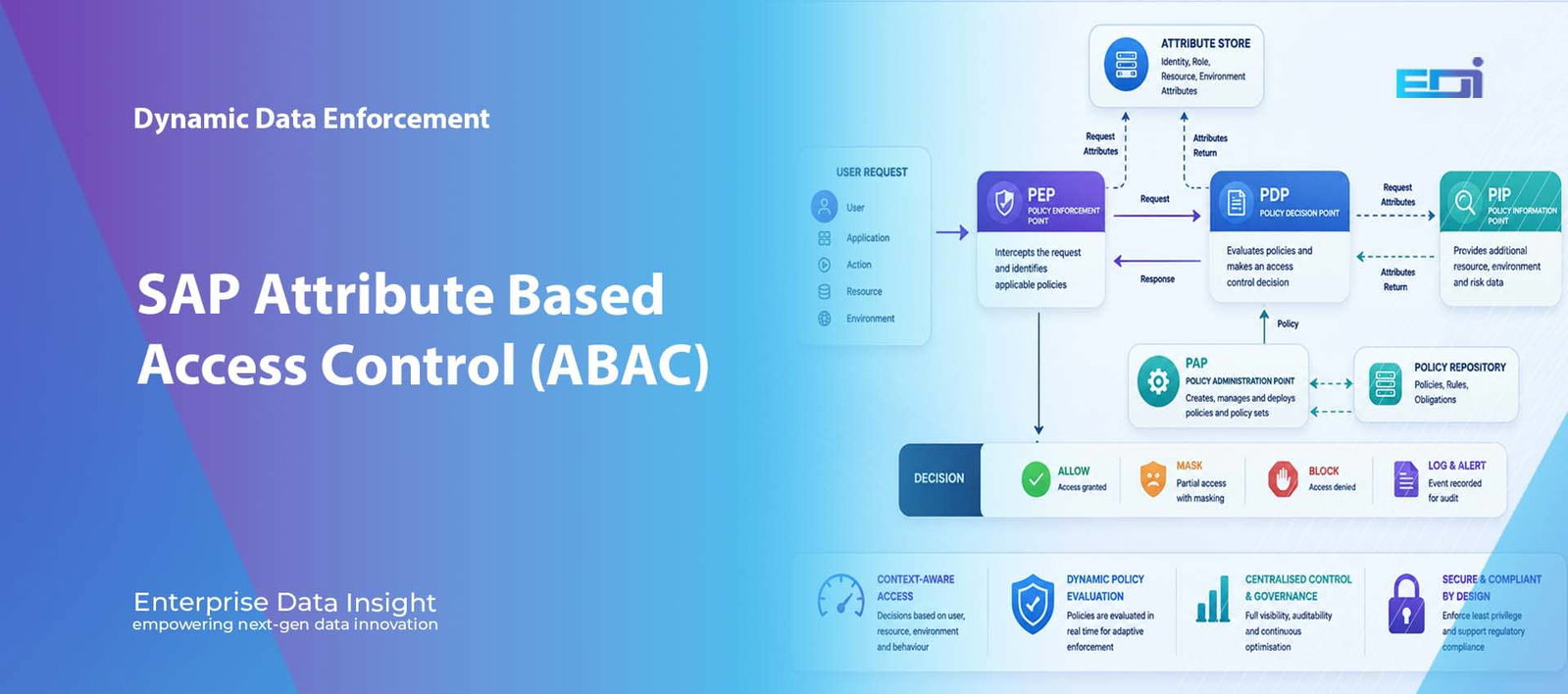
SAP Attribute Based Access Control (ABAC)
SAP Attribute-Based Access Control (ABAC): From Static Authorisation to Real-Time Policy Enforcement
Traditional SAP roles remain essential for establishing broad business permissions, but modern data-security decisions often require more context than a static role can provide. Attribute-Based Access Control adds that context by evaluating the user, resource, requested action and environment at the point of access, allowing a policy to decide whether a specific request should be allowed, masked, blocked, logged or escalated.
Decisions can consider identity, role, organisational responsibility, application, data classification, device, location, time and other live attributes rather than relying only on a previously assigned role.
The request is evaluated against centrally governed policy at the moment access is attempted, helping the organisation adapt enforcement to the precise circumstances of the transaction.
The result does not have to be simply permit or deny. A policy can permit an action while masking sensitive fields, record evidence, apply an obligation or trigger an alert.
The question changes from “Does this user have a role?” to “Should this user perform this action on this data, from this context, right now?”

Why Static SAP Authorisation Alone Can Be Too Coarse for Sensitive Data
SAP role design is normally built around business responsibilities. A user may be authorised to display HR data, maintain a vendor, approve a purchase order or execute a finance transaction because those activities are part of the user’s job. That is necessary, but the role itself does not always answer every security question that exists at runtime.
Consider an HR business partner who legitimately needs access to employee records. The user’s role may permit the relevant application and transaction, yet the organisation may still want different behaviour depending on the employee being viewed, the sensitivity of the field, the user’s organisational responsibility, the device being used or whether the request is coming from an expected location.
SAP Attribute Based Access Control addresses this gap by evaluating attributes associated with the subject, object, action and environment against policy. This is consistent with the ABAC model described by NIST, where authorisation decisions are based on attributes and policy rather than only on a static identity-to-permission assignment.
PEP, PDP, PIP and PAP: The Core Components of an Enterprise ABAC Architecture
The architecture shown in the slide separates responsibilities so that policy can be centrally governed without hard-coding every decision into the application. The terminology aligns closely with the XACML access-control architecture: a Policy Enforcement Point requests and applies a decision, the Policy Decision Point evaluates the request, the Policy Information Point supplies attributes, and the Policy Administration Point manages policy.
What an ABAC Decision Actually Evaluates
A useful way to understand ABAC is to stop thinking about a permission as a single property attached to a user. The decision is created from a request context. That context can combine attributes from several sources and can therefore reflect both business responsibility and real-time operating conditions.
| Attribute group | Examples in an SAP environment | Why it matters |
|---|---|---|
| Subject / user | User ID, business role, department, cost centre, company code responsibility, employment type, clearance | Describes who is making the request and the business responsibility associated with that identity. |
| Resource / data | Employee record, vendor, business partner, bank details, salary field, customer record, document classification | Describes the specific information being requested rather than treating all data behind one transaction as identical. |
| Action | Display, change, create, approve, export, download, mass update | A user may be permitted to view data but not change, export or perform a higher-risk action. |
| Environment | Managed device, network, country, time, session risk, authentication strength, remote access | Allows the same business request to be treated differently when the surrounding risk changes. |
SAP itself supports attribute-oriented authorisation patterns in several areas. For example, SAP BTP attributes can restrict access using values such as country or cost centre, and SAP CDS access controls can express dynamic attribute-based restrictions alongside role-based conditions.
Example: An HR User Opens Sensitive Employee Data in SAP
Assume an HR business partner has the legitimate functional role required to display employee information. A conventional role check may therefore succeed. The ABAC layer then evaluates whether the specific request should be fulfilled in full, partially masked or denied based on the live context.
Request attributes
The request is inside the user’s business responsibility, originates from a managed device on the corporate network and occurs during approved working hours. Full authorised display is allowed and the access event is logged.
The important point is that the user’s role has not disappeared. The role remains one of the inputs. ABAC adds the additional attributes necessary to produce a decision that is specific to the requested data and current circumstances.
ABAC Does Not Have to End With a Simple Allow or Deny
A mature enforcement layer can return different outcomes according to the risk and business need. This is particularly important in SAP because blocking an entire transaction can be unnecessarily disruptive when a narrower control can achieve the security objective.
For example, a remote HR user may still be allowed to work while bank-account fields are masked. The same request from an unmanaged device could be blocked. An unusual after-hours request could be denied and simultaneously generate an alert. The policy can therefore protect sensitive data without forcing every situation into the same static permission model.
Policy Design Is the Hard Part — Not the Decision Engine
ABAC is powerful because it can express detailed business conditions, but that same flexibility creates a governance requirement. An organisation needs to know which attributes are authoritative, how values are updated, who owns the policy, what happens when an attribute is missing, which rule wins when several policies apply and how decisions can be explained to auditors and support teams.
A strong enterprise implementation therefore treats policy as a governed business asset. Policies should have owners, versions, approval history, effective dates and test cases. Changes should be evaluated before release, and the organisation should be able to reproduce why a particular request resulted in allow, mask or block.
This is also where a PAP becomes important. Central policy administration separates policy lifecycle management from individual SAP applications and allows security logic to be reviewed consistently rather than being distributed across custom code, exits and local implementations.
ABAC Should Usually Complement SAP Roles, Not Replace Them
ABAC and role-based access control solve different parts of the authorisation problem. SAP roles remain an efficient way to assign broad functional responsibilities: an accounts-payable clerk needs invoice functions, an HR partner needs HR applications, and a buyer needs procurement capabilities. Replacing that structure with thousands of individual attribute policies would create unnecessary complexity.
ABAC becomes valuable where the functional role is too broad to represent the final data decision. It can apply additional context after the role has established that the user is broadly eligible to perform the function.
| Question | RBAC / SAP role | ABAC policy layer |
|---|---|---|
| What business capability does the user have? | Strong fit | Can use role as an attribute |
| Which specific record can be accessed? | Possible but can become complex | Strong fit |
| Should a field be masked because of live context? | Limited | Strong fit |
| Does device, location or time change the outcome? | Normally not the primary model | Strong fit |
| Can the same request produce allow, mask, block or alert? | Usually coarse-grained | Designed for policy-driven outcomes |
Where Dynamic Data Enforcement Fits
Enterprise Data Insight’s Dynamic Data Enforcement (DDE) is positioned around real-time control of sensitive SAP data and business actions. In an ABAC-oriented architecture, the enforcement layer can evaluate request context before data is returned or an action is completed, then apply the appropriate control while retaining evidence of the decision.
That approach is relevant to use cases such as field-level masking, contextual access restrictions, blocking of high-risk activities, dynamic privilege decisions, preventative business-process controls and audit analytics. The specific implementation has to be aligned with the customer’s SAP architecture, security model and performance requirements; ABAC should not be treated as a generic rule engine placed in front of every transaction without design discipline.
The strongest use cases are those where the organisation can clearly describe the business risk in contextual terms. For example: “HR users may display employee banking data only for employees within their authorised scope; remote sessions receive masked values; unmanaged devices are blocked; all sensitive access is logged.” That is a policy that can be tested, explained and governed.
A Practical Enterprise ABAC Implementation Roadmap
An ABAC programme should begin with data and business-risk discovery rather than with policy syntax. Identify the SAP processes where existing authorisation is too coarse, the information that needs additional protection and the contextual conditions that genuinely change the business decision.
Next, define the authoritative attributes. User identity may come from the identity platform, organisational responsibility from SAP HR or business master data, device trust from endpoint security, and data classification from SAP metadata or a governance service. Each attribute needs an owner, a trusted source and a clear failure behaviour.
Policies can then be designed and tested against realistic request scenarios before enforcement is introduced. A phased deployment might begin in monitor-only mode so that decisions are calculated and logged without affecting users, followed by masking or warning controls, and finally blocking where the policy has been proven operationally.
Finally, treat policy performance and policy quality as ongoing operational measures. Monitor decision latency, rule conflicts, missing attributes, false positives, bypass attempts and changes in business behaviour. ABAC is not a one-time configuration; it becomes part of the organisation’s access-governance operating model.
SAP ABAC FAQ
What is SAP Attribute-Based Access Control?
SAP Attribute-Based Access Control uses attributes describing the user, data, requested action and environment to evaluate access policy at runtime. It can complement existing SAP roles by adding contextual decision-making where a static permission is not sufficient.
Does ABAC replace SAP roles and PFCG?
Usually no. Roles remain useful for broad functional entitlement. ABAC is most valuable as an additional decision layer for contextual, record-level, field-level or risk-sensitive access decisions.
What are PEP, PDP, PIP and PAP?
The PEP enforces the decision, the PDP evaluates policy, the PIP supplies attribute values and the PAP manages policy. These terms are formally defined in the XACML access-control architecture.
Can ABAC mask SAP data instead of blocking access?
Yes, if the enforcement mechanism supports that outcome. A policy can allow the business process while applying an obligation such as masking a sensitive field, logging the access or triggering an alert.
What makes an ABAC implementation difficult?
The main challenge is policy and attribute governance rather than the decision algorithm itself. Enterprises need authoritative attribute sources, clear policy ownership, rule testing, conflict handling, explainability, performance controls and operational monitoring.
Move From Static Permission to Context-Aware SAP Data Security
Dynamic Data Enforcement can help organisations apply policy to the specific user, data, action and environment involved in an SAP request. The objective is not to create more roles. It is to make the final access decision more precise, explainable and responsive to risk.