


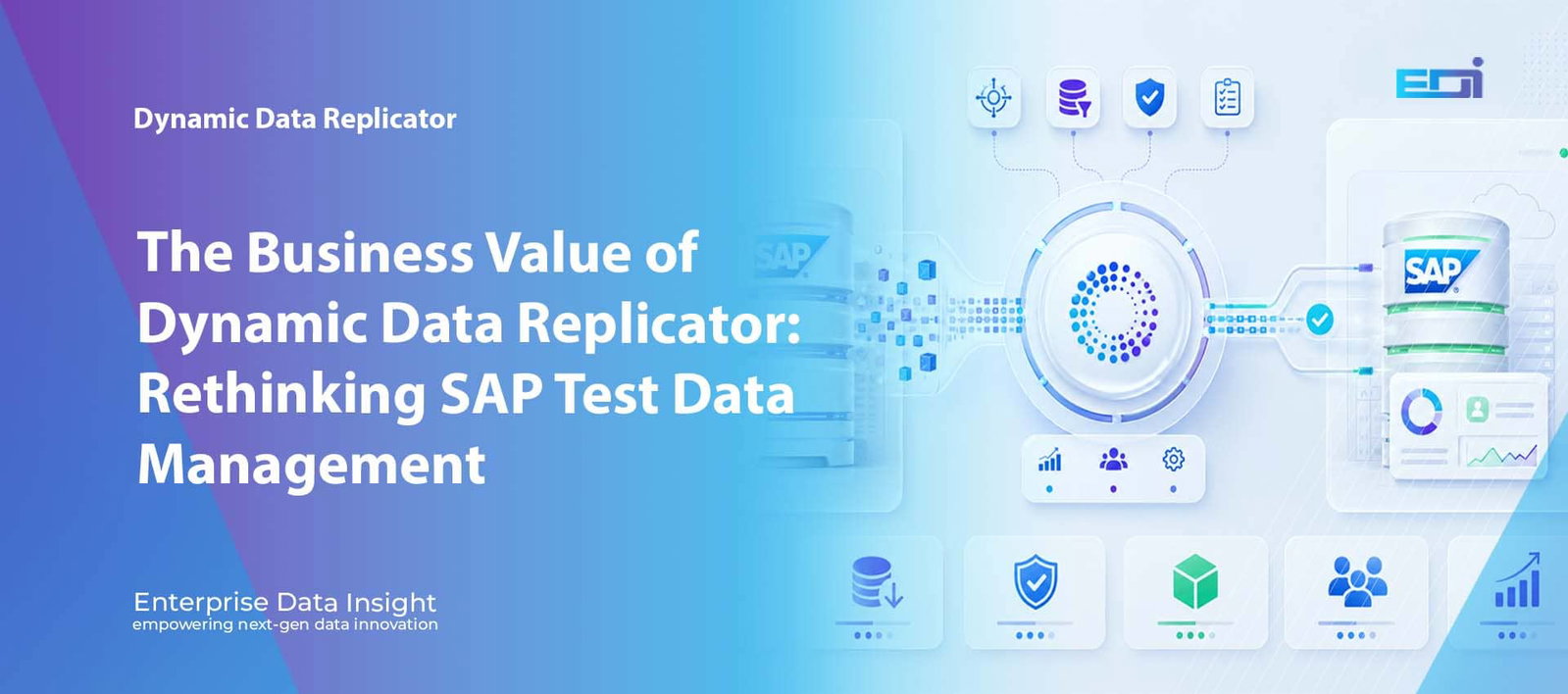
Dynamic Data Replicator: Business Value for SAP Test Data Management
The Business Value of Dynamic Data Replicator: Rethinking SAP Test Data Management
SAP non-production data management is becoming increasingly difficult to justify using traditional full-copy methods. Dynamic Data Replicator changes the operating model by allowing organisations to determine what business data is actually required, replicate that data selectively and reduce the infrastructure, administration and delivery delays associated with repeatedly moving production-scale environments.
Development, testing and support teams need current SAP data more frequently, while traditional refresh processes can still require significant preparation, execution, post-copy activity and specialist Basis involvement.
Large non-production environments can consume substantial storage and operational capacity even when only a limited business scope is required for the actual test or project activity.
The value of a test environment depends on relevant, current and usable data. Selective delivery can also reduce unnecessary exposure of sensitive production information.
The strategic question is no longer simply how quickly another SAP system can be copied. It is whether the entire production-scale dataset needs to be moved at all.

Why SAP Test Data Management Needs a Different Operating Model
For many SAP organisations, the challenge is no longer whether system copies can be performed. The more important question is whether moving a large proportion of production data every time a development, testing, support or transformation team needs current information remains the right operating model.
Production databases continue to grow, S/4HANA programmes require repeated test and migration cycles, infrastructure costs are under closer scrutiny, and project teams increasingly expect useful data to be available when they need it. A traditional refresh can therefore create a disproportionate amount of work: data is moved, specialist SAP resources are allocated, storage is consumed, post-copy processing is completed and the project waits for the environment to become usable.
Dynamic Data Replicator (DDR) approaches the problem from a different starting point. Instead of treating every requirement as another full-system copy, DDR enables organisations to define the business scope first and selectively replicate the information required for that purpose.
Why the Traditional SAP Refresh Model Is Becoming a Business Constraint
SAP system refreshes have traditionally been treated as infrastructure or Basis activities, but their impact extends across project delivery. A refresh may require system preparation, database movement, post-copy configuration, validation, workflow coordination and environment-specific processing before the system can be released back to users.
Where these activities remain highly manual, the operational effort can be significant. In some environments, an estimated 40–70% of refresh-related work can involve manual activity. The exact proportion will differ between organisations, but the underlying problem is consistent: specialist teams repeatedly spend time on technical tasks that could potentially be standardised and automated.
The consequence is wider than additional administration. Development teams wait for current data, testing can be delayed, production defects take longer to reproduce, user acceptance testing may be compressed and migration rehearsals become harder to schedule. A technical refresh process can therefore become a constraint on the organisation’s ability to deliver SAP change at the pace the business expects.
Large Non-Production Systems Can Carry a Cost That Adds Little Testing Value
As production systems grow, conventional copying methods can result in equally large development, quality assurance, training and support environments. Organisations may therefore find themselves storing, backing up and maintaining significant volumes of historical production information that have limited relevance to the activity being performed in the target system.
The infrastructure implications can extend across database capacity, backup windows, storage tiers, cloud consumption and operational support. The organisation is effectively paying to move and preserve information because it exists in production, rather than because the non-production requirement genuinely needs it.
Selective replication changes that equation. Instead of optimising how quickly an oversized dataset can be copied, the organisation can reduce the amount that needs to move in the first place. In suitable DDR scenarios, the value model identifies the potential for up to 80% lower infrastructure and storage demand and up to 95% smaller non-production environments.
More Data Does Not Automatically Produce Better SAP Testing
A test environment containing more production information is not automatically a better test environment. A developer investigating a problem with a sales process does not necessarily need years of unrelated transactions. What matters is whether the relevant customer, material, pricing, document flow and dependent records are available in a form that accurately supports the scenario being tested.
The same principle applies to transformation programmes. A migration team may need a specific company code, plant, organisational structure or period of transactional activity. If non-production systems are refreshed infrequently, the data can become outdated, forcing teams to create transactions manually, repair dependencies or search for usable examples.
That preparation effort is rarely included when organisations calculate the cost of test-data management, but it directly affects delivery productivity. In suitable use cases, the DDR value model identifies the potential for up to 90% faster test-data delivery, helping teams obtain more current and relevant information closer to the point at which they need it.
Start With the Business Requirement, Not the System Copy
Dynamic Data Replicator changes the starting point of SAP data delivery. Rather than assuming that an entire SAP system must be refreshed, the organisation begins by identifying the actual requirement. That requirement might relate to a business object, selected tables, an organisational scope, a client, a specific date range, a defined transaction set or changes that have occurred since an earlier replication.
This matters because SAP data is highly relational. Moving a sales order or purchase order is not simply a matter of copying one database record. The associated master data, transactional dependencies and related tables must remain consistent if the target information is going to be usable. A selective replication process therefore has to reduce unnecessary volume while preserving the relationships that give the data its business meaning.
Where the target environment already exists, delta-style replication can further reduce the need to repeatedly rebuild everything from the beginning. Instead, subsequent changes can be delivered within the selected scope, creating a more flexible operating model for development, testing and transformation teams.
Large production dataset containing current and historical SAP business information.
Define scope, preserve dependencies, automate delivery, apply protection and validate the result.
A focused dataset aligned to the development, testing, support or transformation requirement.
Cross-System Dependencies and Manual Administration Make Refreshes Harder to Scale
Large SAP estates rarely operate as isolated systems. Business processes can span multiple modules, interfaces and connected platforms, so a refresh in one environment may require dependencies to be re-established elsewhere. Interfaces may need to be reconfigured, related systems may require synchronisation and a delay or failure in one stage can affect the rest of the test landscape.
A more targeted replication model helps reduce this complexity by narrowing the scope of what has to move and by making data delivery more repeatable. The process becomes easier to plan around the business requirement rather than treating every request as a major infrastructure event.
Automation creates an additional layer of value. When replication, workflow, scheduling, validation and associated processing can be standardised, SAP Basis teams spend less time repeating operational steps. For suitable implementations, the DDR value model identifies the potential for up to 70% less SAP Basis administration, allowing scarce technical expertise to be redirected towards architecture, performance, security and transformation work.
Production Data Outside Production Creates a Security Responsibility
Production SAP systems can contain customer information, employee records, financial data, supplier details and other commercially sensitive or regulated information. When large production copies are moved into development, testing or training, that information can become available across a wider technical landscape and to a broader population of users.
Selective replication can reduce unnecessary exposure because information that has no purpose in the target does not need to be transferred there. Where sensitive records are genuinely required for the business scenario, scrambling or masking can be incorporated so that the dataset remains useful without unnecessarily reproducing original production values.
This creates a stronger operating model than treating privacy as a clean-up activity after the system copy has already completed. Data protection becomes part of the delivery process itself, while workflow and audit evidence provide visibility over what was requested, approved and moved.
S/4HANA Programmes Magnify the Cost of Repeated Data Preparation
Large S/4HANA programmes rarely perform one migration and one test cycle. They typically involve repeated conversion rehearsals, integration testing, regression testing, defect retesting, user acceptance testing, training preparation and cutover rehearsals. Each iteration creates another demand for appropriate business data.
If every cycle requires another large system refresh, the accumulated operational effort can become substantial. Migration teams spend time waiting for targets to be rebuilt or synchronised before the next test cycle can begin, and the refresh process becomes part of the programme’s critical path.
Selective and delta-based replication can reduce repeated data movement by delivering the data required for the migration scope and then transferring relevant changes where appropriate. In suitable scenarios, the DDR value model identifies the potential for up to 60% shorter S/4HANA migration downtime, while giving the programme greater freedom to execute additional test and rehearsal cycles.
Faster Data Delivery Still Needs Strong Enterprise Control
Greater automation does not reduce the need for governance. Making SAP data easier to move makes it even more important that an organisation can demonstrate who requested a replication, which scope was selected, who approved the activity, when execution occurred and whether validation completed successfully.
Where sensitive information is involved, the organisation should also be able to demonstrate which protection controls were applied. DDR’s value model therefore includes a full audit trail and governance proposition in which replication, approval, validation and execution can be tracked to provide greater visibility over the lifecycle of the request.
The objective is controlled automation. Repetitive operational work is reduced, while accountability remains part of the process.
The Commercial Impact Extends Beyond a Faster SAP Refresh
Speed is important, but measuring DDR only by refresh duration would underestimate the wider business case. The strongest value comes when smaller data volumes, automation, more relevant test data and stronger governance improve several parts of the operating model at the same time.
In appropriate selective-replication scenarios, Enterprise Data Insight’s DDR value model identifies the potential for refresh times to improve by up to 95%, infrastructure and storage demand to reduce by up to 80%, non-production environments to become up to 95% smaller and SAP Basis administration to reduce by up to 70%.
The model also identifies the potential for up to 90% faster test-data delivery, up to 60% shorter S/4HANA migration downtime and full governance across approval, execution and validation. The combined commercial effect can extend to up to 50% lower project costs, a potential 3–10x return on investment and a typical payback period of less than 12 months in suitable environments.
Reduce environment waiting time and make relevant data available closer to project demand.
Limit unnecessary production-data movement and strengthen governance over each request.
Give testing teams more current and business-relevant datasets.
Reduce repetitive technical activity and manual test-data preparation.
Align non-production infrastructure and operational effort more closely with actual demand.
Create an SAP data-delivery capability that supports faster change and transformation.
From Reactive Refresh Events to a Proactive SAP Data-Delivery Model
The most significant change introduced by DDR is not any single performance percentage. It is the maturity shift in how non-production SAP data is managed. In a traditional environment, refreshes are often reactive: a project requests a copy, teams coordinate the activity, Basis executes it, post-copy work is completed and users wait for the environment to become ready.
A more mature model makes selective replication repeatable, increases automation, improves the relevance of test data, incorporates privacy controls into the delivery process and creates stronger governance over each request. The DDR value model illustrates this movement from an approximate maturity score of 42/100 in a reactive state towards 85+/100 in a proactive DDR-enabled state.
The change is measured across five dimensions: Automation, Data Quality, Compliance & Privacy, Governance & Visibility, and Efficiency & Agility. The actual maturity improvement will vary between organisations, but the direction is clear: from individually managed refresh events towards a repeatable enterprise data-delivery capability.
Moving From SAP System Copy to Data as a Service
Once selection, approval, protection, replication and validation become repeatable, SAP non-production data can begin to operate as an internal service rather than an occasional infrastructure event. A development team should not necessarily need to request an entire refresh simply to reproduce a production issue, and a test manager should not automatically need another full copy to execute a defined business process.
Instead, teams can request the data required for their purpose and have that requirement fulfilled through a governed delivery process. The business scope is defined, the relevant data is identified, approvals are applied, sensitive information is protected where necessary, the selected information is replicated and validation confirms that the process completed successfully.
This changes the experience for the consuming team and changes how the organisation uses scarce SAP expertise. Test-data management moves away from the mechanics of the copy and towards the availability, relevance and control of enterprise data.
The Question SAP Leaders Should Be Asking Has Changed
For years, organisations have concentrated on making SAP system copies faster and more reliable. That remains important, but it should no longer be the only question. As SAP landscapes grow and organisations move towards S/4HANA, cloud infrastructure and more continuous delivery models, leaders should also ask whether the traditional full-copy approach remains appropriate for every use case.
If a team requires a defined business process, a particular company code, a selected period of transactional data or a specific set of business objects, moving and maintaining an entire production-scale dataset may be unnecessary. Dynamic Data Replicator provides an alternative by allowing the organisation to identify the requirement, preserve the relevant SAP relationships, protect sensitive information and deliver the result through a controlled process.
The real business value therefore comes from making a better decision before the data moves: what information does this requirement genuinely need, and how can it be delivered efficiently, securely and repeatedly?
Dynamic Data Replicator FAQ
What is Dynamic Data Replicator?
Dynamic Data Replicator is Enterprise Data Insight’s SAP data replication and test-data-management solution. It is designed to help organisations selectively deliver relevant SAP data to non-production environments instead of relying on full-system movement for every requirement.
How can selective SAP data replication reduce refresh time?
Selective replication can reduce the amount of information that must be transferred and processed. Where the receiving environment only requires a defined business scope, moving less data can shorten elapsed refresh activity and reduce associated infrastructure and operational work.
Can DDR support S/4HANA transformation programmes?
DDR can support repeated testing, rehearsal and non-production data requirements around S/4HANA transformation by enabling targeted and delta-style replication approaches where these are appropriate to the technical landscape and project scope.
Can DDR help protect sensitive production data in test systems?
Selective replication can reduce unnecessary production-data movement, while scrambling or masking can be incorporated for sensitive information that is genuinely required in the target environment.
Are the percentage benefits shown in the DDR value model guaranteed?
No. They are illustrative potential outcomes for suitable DDR deployment scenarios. Actual results depend on SAP landscape size, infrastructure, selected data scope, refresh frequency, existing automation and implementation design.
Turn SAP Data Management Into Measurable Business Value
Dynamic Data Replicator is designed to help organisations move away from unnecessarily large and repetitive SAP refresh activity towards a more selective, automated and governed data-delivery model. The opportunity is not simply to copy systems faster, but to make better decisions about which data needs to move at all.