


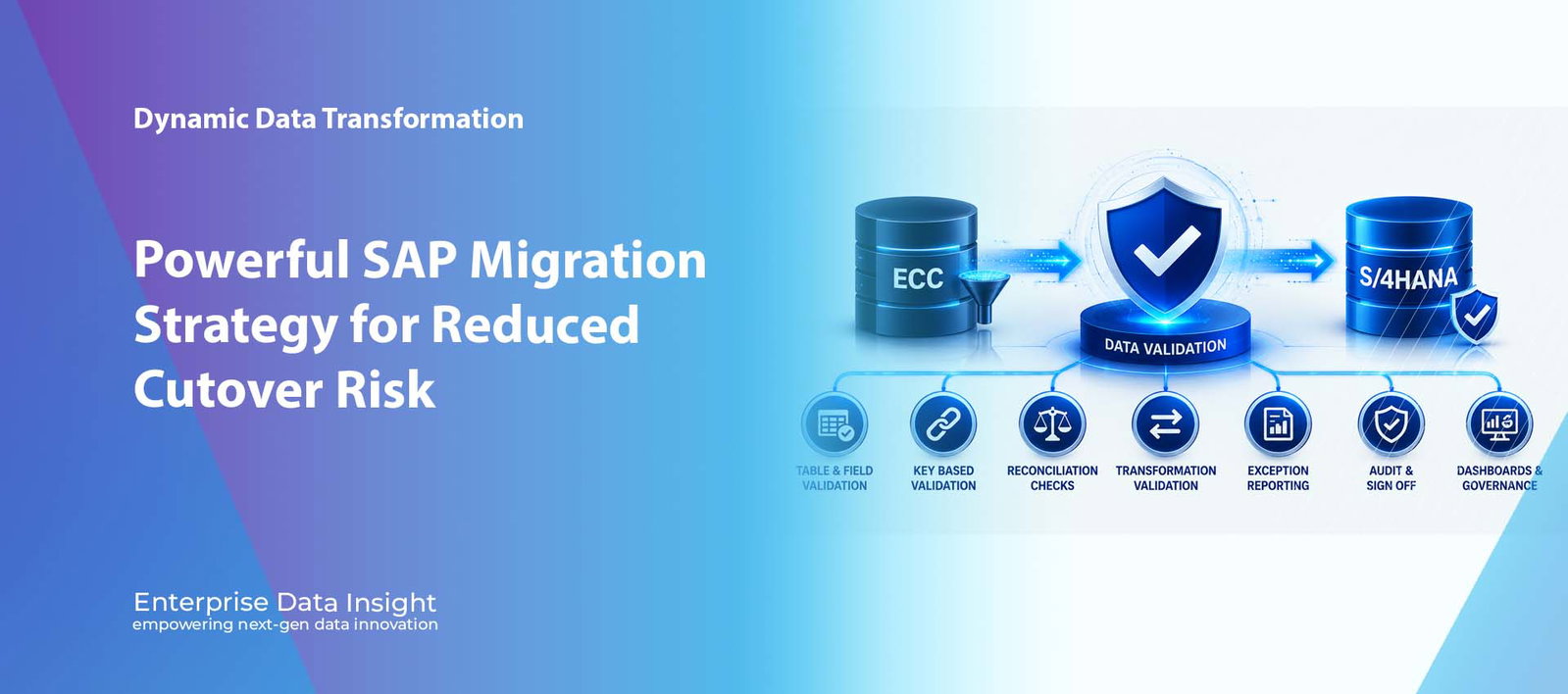
ECC and S/4HANA Synchronisation: Powerful SAP Migration Strategy for Reduced Cutover Risk
ECC and S/4HANA Synchronisation: Powerful SAP Migration Strategy for Reduced Cutover Risk
ECC and S/4HANA Synchronisation is the missing strategy in many SAP S/4HANA migration programmes. The initial migration load creates the target environment, but the live ECC system continues to change every day. Dynamic Data Replicator helps organisations continuously replicate, validate, and reconcile data between ECC and SAP S/4HANA so testing remains current, cutover deltas stay smaller, downtime is reduced, and CIOs gain evidence based confidence in go live readiness.
The CIO question
The strategic question is no longer simply how to migrate ECC to S/4HANA. It is how to keep both systems aligned while the business continues to operate.
ECC and S/4HANA Synchronisation is one of the most important capabilities missing from many SAP S/4HANA migration programmes. Most projects focus heavily on the initial load from SAP ECC into the target SAP S/4HANA environment. The target is built, data is loaded, business users begin testing, reports are reconciled, interfaces are connected, and cutover planning begins.
Then a practical problem appears. ECC continues to operate. New customers are created. Vendors are changed. Purchase orders are raised. Sales orders are processed. Invoices are posted. Goods movements occur. Financial documents are created. Production planning continues. Inventory positions change constantly. The moment the initial migration load completes, the target SAP S/4HANA environment starts falling behind.
Why ECC and S/4HANA Synchronisation Matters
The issue is not that SAP migration teams cannot move data. Most programmes already know how to extract, transform, and load data into SAP S/4HANA. The real challenge is maintaining alignment while the business continues to trade, manufacture, procure, sell, ship, invoice, and close financial periods in ECC.
Without continuous synchronisation, business users test against outdated data, reconciliation becomes harder, cutover deltas grow, and project teams face a larger volume of unresolved change during the final migration window. This creates direct CIO level risk because the programme becomes more dependent on a high pressure cutover weekend.
Migration moves the starting point. Synchronisation maintains alignment. That distinction can determine whether SAP S/4HANA go live is controlled or chaotic.
Why Traditional Migration Approaches Create Risk
A traditional migration approach usually follows a familiar pattern. An initial load is performed. Users test the target. A final delta is moved during cutover. The organisation switches to SAP S/4HANA. On paper, this model appears straightforward. In practice, the longer testing continues, the larger and riskier the delta becomes.
In large SAP environments, weeks or months of activity can accumulate between the initial load and go live. That activity may include:
- millions of new or changed financial transactions
- new and updated customers, vendors, and Business Partners
- new purchase orders, sales orders, deliveries, and invoices
- inventory changes across multiple plants and warehouses
- new production orders and material movements
- master data changes across materials, assets, cost centres, and profit centres
- configuration or organisational changes required by the programme
By the time cutover arrives, project teams are expected to process, validate, reconcile, and sign off a large volume of change in a compressed window. Any defect discovered during that period can delay go live or force manual remediation.
The Hidden Cost of Out-of-Sync Migration Landscapes
Out-of-sync landscapes create hidden cost long before the go live weekend. Business users may spend weeks testing processes against data that no longer represents the live organisation. Developers may investigate defects that are caused by stale data rather than system design. Finance teams may struggle to reconcile reports because the source and target are drifting further apart every day.
This creates wasted effort, reduced confidence, more rework, and increased reliance on manual spreadsheets. The programme appears busy, but the quality of testing evidence becomes weaker because the target system is no longer close enough to the live ECC position.
Why Final Delta Migration Alone Is Not Enough
Delta migration is important, but relying on one final delta load is not enough for complex SAP landscapes. A single cutover weekend can become responsible for changed master data, new transactions, updated documents, deleted records, open item reconciliation, inventory changes, and final business sign off.
The problem is not simply the volume of data. The issue is the business pressure created when data movement, validation, reconciliation, defect investigation, and executive go live decision making all happen at the same time.
Continuous ECC and S/4HANA Synchronisation reduces this pressure by keeping the delta smaller throughout the programme. Instead of treating alignment as a final event, synchronisation becomes a controlled operating model during migration.
What Must Be Synchronised Between ECC and S/4HANA?
A successful SAP S/4HANA migration requires more than table level copying. The source and target systems must remain aligned across the data objects that matter to business process execution, testing, reconciliation, and cutover readiness.
Master and organisational data
- customer master and vendor master
- Business Partner data
- material master and inventory relevant fields
- cost centres and profit centres
- assets, plants, storage locations, and company codes
- organisational structures and business rules
Transactional and open item data
- purchase orders and sales orders
- financial documents and open items
- deliveries, invoices, and billing documents
- goods movements and inventory positions
- production orders and material movements
- custom tables, extensions, and programme specific objects
A Better Approach: Continuous Synchronisation
Leading organisations are moving away from migration models that depend entirely on one time loads and final cutover deltas. They use continuous synchronisation to keep SAP ECC and SAP S/4HANA aligned throughout the project lifecycle.
The objective is simple: keep the target SAP S/4HANA environment close enough to live ECC that testing, validation, reconciliation, and business sign off remain meaningful.
- More accurate testing: users validate against current business data rather than an ageing snapshot.
- Reduced cutover risk: the final migration delta becomes smaller and easier to validate.
- Faster reconciliation: fewer accumulated differences make source to target comparison more manageable.
- Lower downtime: less data needs to be processed during the final cutover window.
- Greater confidence: project teams know the target environment reflects the live business more closely.
How Dynamic Data Replicator Supports ECC and S/4HANA Synchronisation
Dynamic Data Replicator was designed to support controlled SAP data movement, replication, filtering, validation, and synchronisation across complex SAP landscapes. During migration programmes, DDR can help organisations keep ECC and SAP S/4HANA aligned by continuously replicating relevant data changes rather than relying only on large one off migration loads.
DDR can support synchronisation through:
- Initial migration load: replicate the required master data, transactional data, and business object scope into SAP S/4HANA.
- Delta synchronisation: identify and transfer changed records between ECC and S/4HANA during the migration lifecycle.
- Object based replication: synchronise specific business objects such as materials, customers, vendors, Business Partners, purchase orders, sales orders, and financial documents.
- Time slice replication: replicate a defined period of business activity rather than moving unnecessary history.
- Company code and plant filtering: synchronise only the organisational scope participating in the migration.
- Automated scheduling: run synchronisation jobs on agreed intervals to maintain target freshness.
- Validation and reconciliation: compare source and target environments to identify differences and support sign off.
- Audit and governance: maintain traceability of what was replicated, when it was replicated, and which scope was included.
| Migration challenge | Without continuous synchronisation | With DDR synchronisation |
|---|---|---|
| Testing quality | Business users test against outdated data that may not reflect the live ECC position. | Testing is performed against more current business data, improving user confidence and defect relevance. |
| Cutover delta | Weeks or months of accumulated changes must be moved during the final cutover window. | Continuous replication reduces the final delta and lowers weekend execution pressure. |
| Downtime | Large final data movement increases the risk of extended downtime. | Smaller deltas can help reduce cutover duration and operational disruption. |
| Validation effort | Large differences make reconciliation difficult and increase manual effort. | Frequent synchronisation makes differences easier to identify, explain, and resolve. |
| CIO confidence | Go live decisions depend heavily on compressed final weekend evidence. | Programme leadership gains progressive assurance throughout migration cycles. |
Supporting Different SAP Migration Strategies
ECC and S/4HANA Synchronisation is valuable across multiple SAP transformation models. Every programme has a different scope, but the need for alignment remains consistent.
- Greenfield migration: selectively replicate required business data for testing, training, validation, and migration preparation.
- Brownfield migration: support transition readiness, validation, and synchronisation where parallel environments are used.
- Selective transformation: synchronise specific company codes, plants, regions, business units, or object scopes.
- SAP carve-outs: keep separated business scope aligned while the source business continues to operate.
- Phased migration programmes: support parallel running and wave based migration across business units or regions.
The ROI Case for Continuous Synchronisation
The ROI case for ECC and S/4HANA Synchronisation is not based only on faster data movement. It is based on reducing expensive programme risk. Every additional hour of downtime, every failed reconciliation, every late defect, and every cutover delay carries business and financial consequences.
Continuous synchronisation protects ROI by reducing the volume of change left to the final migration window, improving testing quality, lowering manual reconciliation effort, and strengthening go live confidence.
Where ECC and S/4HANA Synchronisation creates measurable value
The measurable value comes from reducing downtime, shrinking the final delta, improving validation quality, and lowering the risk of expensive go live delays.
Technical Synchronisation Patterns
A mature ECC and S/4HANA Synchronisation strategy should be designed around business objects, delta logic, selection rules, validation controls, and execution schedules. The objective is not to move everything repeatedly. The objective is to move the right changes at the right time with the right controls.
- Object driven synchronisation: replicate complete business objects rather than isolated table fragments.
- Delta based identification: capture new and changed records to reduce unnecessary data movement.
- Organisational filtering: apply company code, plant, sales organisation, purchasing organisation, or region filters.
- Time based filtering: replicate only relevant business activity for the selected migration window.
- Dependency aware replication: include related master and transactional dependencies to preserve integrity.
- Scheduled execution: run synchronisation cycles daily, weekly, or by project milestone.
- Validation checkpoints: reconcile source and target after each synchronisation cycle.
- Audit logging: record scope, timing, user, object, filter, result, and exceptions for governance.
Why Synchronisation Matters for Future SAP Operations
ECC and S/4HANA Synchronisation also supports the wider future of SAP operations. Current data improves testing, reporting, validation, reconciliation, analytics, automation, and operational decision making. Stale migration data weakens confidence across every downstream workstream.
As organisations increase reliance on analytics, automation, intelligent business processes, and real time reporting, migration environments must reflect current business reality. Continuous synchronisation ensures that decisions made during testing and cutover planning are based on relevant data rather than historical snapshots.
For broader context, review SAP S/4HANA, SAP Business Technology Platform, and ISO 27001.
Migration creates the target environment. Synchronisation keeps it relevant. In modern SAP transformation programmes, that distinction often determines the difference between a smooth go live and a difficult one.
Frequently Asked Questions About ECC and S/4HANA Synchronisation
What is ECC and S/4HANA Synchronisation?
ECC and S/4HANA Synchronisation is the process of keeping the source ECC system and target SAP S/4HANA environment aligned during a migration programme by continuously replicating relevant data changes, validating results, and reducing the final cutover delta.
Why is final delta migration not enough?
Final delta migration is important, but relying on it alone can leave weeks or months of changes to be moved, validated, and reconciled during a compressed cutover window. Continuous synchronisation reduces that pressure by keeping the target closer to the source throughout the programme.
How does DDR help with ECC and S/4HANA Synchronisation?
Dynamic Data Replicator helps by supporting initial load, delta synchronisation, object based replication, time slice replication, company code and plant filtering, automated scheduling, validation, reconciliation, and audit logging.
What is the business value of continuous synchronisation?
The business value comes from improved testing quality, reduced cutover downtime, smaller final deltas, easier reconciliation, lower migration risk, and stronger CIO confidence in go live readiness.
Conclusion
ECC and S/4HANA Synchronisation is now a critical capability for complex SAP migration programmes. Traditional migration approaches focus on moving data at defined milestones, but modern business environments continue to operate, change, and generate new transactions throughout the project lifecycle.
Organisations that solve synchronisation reduce cutover risk, improve testing quality, shorten downtime, strengthen validation, and increase executive confidence. The question is no longer whether data can be migrated from ECC to SAP S/4HANA. The real question is how both environments remain aligned until the day the business switches over.
Dynamic Data Replicator delivers measurable value by helping SAP teams keep ECC and SAP S/4HANA synchronised, validated, and ready for a more controlled migration outcome.
For broader EDI context, explore DDR Object Replicator, Dynamic Data Transformation for SAP S/4HANA, and Dynamic Data Insight.