


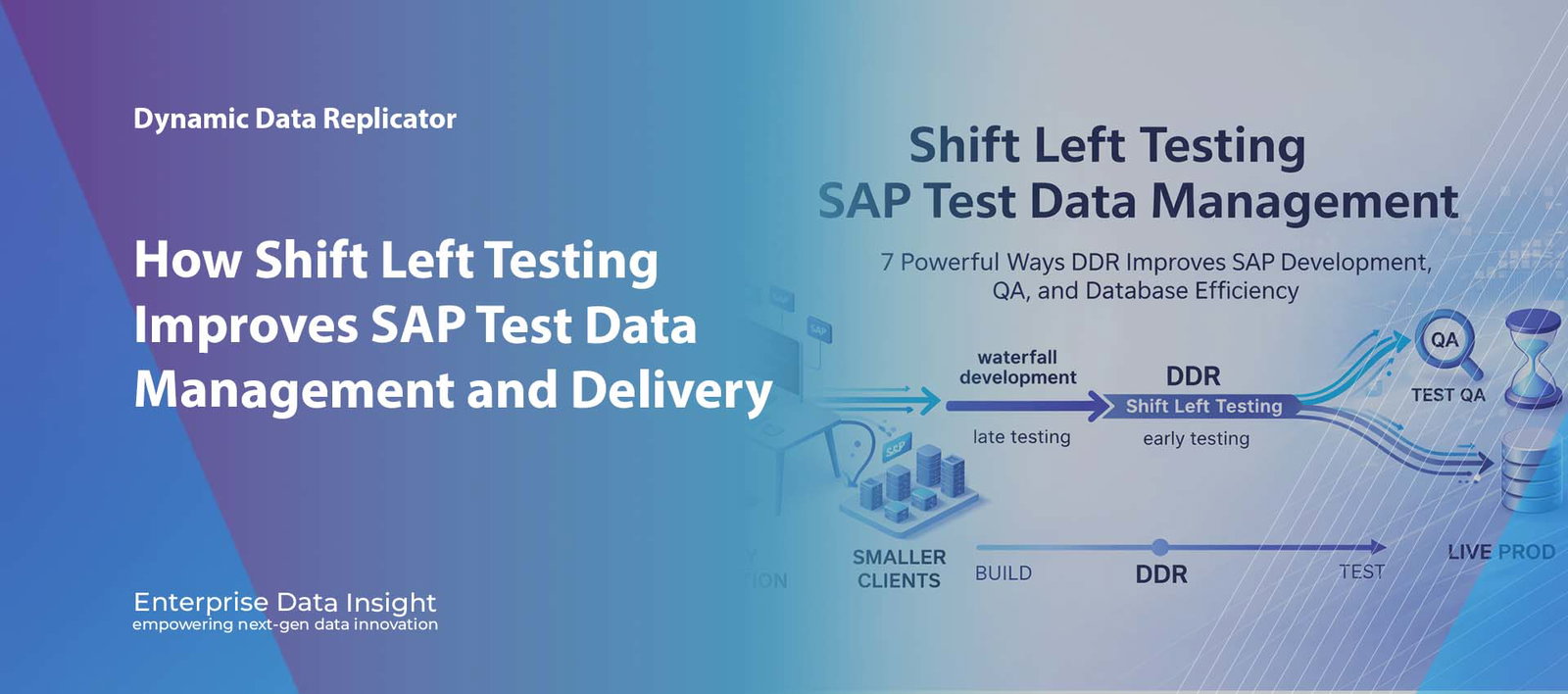
Shift Left Testing with SAP Test Data Management: 7 Powerful Ways DDR Improves SAP Delivery
Shift Left Testing with SAP Test Data Management: 7 Powerful Ways DDR Improves SAP Development, QA, and Database Efficiency
Shift Left Testing with SAP Test Data Management is becoming essential for SAP teams that need faster feedback, lower non production database growth, and better release quality. In many SAP landscapes, developers build early, but meaningful business testing still happens later in QA. By the time issues are identified, the change has already moved downstream, the developer has lost context, and rework begins. Dynamic Data Replicator changes this model by enabling Shift Left Testing with SAP Test Data Management through smaller, selective, scrambled, production like datasets that can be provisioned much earlier in the lifecycle.
What this solves technically
DDR helps SAP teams reduce full refresh dependency, accelerate test readiness, support Shift Left Testing, and control non production data volumes without sacrificing functional realism.
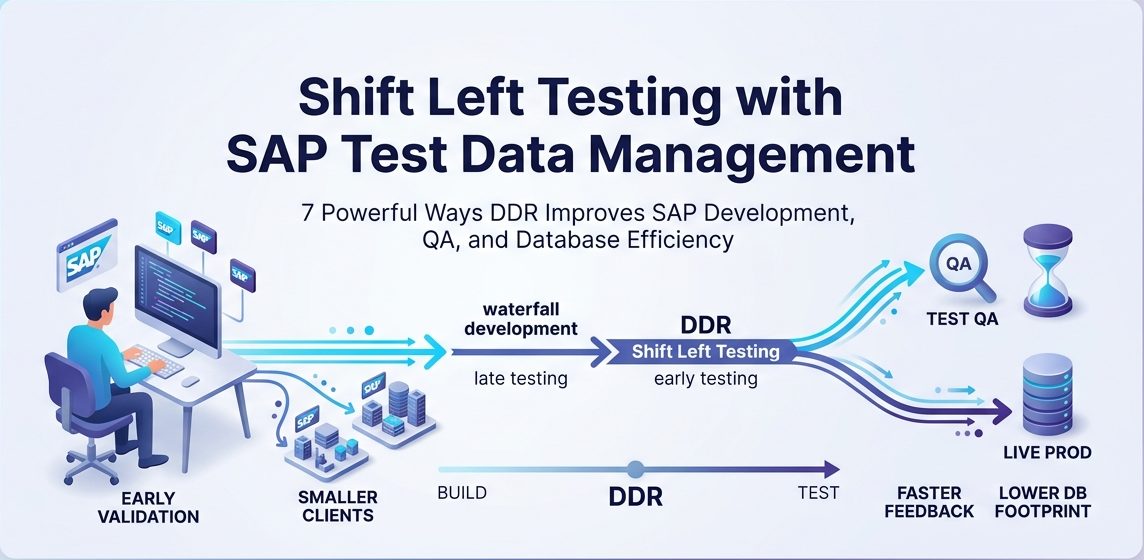
Shift Left Testing with SAP Test Data Management is a modern SAP delivery approach that enables project teams to validate functionality earlier using realistic and secure data. By combining Shift Left Testing with SAP Test Data Management, organisations reduce dependence on late QA discovery, improve defect resolution speed, and minimise unnecessary database growth across development, QA, sandbox, and training environments.
Why Traditional Testing Slows SAP Delivery
In a traditional SAP landscape, the development cycle and the testing cycle are often separated by time, infrastructure, and data readiness. Developers create ABAP enhancements, functional configuration, forms, interfaces, workflows, and business logic changes. Yet end to end validation is commonly postponed until the change reaches a shared QA environment.
This creates a technical lag between build and business truth. The code may compile, transports may import cleanly, and unit checks may pass, but the real validation of process integrity happens later, often against complex business data relationships that were not available during initial development.
The result is predictable:
- developers build changes without early access to realistic data
- business process testing is delayed until QA
- defects are discovered after handover
- the work returns to development for analysis and correction
- release cadence slows and rework increases
In SAP, this is not only a testing process issue. It is a data availability issue. Without the right dataset, teams cannot properly validate joins, document flow, object dependencies, organisational scope, authorisation behaviour, or downstream business outcomes.
The later realistic SAP test data becomes available, the later defects are exposed. The later defects are exposed, the more expensive they become to analyse, fix, transport, and retest.
How Full Copies Increase Database Size and Delay Testing
Screenshot one reflects a common pattern in large SAP estates. Production may hold 2 TB, but traditional one to one copies into QA, training, pre production, sandbox, and development quickly multiply storage demand. The total non production footprint can become several times larger than the productive system itself.
From a technical perspective, full copies are blunt instruments. They duplicate everything, including historical records, redundant objects, inactive business scope, and data that offers no value to the testing scenario in question.
This creates several technical and operational problems:
- larger HANA or database storage footprint across non production systems
- more time required for refresh execution and post copy activities
- greater basis workload for repeated environment management
- higher infrastructure and cloud cost
- increased risk if sensitive data is copied without effective scrambling
Full copies also weaken Shift Left Testing because they make early, small, targeted validation harder to achieve. Instead of fast, scenario based provisioning, teams wait for broad refresh cycles that are too large for agile delivery needs.
Technical weaknesses of full copies
- copy all data regardless of testing relevance
- extend refresh duration and operational overhead
- increase database growth in non production
- delay availability of realistic test data
- create unnecessary exposure of production data
Practical impact on SAP delivery
- late QA discovery of defects
- longer defect correction cycles
- more transport rework
- slower project throughput
- lower release confidence
What Shift Left Testing with SAP Test Data Management Really Means in SAP
In SAP, Shift Left Testing with SAP Test Data Management means making realistic and functionally relevant data available earlier so that testing begins closer to the point of build. This is not limited to unit testing. It extends to integration logic, process validation, master and transactional data behaviour, authorisation dependent flows, and cross module scenario execution.
For example, an order to cash enhancement may require customer master data, pricing conditions, material records, sales area configuration, output logic, and linked transactional context. A finance validation may require company code scope, posting periods, master records, document chains, and reconciliation behaviour. Without that context, early testing remains superficial.
This is why SAP Test Data Management is so important. It is not simply about masking or moving data. It is about providing technically usable, business aligned, and secure datasets that support earlier validation.
How DDR Enables Shift Left Testing with SAP Test Data Management
Dynamic Data Replicator enables selective replication of SAP data based on business scope rather than full system cloning. Instead of duplicating entire environments, DDR provisions the specific objects and dependent datasets required for a defined testing scenario while maintaining referential integrity.
With Shift Left Testing with SAP Test Data Management, DDR allows developers to test earlier using smaller, relevant datasets instead of waiting for large QA cycles.
Technically, this matters because SAP business processes are relational and interdependent. To test properly, teams need more than isolated rows from individual tables. They need the surrounding object context that makes the process executable and meaningful. DDR addresses this by following SAP object relationships and supporting consistent replication of related data.
DDR also supports data scrambling so that sensitive data can be protected while the dataset remains usable in non production systems.
This enables organisations to:
- create smaller development and test clients with controlled business scope
- support early validation for developers and functional teams
- reduce non production database growth
- preserve realistic data relationships for end to end testing
- improve security posture through scrambled test data
Technical Benefits of DDR for SAP Development and QA
The strongest advantage of DDR is that it improves the technical quality of the delivery model itself. Rather than treating test data as a heavy infrastructure event, DDR turns it into a repeatable, targeted, scenario aligned capability.
From a technical perspective, that brings multiple benefits:
- faster provisioning of fit for purpose SAP datasets
- less dependency on fixed refresh windows
- earlier execution of integration and process level validation
- reduced cost of defect detection and correction
- smaller downstream storage footprint
- more secure handling of sensitive data in non production
This matters for ABAP teams, functional teams, testing teams, and SAP platform owners alike. The earlier the dataset becomes available, the more efficient the whole delivery chain becomes.
Where DDR creates measurable value
The business case for DDR combines infrastructure efficiency, higher testing quality, earlier validation, and better control of sensitive data. The saving is rarely from storage alone. It comes from the whole reduction in delay, waste, and rework.
Why This Aligns with DevOps and Modern SAP Engineering
DevOps is based on shorter feedback loops, faster validation, and tighter coordination between build and test. In SAP environments, that objective is difficult to achieve if test data is only made available through large, infrequent, infrastructure heavy refresh cycles.
Shift Left Testing with SAP Test Data Management brings SAP delivery closer to those engineering principles. It allows testing to happen earlier, with more relevant data, and with less environmental overhead.
Modern engineering practices increasingly emphasise early validation and continuous feedback. SAP also highlights the importance of integrated DevOps practices for enterprise delivery, and secure data handling remains critical for non production use of business information. See SAP DevOps practices, SAP Business Technology Platform, and GDPR guidance for broader context around delivery discipline, platform modernisation, and protection of sensitive data.
These external links are intentionally DoFollow and help signal relevance, authority, and contextual depth.
Shift Left Testing with SAP Test Data Management is most effective when realistic SAP data can be provisioned early, selectively, securely, and without forcing every test cycle to depend on a full production copy.
A Practical SAP Example
Consider a team working on an enhancement to a procurement or order to cash flow. Under a traditional model, the developer completes the change and sends it onward. Formal validation then takes place in QA, where the team discovers that a related data dependency, process branch, pricing condition, or document link behaves differently than expected.
The issue now returns to development. Analysis begins again. The original context must be reconstructed. A fix is built, transported, and retested. This is slow and expensive.
With DDR, the organisation can provision a smaller client or environment that contains the relevant business scope, including the connected master and transactional data required for the scenario. Sensitive fields can be scrambled. The developer or project team can validate earlier, identify the issue sooner, and reduce the likelihood that QA becomes the first meaningful point of discovery.
That is the core practical benefit of Shift Left Testing with SAP Test Data Management. It reduces the distance between change and evidence.
Why This Topic Matters for SAP Test Data Management Strategy
Many organisations still treat SAP Test Data Management as a refresh activity. In reality, it is a delivery capability that directly affects development speed, QA quality, database growth, security, and release confidence.
A modern SAP Test Data Management strategy should support:
- selective replication instead of bulk refresh dependency
- scrambling for sensitive and regulated data
- smaller non production database footprints
- earlier process and integration testing
- more consistent and technically realistic datasets
When organisations implement Shift Left Testing with SAP Test Data Management, they improve both engineering efficiency and operational governance.
Conclusion
Shift Left Testing with SAP Test Data Management is no longer optional for organisations that want faster, more controlled SAP delivery. When testing begins earlier using the right data, teams reduce rework, lower infrastructure cost, improve defect quality, and strengthen release confidence across the SAP lifecycle.
Dynamic Data Replicator supports this model by enabling selective replication, realistic business scope, referential consistency, and scrambled SAP test data in smaller downstream environments. That helps developers validate earlier, helps QA receive better quality changes, and helps platform owners reduce unnecessary non production database growth.
If your SAP landscape still relies on large one to one copies for development, QA, training, and sandbox refreshes, the operating model is likely slowing delivery more than it helps it. A more technical, agile, and secure approach starts with modern SAP Test Data Management and a practical Shift Left Testing strategy.
Explore Dynamic Data Replicator, review the SAP Test Data Management ROI Calculator, and link this post internally to your related SAP Test Data Management, client refresh, data scrambling, and SAP DevOps content to strengthen overall authority.