

Powerful Oil & Gas SAP Test Data Management with DDR for Peak Efficiency
Oil & Gas SAP Test Data Management with DDR
Oil & Gas SAP Test Data Management has become a critical efficiency issue for Middle East operators running large, complex SAP landscapes across upstream, midstream, downstream, trading, finance, maintenance, and supply chain operations. In many organisations, the hidden drag on delivery is not production performance. It is the way non production data is copied, refreshed, protected, and made available for testing. Dynamic Data Replicator changes this by enabling selective, secure, business aligned replication of SAP data, helping Oil and Gas companies achieve peak efficiency with smarter test data rather than relying on heavy full system copies.
What this solves technically
DDR helps Oil and Gas organisations reduce full refresh dependency, preserve referential integrity, accelerate project validation, support data scrambling, and lower infrastructure pressure across SAP environments.
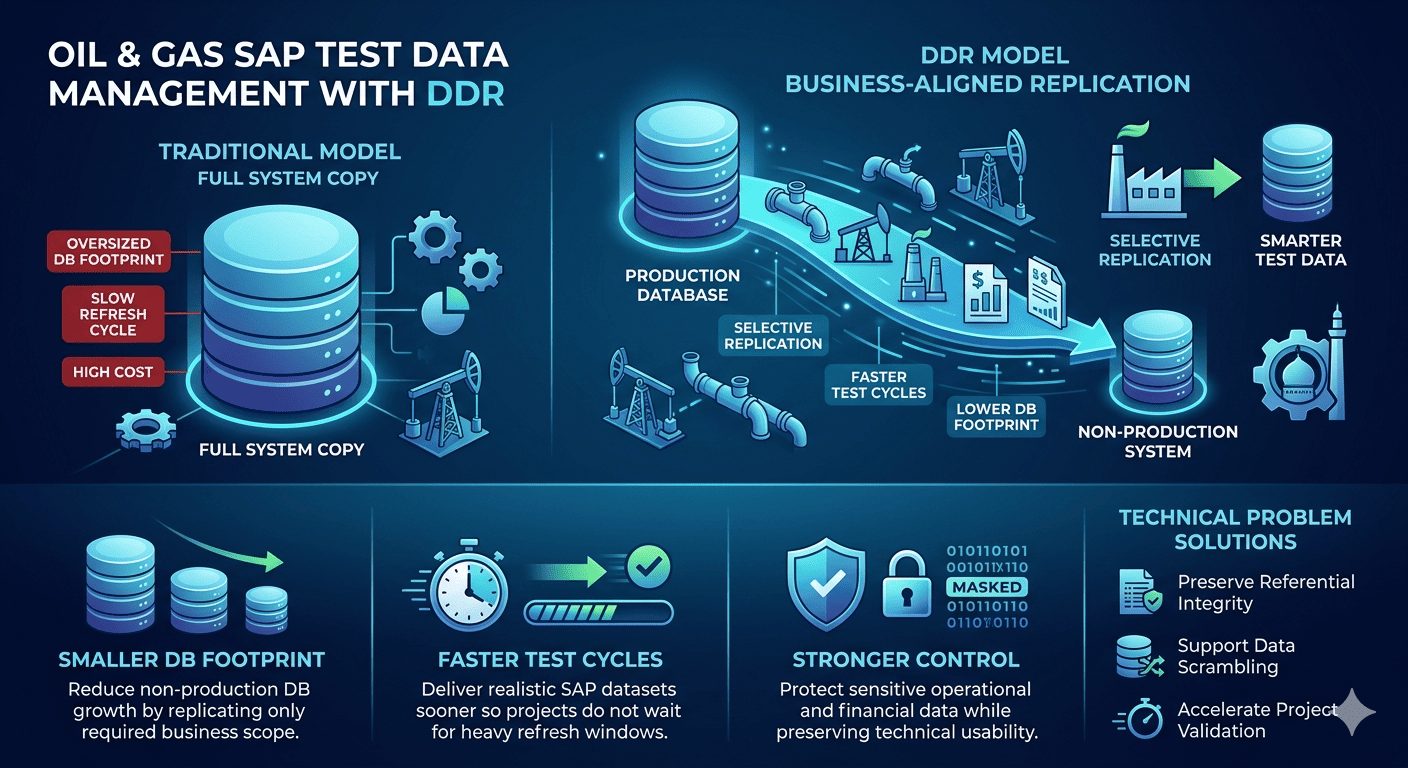
Oil & Gas SAP Test Data Management is no longer just an administrative refresh activity. It directly affects programme speed, test quality, data protection, cloud cost, and operational resilience. Middle East Oil and Gas companies often operate some of the largest SAP environments in the world, with integrated processes spanning asset management, plant maintenance, materials, procurement, finance, logistics, and trading. When those organisations continue to depend on full system copies for development, QA, UAT, and training, non production becomes oversized, costly, and slow to support change.
Why efficiency is difficult in Oil and Gas SAP landscapes
Oil and Gas environments are structurally more demanding than many other industries. Systems must support complex master data structures, large equipment hierarchies, deep transactional histories, strict operational controls, and high assurance testing across interconnected processes.
Typical SAP scope may include:
- Plant Maintenance for equipment, functional locations, notifications, and orders
- Materials Management for spares, procurement, and inventory control
- Sales and Distribution for supply and distribution scenarios
- Finance and Controlling for cost capture, asset value, and profitability analysis
- Industry specific processes linked to hydrocarbon operations, terminals, pipelines, and logistics
In this context, testing is only as strong as the data behind it. If project teams do not have realistic, complete, and technically consistent data, defects surface late, business scenarios are missed, and change becomes slower and more expensive.
For large Oil and Gas operators, smarter test data is not just a technical improvement. It is a direct lever for SAP efficiency, delivery speed, infrastructure control, and lower operational risk.
Why the traditional model holds Oil and Gas companies back
Many organisations still refresh non production environments through large one to one copies from production. On paper this looks simple because everything is copied. In practice it creates multiple problems.
First, it moves vast amounts of data that have no relevance to the testing objective. Historical records, inactive plants, obsolete materials, aged maintenance history, and dormant business scope are all replicated into QA and development even when they are not needed.
Second, it creates heavy operational overhead. Basis teams must coordinate refresh windows, storage requirements, post copy steps, user management, system adjustments, and validation checks.
Third, it increases data risk. Sensitive finance, employee, vendor, and operational information may be copied unnecessarily into non production systems unless a separate masking process is added.
Finally, it slows change. Teams often wait for refresh schedules rather than receiving the exact business data they need when they need it.
Technical problems with full copies
- large HANA and database footprint in non production
- slow refresh and post processing cycles
- high storage and compute demand
- copy of irrelevant or stale business scope
- greater exposure of sensitive production data
Business impact on Oil and Gas operations
- slower project delivery and delayed testing
- higher infrastructure and hosting cost
- more rework after late defect discovery
- less flexibility for urgent operational change
- weaker control over non production data growth
How DDR changes Oil and Gas SAP Test Data Management
Dynamic Data Replicator replaces bulk copying with selective, business aligned replication. Instead of cloning whole systems, DDR allows organisations to provision exactly the SAP data needed for a defined test scenario while preserving the related object context.
That matters because Oil and Gas testing rarely depends on isolated rows in individual tables. It depends on connected business data. For example, a maintenance test scenario may need equipment, functional locations, work centres, notifications, maintenance orders, reservation items, materials, stock, procurement context, and associated financial impact. DDR is designed for this reality.
With Oil & Gas SAP Test Data Management using DDR, organisations can:
- replicate only selected plants, company codes, storage locations, or business periods
- move active equipment and related transactional history without copying everything else
- support project specific testing for maintenance, procurement, logistics, and finance
- create smaller QA, UAT, or training datasets aligned to real business scope
- reduce the non production footprint while maintaining technical completeness
Why referential integrity matters in Oil and Gas testing
Oil and Gas processes are highly interconnected. The quality of testing depends on preserving those relationships. If data is moved without its dependencies, scenarios appear valid at first but fail when the process actually runs.
Consider just a few examples:
- equipment linked to functional locations, maintenance plans, notifications, and orders
- materials linked to valuation, inventory, purchasing info records, and movement history
- finance documents linked to cost centres, internal orders, asset values, and controlling structures
- logistics scenarios linked to storage, transport, delivery, and billing objects
DDR protects testing quality by supporting the replication of connected business scope rather than disconnected fragments. This is one of the strongest technical reasons why smarter test data improves efficiency in Oil and Gas SAP landscapes.
Use case: upstream and asset intensive maintenance environments
In upstream operations and asset heavy environments, maintenance data can be both massive and sensitive. Testing a new enhancement in PM, workflow, reporting, mobile maintenance, or spare parts planning often requires realistic equipment and maintenance history.
Under a traditional full copy model, the organisation may replicate years of history for every asset in scope, even if the project only needs a limited subset.
With DDR, teams can instead:
- select a defined asset class, plant, or operating area
- replicate recent notifications and maintenance orders
- include related materials and stock positions
- scramble sensitive fields where required
- provision a smaller, technically complete dataset for QA or UAT
The result is more realistic testing, faster availability, and lower database growth.
Use case: downstream logistics, distribution, and finance
Downstream environments often carry large transaction volumes across supply, dispatch, delivery, pricing, billing, and finance. Testing these areas requires not just documents, but connected end to end process data.
DDR allows organisations to replicate a meaningful business slice such as a specific region, terminal, business period, or company code. This enables pricing tests, financial validation, logistics changes, and reconciliation checks to be performed on a realistic but smaller footprint.
That directly improves delivery efficiency because testers get the right data sooner, while infrastructure teams avoid unnecessary volume.
Where efficiency gains are unlocked
The value of DDR is not limited to storage reduction. The broader gain comes from combining smaller non production environments, faster testing readiness, lower operational overhead, stronger data security, and better use of skilled project teams.
Why this matters specifically in the Middle East
Middle East Oil and Gas organisations are under pressure to modernise while controlling cost and maintaining operational discipline. Many are balancing S/4HANA programmes, cloud hosting, infrastructure optimisation, cybersecurity requirements, and increasingly complex data governance expectations.
In that environment, oversized non production systems are difficult to justify. They consume storage, memory, compute, and operational effort, while still failing to provide project teams with the precise data they need at the right time.
Oil & Gas SAP Test Data Management with DDR supports a more disciplined operating model. It allows organisations to align test data provisioning with actual business need rather than inherited full copy habits.
Data security and compliance cannot be separated from efficiency
Efficiency is not only about speed and size. It is also about control. When production like datasets are copied into non production without clear rules, the organisation creates unnecessary exposure.
That is why data scrambling and governance should be part of the same conversation as SAP test data management. DDR supports this by helping teams provide realistic data while applying protection to sensitive fields and business content as required.
Broader guidance on secure data handling and privacy can be reviewed through resources such as GDPR guidance, while SAP’s wider platform and engineering direction can be explored via SAP Business Technology Platform and SAP DevOps practices.
Peak efficiency in Oil and Gas does not come from copying more SAP data. It comes from delivering the right SAP data, in the right scope, to the right teams, at the right time.
Technical impact on SAP architecture and operations
From an architecture perspective, DDR helps separate business value from bulk data movement. Instead of treating non production as a mirror of production, organisations can treat it as a fit for purpose testing platform.
That improves:
- landscape efficiency because target systems are smaller and more manageable
- testing agility because project teams receive business aligned datasets sooner
- operational control because fewer heavy refresh events are needed
- cost discipline because database and cloud growth are reduced
- security posture because sensitive data movement becomes more deliberate and controlled
This is particularly valuable in multi system SAP estates where several non production environments exist for QA, UAT, training, project work, and support activities.
How Oil and Gas companies achieve peak efficiency with smarter test data
The route to peak efficiency is not a single technical change. It is an operating model improvement built on smarter SAP test data principles:
- stop copying entire landscapes when only limited scope is needed
- provision scenario aligned datasets for specific projects and teams
- preserve referential integrity so testing remains technically valid
- scramble sensitive data as part of the process rather than as an afterthought
- reduce non production growth and infrastructure overhead
- support faster testing, faster fixes, and faster delivery
This is where DDR creates measurable value for Oil and Gas operators in the Middle East. It helps transform SAP Test Data Management from a heavy refresh dependency into a controlled delivery capability.
Conclusion
Oil & Gas SAP Test Data Management is central to SAP efficiency, not peripheral to it. In Middle East Oil and Gas organisations, where SAP environments are large, business critical, and deeply interconnected, traditional full copies create unnecessary database growth, testing delay, infrastructure cost, and data exposure.
Dynamic Data Replicator offers a more technical, precise, and scalable approach. By enabling selective replication, preserving business relationships, supporting data scrambling, and reducing non production footprint, DDR helps project teams move faster while helping the organisation operate with more control.
If the goal is peak efficiency, smarter test data is one of the most practical places to start.
Explore Dynamic Data Replicator, review the ROI Calculator, and connect this post internally to your related content on SAP Test Data Management, data scrambling, client refresh, and SAP delivery optimisation.