


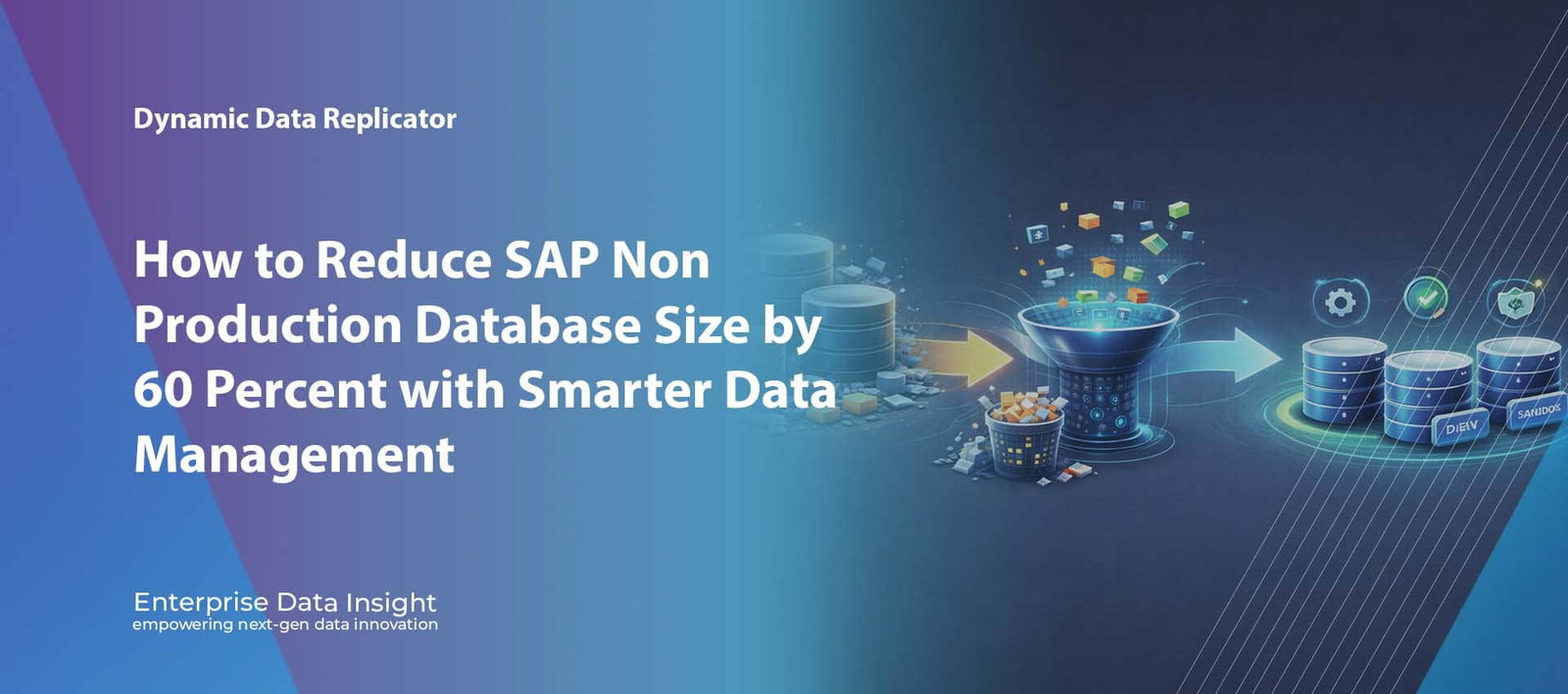
Reduce SAP Non Production Database Size: Powerful Strategy to Cut SAP Test Systems by 60 Percent
How to Reduce SAP Non Production Database Size by 60 Percent with Smarter Data Management
SAP Non Production Database Size Reduction is now a major priority for SAP teams managing development, QA, training and sandbox systems. In many organisations, non production environments become almost as large as production because years of copied data, obsolete records and redundant test data continue to accumulate. The result is higher storage cost, slower refresh cycles, longer backup windows and poorer performance. The good news is that SAP Non Production Database Size Reduction is achievable when organisations combine subsetting, controlled deletion and targeted refresh strategies supported by Dynamic Data Replicator, or DDR.
Why SAP Non Production Database Size Reduction matters
One of the most common challenges SAP teams face today is the rapid growth of non production systems. Development, QA, training and sandbox environments often become almost as large as production systems. Over time these systems accumulate years of copied data, obsolete records and redundant test datasets.
It is not unusual to see organisations running multiple multi terabyte non production systems, each containing far more data than is actually required. The result is increased storage costs, slower refresh cycles, longer backup times and reduced system performance.
With the right strategy, SAP Non Production Database Size Reduction of 50 to 60 percent is realistic while still preserving the business data needed for testing and development.
The key to SAP Non Production Database Size Reduction lies in combining data subsetting, controlled deletion and targeted refresh rather than relying on repeated full system copies.
Full Non Production Database
Years of copied production data, obsolete records, redundant test data and unnecessary historical transactions.
DDR Driven Reduction Model
Subset relevant data, delete obsolete history, and refresh only the business objects needed for testing.
Optimised Non Production System
Smaller, faster and more relevant environment with improved performance and lower storage footprint.
The problem with traditional system copies
The traditional approach to refreshing non production systems is a full system copy from production. While this guarantees data consistency, it also means that every refresh brings across the entire production dataset, including historical transactional data from many years ago, archived or inactive business records, unnecessary master data, and old completed documents that are no longer relevant for testing.
For example, an organisation with a 5 TB production system may copy the entire database into QA and development environments. If three non production systems exist, this quickly results in 15 TB or more of duplicated data, much of which is never actually used.
Beyond storage costs, these oversized systems create technical challenges. Large databases increase backup duration, database maintenance effort, transport import time and test cycle runtime. Even routine system refreshes become lengthy exercises that disrupt project timelines.
Step One: SAP Non Production Database Size Reduction through data subsetting
Subsetting is the process of extracting only the relevant portion of data required for a particular non production environment. Instead of copying the entire database, subsetting allows organisations to define filters such as company code, plant, sales organisation, material ranges, or time periods such as the last two years of transactions.
The complexity in SAP lies in maintaining referential integrity across related tables. A single business document such as a sales order can span dozens of tables including VBAK, VBAP, VBFA, VBRK and accounting entries. Extracting only part of this dataset without breaking relationships requires a deep understanding of SAP data models.
This is where Dynamic Data Replicator provides a powerful advantage. DDR identifies the relevant SAP business objects and automatically replicates the required related data while preserving document relationships. This ensures that when a subset of data is replicated into a non production system, it remains fully functional for testing and development.
DDR supports SAP Non Production Database Size Reduction by replicating only the required business objects and their related SAP tables while maintaining functional usability.
Step Two: SAP Non Production Database Size Reduction through controlled deletion
Another major contributor to oversized non production systems is historical transactional data that is no longer required. Many organisations retain ten or more years of data in production for compliance reasons. However, most development and testing scenarios do not require such extensive history.
By implementing controlled deletion strategies in non production systems, organisations can remove completed financial documents older than a defined period, historical logistics transactions, outdated test records, and old development data created during past projects.
When performed carefully, this process can dramatically reduce database footprint while maintaining recent and relevant business data. DDR supports this process by allowing organisations to selectively refresh only current or relevant data from production, ensuring that deleted historical data does not return during the next refresh cycle.
Step Three: SAP Non Production Database Size Reduction through targeted refresh
Traditional refresh processes rely on periodic full system copies. These events are disruptive and often require significant downtime. A more efficient approach is targeted refresh, where only the data required for specific testing scenarios is replicated from production.
For example, instead of refreshing an entire QA system, teams may replicate recent sales orders for a specific company code, selected customer and vendor master data, materials related to a particular plant, or HR data with appropriate scrambling applied.
Dynamic Data Replicator makes this possible by allowing organisations to replicate specific SAP business objects directly from production into non production systems. This approach significantly reduces the volume of data transferred and allows environments to be refreshed much more frequently.
The technical impact of SAP Non Production Database Size Reduction
When subsetting, deletion and targeted refresh strategies are combined, the impact can be dramatic. Many organisations have achieved database size reductions of 50 to 60 percent or more in their non production landscapes.
This delivers several measurable technical benefits:
- reduced database storage requirements
- faster system refresh cycles
- improved database performance
- shorter backup and recovery times
- lower infrastructure costs in cloud environments
For SAP Basis teams, this also reduces the operational burden associated with large system copies and post copy processing.
Real business example
Consider an organisation with a 5 TB production system and three non production environments. Under a traditional model, each environment may hold close to the full production footprint. The business ends up managing around 15 TB of non production data.
By using DDR to subset only the required company codes, recent transactions and relevant business objects, then deleting obsolete historical records, the organisation could reduce each non production system significantly. Even a 50 percent reduction across those environments would save several terabytes of storage and materially improve refresh and backup performance.
A smarter approach to SAP data management
As SAP environments continue to grow and more organisations adopt cloud platforms such as RISE with SAP, managing data efficiently becomes increasingly important. Full system copies are no longer the only option.
By combining data subsetting, controlled deletion and targeted replication, organisations can maintain high quality test data while significantly reducing system footprint. Solutions such as Dynamic Data Replicator are helping organisations implement this approach in a controlled and automated way, allowing SAP teams to manage their data landscapes more efficiently without sacrificing data quality.
Conclusion: Why SAP Non Production Database Size Reduction is now essential
The future of SAP test data management is not about copying entire systems. It is about delivering the right data, in the right place, at the right time.
SAP Non Production Database Size Reduction is not just a storage optimisation exercise. It is a practical strategy for improving performance, reducing infrastructure cost, accelerating refresh cycles and modernising how SAP teams manage non production environments.
For practical demonstrations of subsetting, selective refresh and DDR, visit the Enterprise Data Insight YouTube channel.